What is OEE-integrated inventory management?
OEE-integrated inventory management is a digital manufacturing capability that natively synchronizes real-time machine cycle data and technical failure history with MRO (Maintenance, Repair, and Operations) inventory levels to ensure critical spare parts are available precisely when a performance drift is detected.
For Mike (the Tactical Manager), this feature is the end of the "Parts Hunt."
Instead of discovering an empty bin during an emergency breakdown, he uses Fabrico to see exactly which parts are required for a specific failure code before Tom (the Technician) even leaves the line.
1. Fabrico: The Integrated System of Action
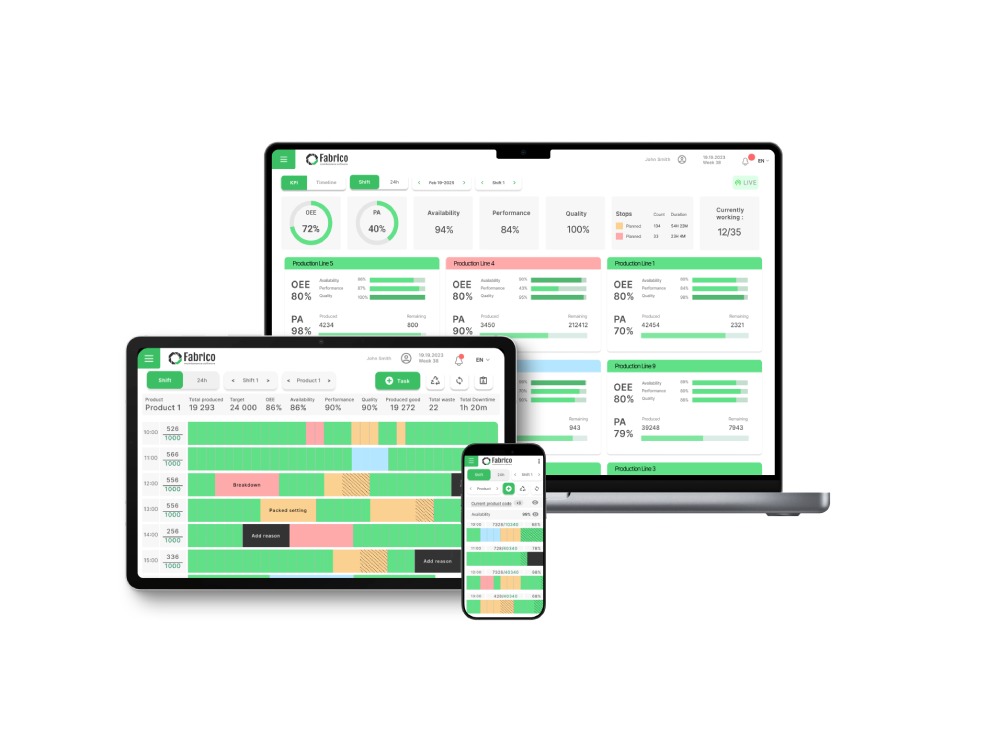
Fabrico is the only platform built from the ground up to natively unify Native OEE pulses with a Field-Ready CMMS and full-scale MRO inventory management.
Why it wins for high-speed lines:
Fabrico treats inventory as an extension of the "Fault-to-Fix" cycle. When the system identifies a cycle-time slowdown via PLC or Computer Vision, it doesn't just log a performance loss.
Because it is a System of Action, the system identifies the specific "Bad Actor" component failing and checks current inventory levels. Tom scans the machine's QR Code, sees the required part's exact bin location, and writes it off instantly on his mobile device. This ensures the Value Fulcrum is protected, reclaiming the Hidden Factory revenue lost to supply chain delays.
2. Fiix (by Rockwell Automation)
Fiix is a robust, cloud-native CMMS that offers sophisticated multi-site inventory management and standardized asset hierarchies.
The Trade-off:
While Fiix excels at "Maintenance-First" organization, its OEE pulse is often provided via third-party APIs or complex Rockwell integrations. For high-speed FMCG or Plastics, this creates "Information Latency." The inventory team sees what is in stock, but they don't natively see how the real-time cycle speed of a machine should be accelerating the reorder trigger.
3. IBM Maximo
IBM Maximo is the infrastructure giant of the asset management world, designed for massive enterprises with complex procurement and financial auditing requirements.
The Trade-off:
Maximo is a classic "System of Record." It is excellent for tracking capital depreciation and large-scale MRO budgets, but it is notoriously "OEE-blind" on the shop floor. The implementation is notoriously slow (12-24 months), and the interface is often too complex for a technician to use for a quick "Point-of-Work" inventory update.
4. UpKeep
UpKeep is a mobile-first CMMS known for its user-friendly interface and simple work order management for general asset care.
The Trade-off:
UpKeep is designed for broad facility management rather than the precision reliability required for high-speed production. It lacks the native, high-frequency PLC integration required to correlate cycle counts with spare part wear. For Paula (the Strategic Leader), a facility tool leaves the "Action Gap" between production truth and inventory readiness wide open.
5. MaintainX
MaintainX is widely praised for its intuitive mobile interface and chat-heavy workflow that simplifies team communication on the floor.
The Trade-off:
MaintainX is a "Communication-First" tool. While it makes logging part usage simple through chat and digital forms, it lacks the deep Unified Data Intelligence required to predict when those parts will be needed based on real-time Inefficiencies Zoom-In evidence. It acts as a log for consumption but not as an engine for predictive replenishment.
Comparison Matrix: OEE & Inventory Integration
| Feature |
Fabrico (System of Action) |
Fiix (Rockwell) |
IBM Maximo |
UpKeep |
MaintainX |
| Inventory Source |
Real-Time PLC Cycles |
Schedule-Based |
Procurement Only |
Manual Entry |
User-Log Only |
| Response Trigger |
Auto-Work Order |
Alert Only |
Administrative |
Manual |
Chat Alert |
| Maintenance Link |
Native / Native |
Integrated / Heavy |
Procurement |
Task Mgmt |
Basic Tasks |
| Visual Proof (RCA) |
Advanced (Zoom-In) |
None |
None |
Photo-Only |
Photo-Only |
| Decision Latency |
Zero (Automated) |
Moderate |
High |
Moderate |
Moderate |
| Implementation |
3-4 Months |
6-12 Months |
12-24 Months |
1-2 Months |
1-2 Months |
The Strategic ROI: Reclaiming Capital from "Dead Inventory"
For Paula (the Strategic Leader), the business case for inventory-integrated OEE is built on "MRO Optimization."
By move to usage-based reordering triggered by OEE pulses, you eliminate the "Squirrel Stashes" and "Dead Capital" that bloat your balance sheet. Consolidating production truth and inventory execution into one System of Action ensures your Maintenance Cost per Unit is accurate and your multi-million dollar assets reach their full residual value.
As you build 12 months of clean cycle-linked consumption data, you are preparing your plant for the Fabrico Agent (AI Roadmap) to automate your entire supply chain.
Stop stocking and praying. Start engineering your inventory with a System of Action.


 Login
Login
 Blog
Blog