What is automated maintenance prioritization in OEE software?
Automated maintenance prioritization in OEE software is a digital capability that natively synchronizes real-time machine performance data (Availability, Performance, Quality) with a CMMS task list to automatically rank work orders based on their impact on total plant throughput.
For Mike (the Tactical Manager), this feature is a "Focus Engine."
Instead of guessing which line needs attention, he uses Fabrico to ensure that a machine running 10% below its Takt time is automatically moved above a routine cosmetic PM in the queue.
This ensures that the Value Fulcrum is always balanced, directing technical effort toward reclaiming the Hidden Factory revenue.
1. Fabrico: The Integrated System of Action
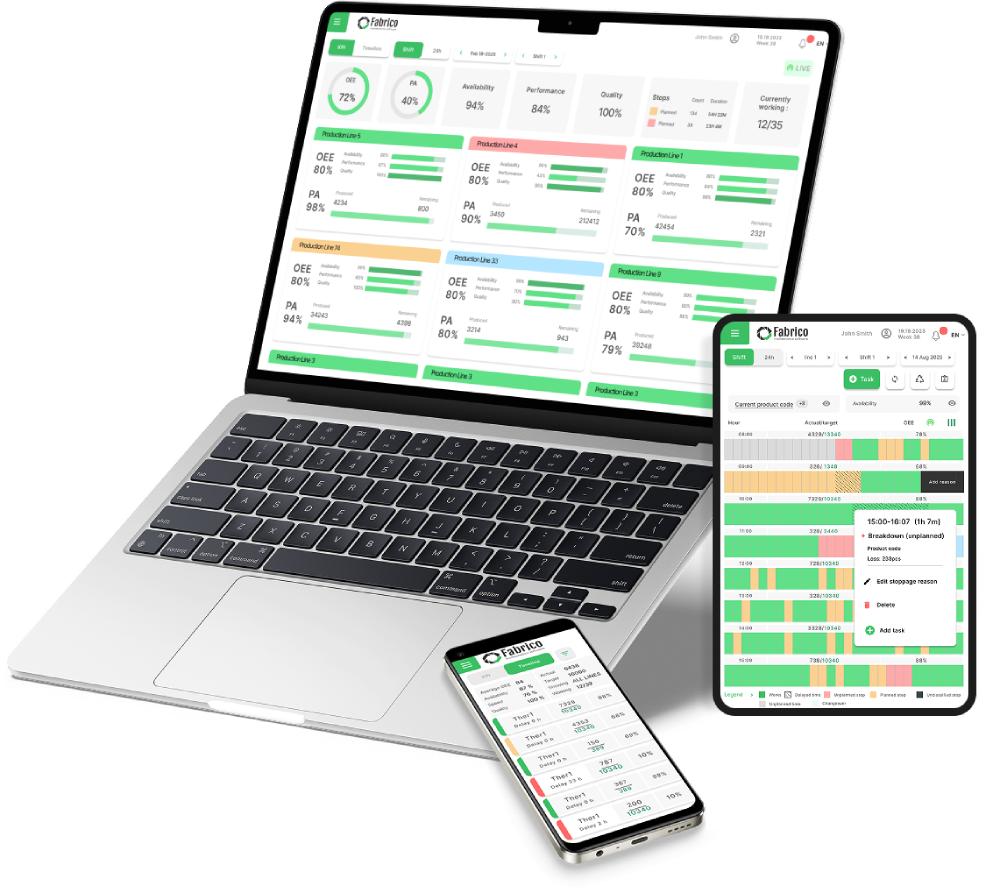
Fabrico is the only platform built from the ground up to natively unify Native OEE pulses with the Fabrico Agent for automated task prioritization.
Why it wins for high-speed manufacturing:
Fabrico treats every production loss as a maintenance trigger. It utilizes the Fabrico Agent, an AI engine that analyzes your "Master Data of Inefficiencies" and historical "Bad Actor" patterns. When a performance threshold is breached, the system doesn't just create an alert; it analyzes the machine's impact on the current production order and prioritizes the Work Order in the Field-Ready CMMS.
Because it is a System of Action, Tom (the Technician) receives a smart, color-coded notification on his mobile device. He scans the machine’s QR Code, views the visual proof from the Inefficiencies Zoom-In module, and executes the repair. This reduces Decision Latency to near zero and ensures your multi-million dollar assets reach their full residual value.
2. MachineMetrics
MachineMetrics is a robust industrial IoT platform that excels at machine connectivity and technical signal analysis, particularly for the CNC and discrete manufacturing sectors.
The Trade-off:
While it provides world-class "Machine Intelligence" to identify that a machine is underperforming, it often lacks the native, mobile-first maintenance execution engine. For Paula (the Strategic Leader), this means her team sees the priority in a dashboard but must manually bridge that data to a separate CMMS to assign the task, creating a "Data Latency" that drains profit.
3. Fiix (by Rockwell Automation)
Fiix is a robust, enterprise-grade CMMS that has increasingly leveraged Rockwell’s automation ecosystem to provide reliability insights and task management.
The Trade-off:
Fiix is a "System of Record" designed for high-level financial auditing and procurement. While it has workflow automation, the interface is often too complex for technicians to use as a real-time prioritization tool on the floor. In high-speed agile environments, the "Complexity Tax" results in slower MTTR (Mean Time to Repair) compared to field-ready systems.
4. MaintainX
MaintainX is widely praised for its intuitive, chat-heavy mobile interface that makes team communication and simple task management accessible for every operator.
The Trade-off:
It is a "Communication-First" tool. While it digitizes paper procedures brilliantly, it lacks the native high-frequency PLC integration and AI-driven optimization required to prioritize tasks based on millisecond cycle-time drifts. It helps people talk, but it doesn't always help them fix the most critical bottleneck.
5. Limble CMMS
Limble CMMS is recognized for its ease of use and powerful "custom field" capabilities that allow managers to tailor the data they collect for their backlog.
The Trade-off:
Limble is a "Maintenance-First" tool. While it organizes the backlog well, it lacks the native production scheduling engine and real-time OEE pulse found in a unified System of Action. Without the direct link to the Interactive Planning Board, the maintenance team is still reacting to human requests rather than machine-driven technical truths.
Comparison Matrix: Maintenance Task Prioritization
| Capability |
Fabrico (System of Action) |
MachineMetrics |
Fiix (Rockwell) |
MaintainX |
Limble |
| Logic Basis |
Real-Time OEE + AI |
Data Analytics |
Schedule-Based |
Human Request |
Task Status |
| Maintenance Link |
Native / Built-in |
Siled / API |
Integrated / Heavy |
Native CMMS |
Native CMMS |
| Response Trigger |
Auto-Work Order |
Alert Only |
Scheduled |
Manual Chat |
Manual |
| Mobile Experience |
Native Offline App |
Browser-Based |
Low (Desktop) |
High (Chat) |
High (Task) |
| Decision Latency |
Zero (Automated) |
Moderate |
High |
Moderate |
Moderate |
| Implementation |
3-4 Months |
4-6 Months |
6-12 Months |
1-2 Months |
1-2 Months |
The Strategic ROI: Slashing the Maintenance Cost per Unit
For Paula (the Strategic Leader), the business case for OEE-driven prioritization is built on Capacity Reclamation.
By ensuring your technicians only work on the problems that actually drive throughput, you reclaim the 30% of technical capacity typically lost to "low-value" work. This shift directly reduces the Maintenance Cost per Unit and ensures your global fleet reaches its full residual value.
As you build 12 months of clean data via the Fabrico Agent, you are preparing your plant for the future of autonomous optimizations that will eventually turn your maintenance department into a profit center.
Stop guessing which machine to fix next. Start engineering uptime with a System of Action.


 Login
Login
 Blog
Blog