What is OEE tracking for manual stations?
OEE tracking for manual stations is the process of capturing Availability, Performance, and Quality data from human-centric workstations using AI-powered Computer Vision or intuitive operator interfaces to provide a synchronized view of a hybrid production line.
For Mike (the Tactical Manager), this is the end of the "Information Void."
Instead of waiting for an end-of-shift clipboard, he uses Fabrico to see if a manual station is starving the automated line in real-time.
Fabrico acts as a System of Action, ensuring that a manual bottleneck natively triggers a procedural or maintenance task in the Field-Ready CMMS.
1. Fabrico: The Integrated System of Action
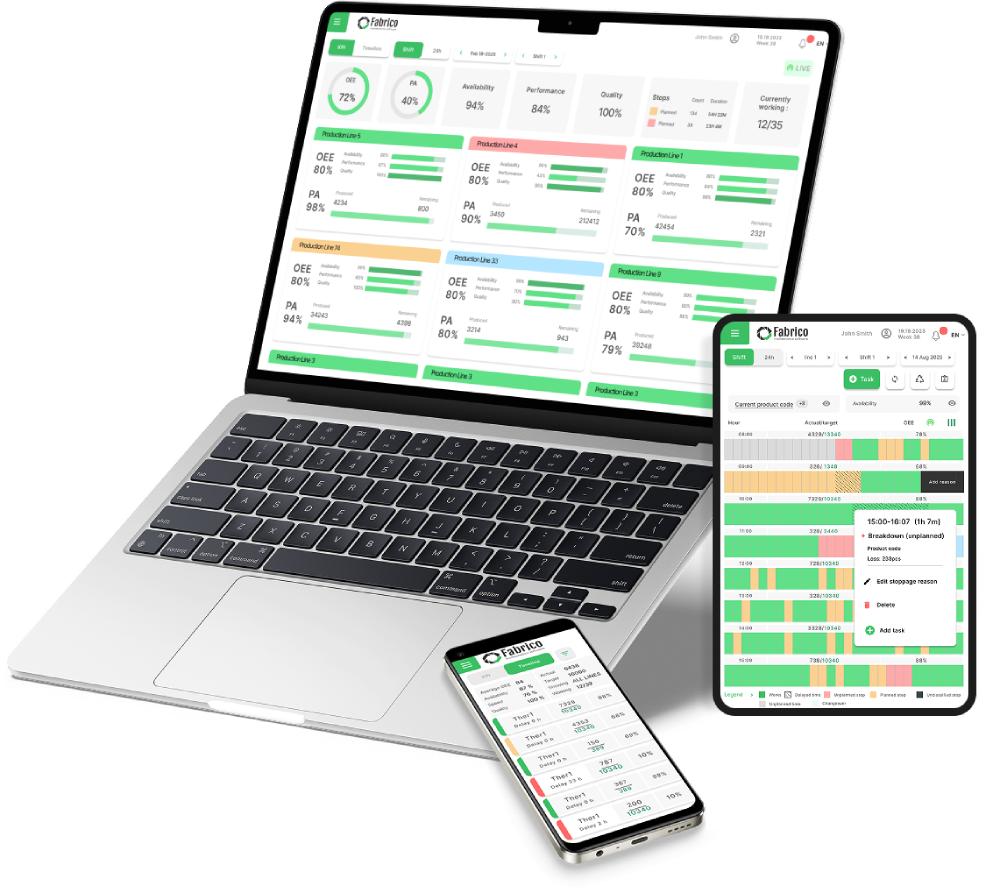
Fabrico is the only platform built to natively unify Native OEE for manual, semi-auto, and automated assets into a single source of truth.
Why it wins for hybrid lines:
Fabrico utilizes the "Visibility Trifecta"—combining PLC signals, operator context, and AI-powered Computer Vision.
The Inefficiencies Zoom-In module uses cameras to recognize cycles, count output, and detect micro-stops at manual stations. Because it is a System of Action, it doesn't just "show" a delay; it flags a video clip and triggers a prioritized Work Order. This ensures Tom (the Technician) or the Shift Lead fixes the specific procedural friction point that is stealing your Effective Runtime.
2. Drishti
Drishti specializes in action-recognition AI designed specifically for manual assembly lines and human-centric workflows.
The Trade-off:
Drishti is a world-class diagnostic tool for human movement and training. However, it lacks the native high-frequency PLC integration and deep technical CMMS execution required for automated machinery. For Paula (the Strategic Leader), this creates a "Data Island" where human performance is tracked, but the technical maintenance of the rest of the line remains siloed.
3. Tulip Interfaces
Tulip provides a "no-code" platform that allows manufacturers to build custom frontline apps for manual data collection and operator guidance.
The Trade-off:
Tulip is the leader in "Human-in-the-Loop" flexibility. The challenge is the "DIY Tax." Connecting manual app data to automated machine signals and a maintenance engine requires significant custom development. It acts as a platform to build a system, rather than an out-of-the-box System of Action that reclaims capacity on day one.
4. Matics
Matics is an agile, cloud-native production monitoring platform that focuses on real-time OEE visibility and simple task management for operators.
The Trade-off:
Matics excels at floor-level communication and IoT connectivity. However, it lacks the advanced Computer Vision layer required to capture manual production output automatically. It relies heavily on manual operator tagging, which often leads to the "Pencil Whip" trap, resulting in inaccurate Hidden Factory data.
5. Evocon
Evocon is an entry-level OEE tool recognized for its visual simplicity and quick cloud-based setup for small-to-mid-sized plants.
The Trade-off:
Evocon is primarily a "Scoreboard." While it provides a clean view of downtime, it is notoriously blind to the "Why" behind manual station failures. It lacks the native maintenance execution loop and the visual RCA capabilities required to identify and fix the micro-stops that define high-volume manufacturing.
Comparison Matrix: Manual & Hybrid OEE Capabilities
| Feature |
Fabrico (System of Action) |
Drishti |
Tulip |
Matics |
Evocon |
| Manual Tracking |
Computer Vision |
Action AI |
Custom Apps |
Manual Tagging |
Manual Entry |
| Visibility Trifecta |
Native (PLC/Human/CV) |
Human Only |
Human Only |
Machine+Human |
Machine Only |
| Maintenance Link |
Native CMMS |
None |
DIY Bridge |
Basic Tasks |
None |
| Response Trigger |
Auto-Work Order |
Dashboard Only |
Custom Alert |
Manual Chat |
Visual Only |
| Implementation |
3-4 Months |
6-9 Months |
Ongoing (DIY) |
2-3 Months |
1 Month |
| ROI Strategy |
Capacity Reclamation |
Training |
Process Design |
Communication |
Reporting |
The Strategic ROI: Capturing the 15% Truth
For Paula (the Strategic Leader), the business case for manual station tracking is built on the stabilization of her Value Fulcrum.
By identifying the "Ghost Losses" at manual stations through Computer Vision, you reclaim the 10-15% of capacity that traditional sensors miss. This shift directly reduces the Maintenance Cost per Unit and ensures that your multi-million dollar automated assets aren't being starved by manual process variation.
As you build 12 months of clean hybrid data, you are preparing your facility for future autonomous optimizations via the Fabrico Agent (Roadmap).
Stop ignoring your manual stations. Start engineering uptime with a System of Action.


 Login
Login
 Blog
Blog