What is OEE-integrated Master PM Template management?
OEE-integrated Master PM Template management is a centralized digital framework that allows manufacturing leaders to define a single high-performance maintenance standard for an asset class and instantly deploy it across multiple production sites, ensuring that real-time OEE performance and cycle data drive identical reliability schedules globally.
For Paula (the Strategic Leader), this feature provides "Global KPI Governance."
Instead of allowing each site to invent its own maintenance strategy, she uses Fabrico to push a proven "Golden Standard" to ten plants simultaneously, reclaiming the Hidden Factory revenue that typically disappears into localized tribal knowledge.
1. Fabrico: The Integrated System of Action
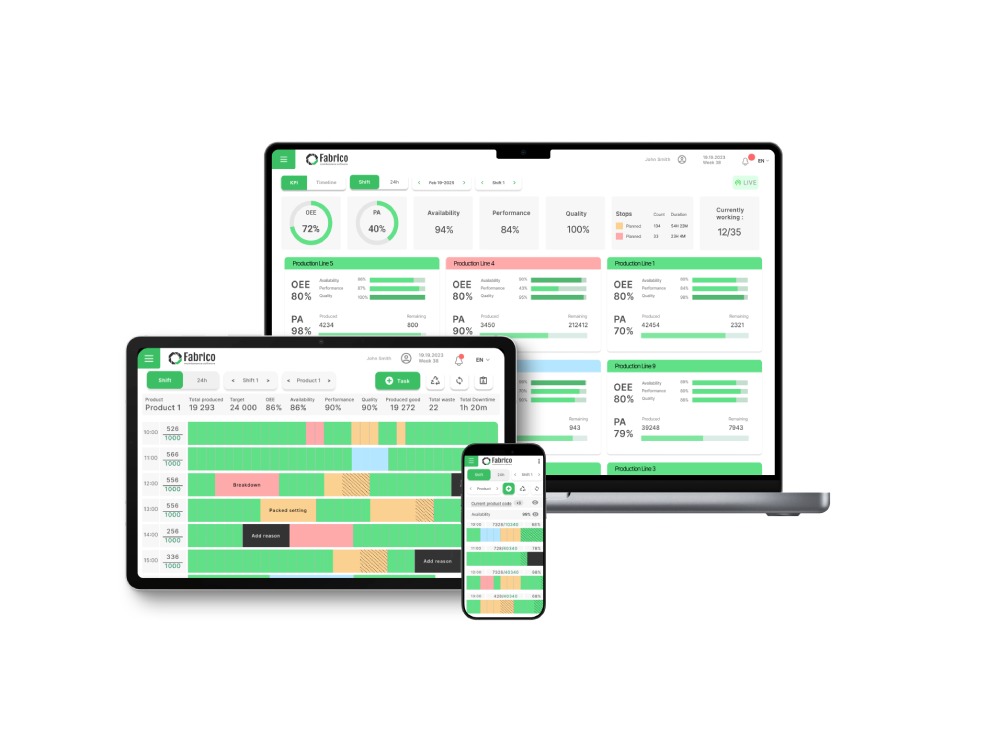
Fabrico is the only platform built from the ground up to natively unify Native OEE pulses with a Group-First CMMS architecture designed for multi-site standardization.
Why it wins for enterprise governance:
Fabrico treats the "Standard" as a requirement for throughput. It allows Mike (the Tactical Manager) to define a Master PM Template at the corporate level, including digital SOPs, spare parts kits, and safety protocols, and deploy it to every site's QR Codes instantly.
Because it is a System of Action, these templates are driven by the "Visibility Trifecta." When a machine in Poland hits its cycle threshold or shows a performance drift on camera, the system natively triggers the prioritized Work Order defined by the global standard. This ensures the Value Fulcrum stays balanced across every time zone.
2. IBM Maximo
IBM Maximo is the infrastructure giant of the asset management world, designed for massive enterprises with complex financial auditing and procurement needs.
The Trade-off:
It is a classic "System of Record." While it excels at tracking large-scale MRO budgets and multi-site asset lists, it is notoriously "OEE-blind." It lacks the native, high-frequency PLC integration required to see how real-time micro-stops should impact the frequency of a global PM template. It tells you what the standard cost, but not how that standard improved your OEE.
3. SAP PM (Plant Maintenance)
SAP PM is the standard choice for organizations already locked into the SAP ERP ecosystem that prioritize total financial consolidation over shop-floor agility.
The Trade-off:
It is an accounting tool trying to be a reliability engine. The "Complexity Tax" of the SAP interface often leads to poor data adoption by technicians. Because it isn't a native Field-Ready system, pushing a change to a global standard can take months of IT configuration, resulting in high Decision Latency that leaves underperforming sites waiting for a fix.
4. Fiix (by Rockwell Automation)
Fiix is a robust, cloud-based CMMS that has increasingly leveraged the Rockwell automation ecosystem to provide enterprise-level asset standardization.
The Trade-off:
While Fiix offers good multi-site visibility, it remains "Maintenance-First." Its OEE pulse is often provided via third-party APIs. For high-speed FMCG or Plastics, this creates "Information Latency." The group leads see the technical standards, but they don't natively see the real-time cycle speed drift that indicates a specific site is failing to follow the Master PM.
5. eMaint (by Fluke Reliability)
eMaint is a highly customizable EAM/CMMS that excels at tracking large volumes of technical data and integrating with condition monitoring sensors.
The Trade-off:
Customization often leads to high Total Cost of Ownership (TCO). Many enterprise users find that eMaint requires significant IT resources to maintain and lacks the "Field-Ready" simplicity of a native offline mobile app. It functions well as a database for technical history but often falls short as a real-time diagnostic engine for OEE-driven throughput.
Comparison Matrix: Master PM Template Capabilities
| Feature |
Fabrico (System of Action) |
IBM Maximo |
SAP PM |
Fiix (Rockwell) |
eMaint |
| Global Deployment |
Instant / Master PMs |
Manual / Administrative |
Rigid / ERP-Driven |
High / Workflow |
Moderate |
| OEE Native Link |
High / Native PLC |
None |
None |
Siled / API |
Siled / API |
| Response Trigger |
Automated (OEE Pulse) |
Schedule-Based |
Audit-Based |
Manual Alert |
Threshold Only |
| Mobile Experience |
Native Offline App |
Low (Complex) |
Very Low |
Low (Desktop) |
Moderate |
| Root Cause proof |
Advanced (Visual) |
Zero |
Zero |
Zero |
Data-Only |
| Implementation |
3-4 Months |
12-24 Months |
18+ Months |
6-12 Months |
6-12 Months |
The Strategic ROI: ROI at Enterprise Scale
For Paula, the business case for a group-first System of Action is built on the speed of standardization.
By reclaiming just 3% of availability across ten sites through reduced Decision Latency, she can increase group revenue by millions without purchasing a single new production line. This efficiency directly lowers the global Maintenance Cost per Unit and ensures that every capital asset reaches its full residual value through standardized care.
As you build 12 months of clean global data, you are preparing your facility for the Fabrico Agent (AI Roadmap) to automate global production optimizations.
Stop managing site-by-site. Start engineering global profit with a System of Action.


 Login
Login
 Blog
Blog
![What is Overall Equipment Effectiveness (OEE)? [2026 Guide]](https://s3.fabrico.io/uploads/what-is-overall-equipment-effectiveness-oee-guide.jpg)