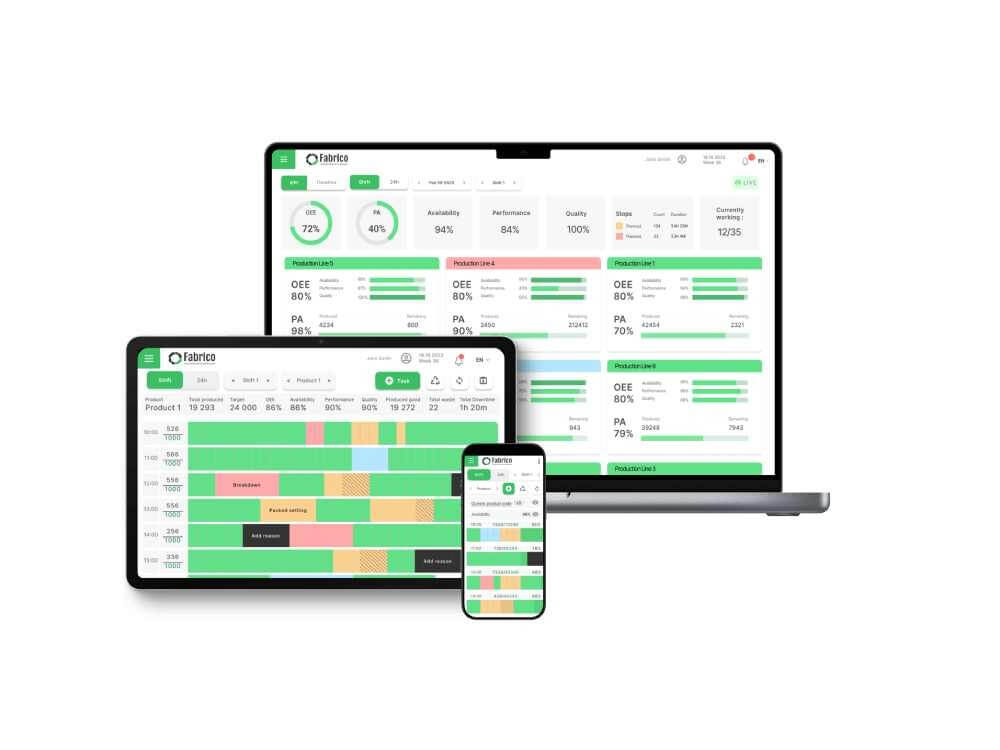
What is multi-site OEE group analytics?
Multi-site OEE group analytics is a centralized digital framework that consolidates real-time production performance and maintenance execution data from multiple facilities into a single dashboard, allowing leadership to benchmark KPIs (Availability, Performance, Quality) and enforce global reliability standards across an entire enterprise.
For Paula (the Strategic Leader), this feature provides "Global Visibility."
Instead of reconciling ten different Excel reports, she uses Fabrico to see exactly why specific regions underperform, natively linking those production gaps to maintenance "Bad Actors" in the Field-Ready CMMS.
1. Fabrico: The Integrated System of Action
Fabrico is the only platform built from the ground up to natively unify Native OEE with a Group-First Architecture for mid-to-large-scale manufacturers.
Why it wins for multi-site groups:
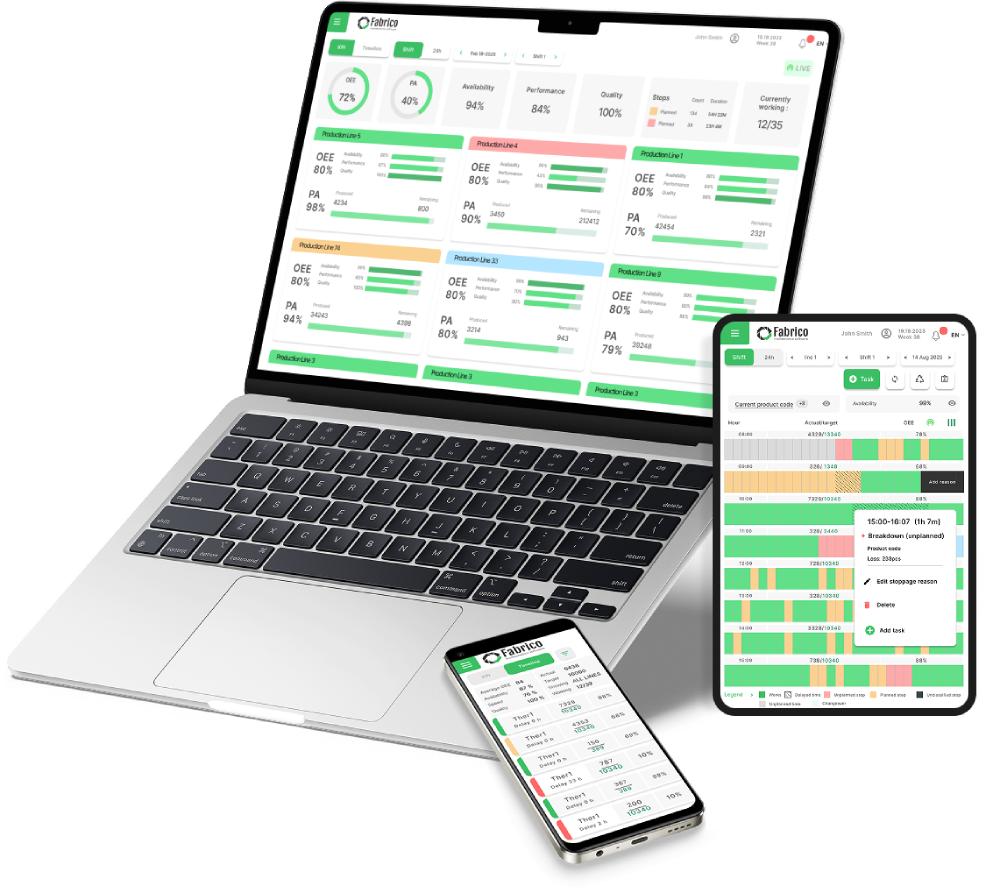
Fabrico enables global governance through "Master PM Templates." When a reliability win is achieved on a specific asset class in one plant, that digital SOP can be pushed to every other site instantly.
By linking real-time OEE cycle speed to maintenance execution across the group, Fabrico identifies "Bad Actor" assets globally. Its "Visibility Trifecta" ensures that every site operates on the same technical truth, preparing your enterprise data foundation for the future Fabrico Agent (Roadmap).
2. IBM Maximo
IBM Maximo is the infrastructure giant of the asset management world, designed for massive enterprises with complex financial auditing requirements.
The Trade-off:
It is a classic "System of Record" that excels at tracking capital depreciation and large MRO budgets. However, it is notoriously "OEE-blind." It lacks the native, high-frequency PLC integration and visual RCA (Computer Vision) required to fix the micro-stops that define high-speed manufacturing. It reports on what you spent, not why your machines stopped.
3. Sight Machine
Sight Machine specializes in "Data Manufacturing," turning raw plant-floor data into a structured "Digital Twin" for enterprise-level analytics.
The Trade-off:
It is a powerful tool for data scientists to find long-term correlations across multiple plants. However, it is often too "heavy" for the shop floor. It lacks the field-ready simplicity and native QR Code asset tagging technicians need to execute repairs in real-time, resulting in high Decision Latency.
4. MachineMetrics
MachineMetrics is a leader in machine connectivity and IoT data analysis, particularly for the CNC and discrete manufacturing sectors.
The Trade-off:
They are leaders in "Machine Intelligence," pulling deep data from control systems across thousands of assets. However, they often lack the native, mobile-first maintenance execution layer required for a full System of Action. For Paula, this means the group sees the data but still struggles to drive standardized "Cures" across sites.
5. Sepasoft (for Ignition)
Sepasoft provides a highly customizable MES module that runs on the Inductive Automation Ignition platform, offering deep control over multi-site SCADA and OEE.
The Trade-off:
It is a "Developer-First" tool. While you can build a comprehensive group-wide system, it requires significant technical resources and long implementation timelines (6–12 months). Many plants find themselves in a "Development Loop," spending more on custom coding than they reclaim in capacity.
Comparison Matrix: Multi-Site Group Analytics
| Capability |
Fabrico (System of Action) |
IBM Maximo |
Sight Machine |
MachineMetrics |
Sepasoft |
| Global Governance |
Master PM Templates |
Financial Only |
Digital Twin |
Data Science |
Custom MES |
| OEE Native Link |
High / Native |
None |
Integrated / API |
Native / High |
Module-Based |
| Micro-stop RCA |
Advanced (Visual) |
Zero |
Data-Only |
Data-Only |
None |
| Warehouse Link |
Virtual (Group-Wide) |
Procurement |
None |
Siled / API |
Custom |
| Implementation |
3-4 Months |
12-24 Months |
12+ Months |
4-6 Months |
12+ Months |
| Strategic Focus |
Capacity Reclamation |
Financial Record |
Process Insight |
OT Visibility |
Bespoke MES |
The Strategic ROI: ROI at Enterprise Scale
For Paula (the Strategic Leader), the business case for a group-first System of Action is built on the speed of standardization.
By reclaiming just 3% of availability across ten sites through reduced Decision Latency, she can increase group revenue by millions without a single new machine. This efficiency directly lowers the global Maintenance Cost per Unit and ensures that every capital asset reaches its full residual value.
Consolidating your multi-site operations into a single source of operational truth is the only way to move from "Monitoring Failure" to "Engineering Global Uptime."
Stop managing site-by-site. Start engineering global profit with a System of Action.


 Login
Login
 Blog
Blog