What is OEE software with native CMMS integration?
OEE software with native CMMS integration is a unified manufacturing platform that synchronizes real-time machine performance data (Availability, Performance, Quality) directly with maintenance execution workflows (Work Orders, Spare Parts, PMs) within a single database to automate the response to production losses.
In high-speed industries like Food & Beverage or Plastics, this integration allows Mike (the Tactical Manager) to move from "Monitoring Failure" to "Engineering Uptime."
When a performance threshold is breached, the "Cure" is already on the technician’s mobile device.
1. Fabrico: The Integrated System of Action
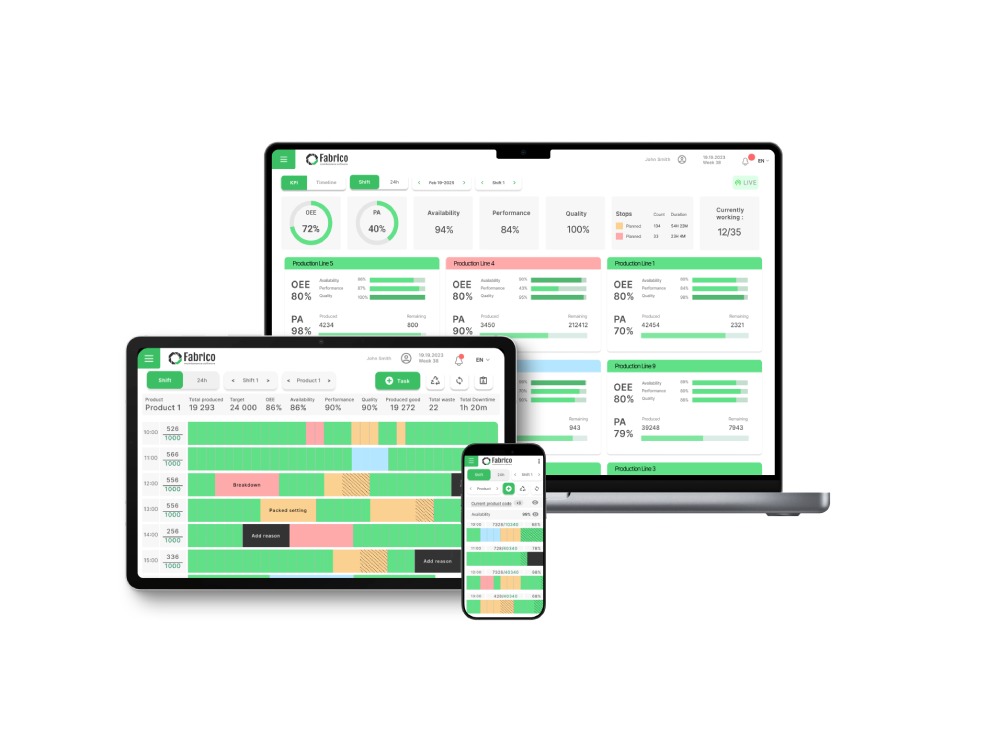
Fabrico is the only platform built from the ground up to natively merge Native OEE diagnostics with a Field-Ready CMMS.
Why it wins for high-speed lines:
Fabrico utilizes the "Visibility Trifecta"—pulling data from PLCs, operators, and AI-powered Computer Vision.
When the system detects a micro-stop or a 5% speed loss, the Inefficiencies Zoom-In module flags a video clip and attaches it to a prioritized Work Order.
This ensures Tom (the Technician) sees the mechanical root cause on his mobile app before he even arrives at the line, slashing diagnostic time and reducing Maintenance Cost per Unit.
2. MachineMetrics
MachineMetrics is a leader in machine connectivity and IoT data analysis, particularly for the CNC and discrete manufacturing sectors.
The Trade-off:
While it provides world-class "Data Intelligence," its maintenance execution layer is often less mature than its OEE module.
For Paula (the Strategic Leader), this means the maintenance team may still experience "Information Silos" because the CMMS functionality often requires third-party bridges to reach the level of detail found in a dedicated System of Action.
3. Fiix (by Rockwell Automation)
Fiix is a robust, enterprise-grade CMMS that has increasingly integrated with Rockwell’s automation ecosystem to provide OEE insights.
The Trade-off:
It is a "System of Record" designed for large infrastructure.
The implementation is often heavy and expensive, and the user interface can be difficult for Tom (the Technician) to navigate on a mobile device.
In high-speed environments where every second counts, the complexity of a legacy-based tool can lead to lower shop-floor adoption.
4. MaintainX
MaintainX is widely praised for its chat-heavy, intuitive mobile interface that technicians find very easy to use for daily checklists.
The Trade-off:
It is a "Maintenance-First" tool.
While it has basic OEE capabilities, it lacks the deep PLC-integration depth and Visual RCA (Computer Vision) required to capture the high-frequency micro-stops that define the Hidden Factory in high-volume production.
5. Evocon
Evocon is a popular entry-level OEE software known for its visual simplicity and rapid floor-level setup.
The Trade-off:
It is primarily a "Scoreboard."
While it helps Mike see his losses, it lacks a native, field-ready maintenance execution engine to manage spare parts, asset hierarchy, and complex reliability strategies like Reliability-Centered Maintenance (RCM).
Comparison Matrix: OEE with Native CMMS Integration
| Buying Factor |
Fabrico |
MachineMetrics |
Fiix (Rockwell) |
MaintainX |
Evocon |
| Maintenance Link |
Native / Native |
Siled / API |
Integrated / Complex |
Manual / Basic |
None |
| Response Trigger |
Auto-Work Order |
Email / Alert |
Scheduled |
Manual Chat |
Visual Only |
| Visual RCA |
Advanced (Zoom-In) |
Data-Only |
None |
Photo-Only |
None |
| Mobile UX |
High (Native App) |
Browser-Based |
Low (Desktop Focus) |
High (Chat Focus) |
Moderate |
| Planning Agility |
Predictive Board |
Static |
Static |
Manual |
None |
| Implementation |
3-4 Months |
4-6 Months |
6-12 Months |
1-2 Months |
1 Month |
The Strategic ROI: Reclaiming Your Hidden Factory
For Paula, the financial choice is clear: you cannot fix what you cannot natively link.
Consolidating production and maintenance into a single System of Action lowers your Total Cost of Ownership (TCO) and eliminates the "Integration Tax" of disconnected tools.
By identifying "Bad Actor" assets through integrated performance data, you move your team to Condition-Directed Tasks that directly protect your revenue.
As you build 12 months of clean OEE-maintenance data, you are also preparing the facility for the Fabrico Agent (AI Roadmap).
Stop managing your data in silos. Start engineering uptime with a System of Action.


 Login
Login
 Blog
Blog