What is PDCA automation in OEE software?
PDCA automation in OEE software is a digital manufacturing framework that natively integrates production scheduling (Plan), machine pulse monitoring (Do), real-time efficiency analytics (Check), and maintenance execution (Act) to ensure every production loss natively triggers a technical or procedural correction.
For Mike (the Tactical Manager), this is the end of the "Whiteboard Kaizen."
Instead of waiting for a monthly meeting, he uses Fabrico to ensure that a 5% speed loss identified at 9:00 AM leads to a completed mechanical calibration by 9:15 AM. Fabrico act as the engine for this loop, protecting the Value Fulcrum in real-time.
1. Fabrico: The Integrated System of Action
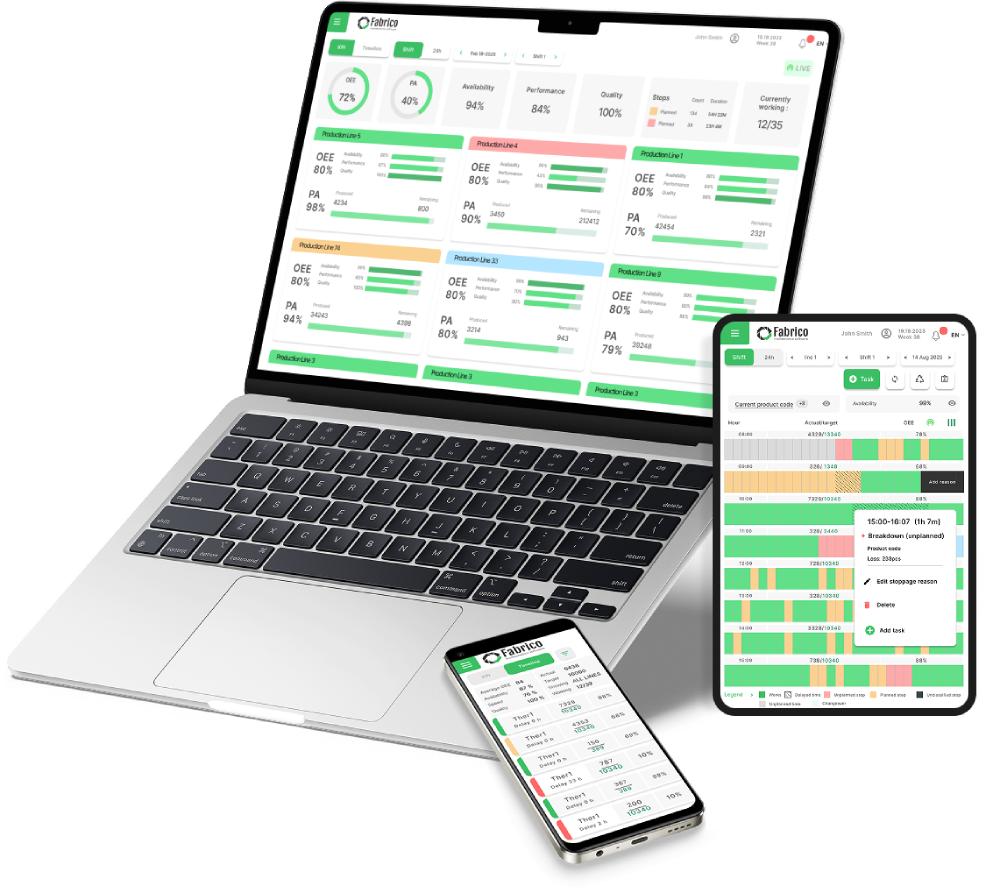
Fabrico is the only platform built to natively unify the entire PDCA cycle—from the Interactive Planning Board to the Field-Ready CMMS.
Why it wins for PDCA automation:
Fabrico treats continuous improvement as an automated workflow. The "Plan" is managed via the maintenance-aware planning board. The "Do" and "Check" phases are captured through the "Visibility Trifecta" (PLC + Human + Vision), which identifies the Hidden Factory losses.
Because it is a System of Action, the "Act" phase is natively automated. When OEE performance drifts, the system triggers a prioritized Work Order. Tom (the Technician) receives the "Cure" on his mobile device, complete with visual proof from the Inefficiencies Zoom-In module, closing the loop before the shift targets are missed.
2. MachineMetrics
MachineMetrics is a robust industrial IoT platform that excels at machine connectivity and high-frequency data analytics.
The Trade-off:
They are leaders in the "Check" phase, providing world-class data on technical failure patterns. However, their "Act" phase is often siloed. For Paula (the Strategic Leader), the lack of a native, mobile-first maintenance execution engine means there is still a significant "Action Gap" between seeing a diagnostic and executing a repair.
3. Sight Machine
Sight Machine specializes in "Data Manufacturing," turning raw plant-floor data into a structured "Digital Twin" for enterprise-level analytics.
The Trade-off:
It is a powerful tool for the "Plan" and "Check" phases of long-term strategic optimization. However, it functions primarily as a "System of Intelligence" for the office. It lacks the field-ready simplicity and native QR Code asset tagging technicians need to manage the "Act" phase at the machine in real-time.
4. Redzone Production System
Redzone is a popular "Social OEE" platform that focuses heavily on operator engagement and shop-floor coaching through gamification.
The Trade-off:
Redzone excels at the "Human" side of the PDCA loop, encouraging operators to "Act" on minor issues. However, it lacks the deep engineering asset data and native MRO inventory management required for the technical "Planned Maintenance" portion of the loop. It helps people talk, but it doesn't always help them engineer reliability.
5. Sepasoft (for Ignition)
Sepasoft provides a highly customizable MES module that runs on the Inductive Automation Ignition platform, offering deep control over OEE and SCADA.
The Trade-off:
It is a "Developer-First" tool. While you can build a comprehensive PDCA automation logic, it carries a high "Complexity Tax." Implementation requires significant technical resources and long timelines (6–12 months). Many plants find themselves stuck in a "Development Loop" rather than a "Continuous Improvement Loop."
Comparison Matrix: PDCA Automation Capabilities
| Feature |
Fabrico (System of Action) |
MachineMetrics |
Sight Machine |
Redzone |
Sepasoft |
| Plan (Scheduling) |
Predictive / Real-Time |
Data-Driven |
Digital Twin |
Social Feed |
Custom MES |
| Check (OEE Pulse) |
Native / High-Freq |
Native / High |
Integrated / API |
Native / High |
Native / High |
| Act (CMMS Loop) |
Native / Automated |
Siled / API |
None |
Basic / Manual |
Module-Based |
| Visual Proof (RCA) |
Advanced (Zoom-In) |
Data-Only |
Data-Only |
Photo-Only |
None |
| Decision Latency |
Zero (Automated) |
Moderate |
High |
Moderate |
Moderate |
| Implementation |
3-4 Months |
4-6 Months |
12+ Months |
4-6 Months |
12+ Months |
The Strategic ROI: Reclaiming the 15% Truth
For Paula (the Strategic Leader), the business case for PDCA automation is built on "Capacity Reclamation."
Reclaiming just 5% of your Effective Runtime by automating the "Check-to-Act" transition is often more profitable than adding a new production line. By identifying "Bad Actor" assets through real-time 3D data, you move your team from reactive "firefighting" to Reliability-Centered Maintenance (RCM).
As you build 12 months of clean data via the Fabrico Agent, you are preparing your plant for the future of autonomous optimizations that will eventually turn your factory into a self-balancing profit engine.
Stop managing PDCA on a whiteboard. Start engineering uptime with a System of Action.


 Login
Login
 Blog
Blog