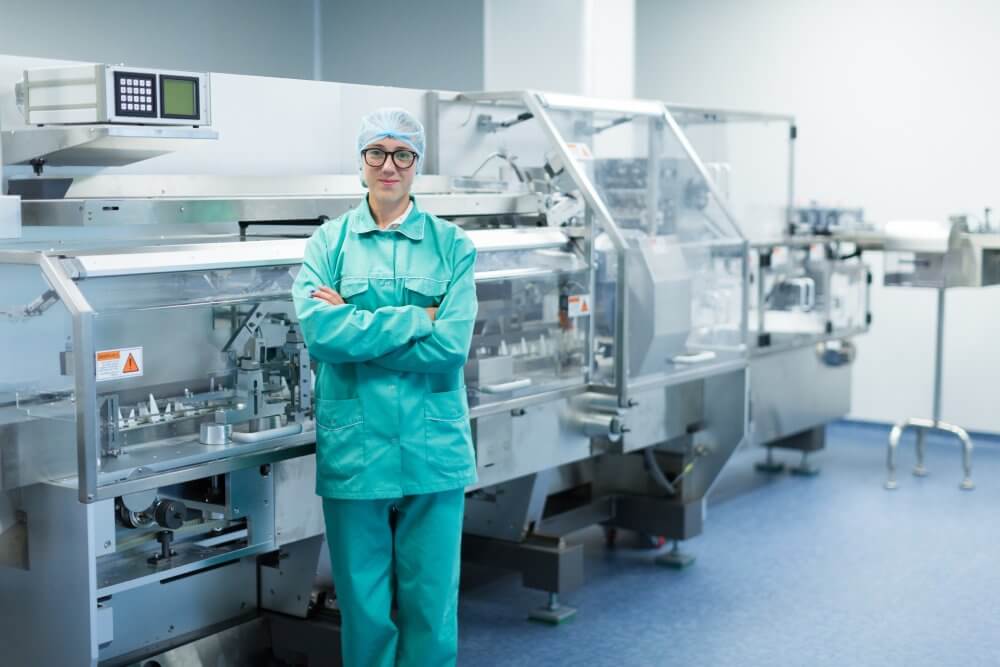
In Pharmaceutical manufacturing, OEE (Overall Equipment Effectiveness) is a high-stakes metric.
In a bottling plant, if a machine crashes, you lose time. In a pharmaceutical plant, if a machine crashes during a sterile fill, you might lose the entire batch, face an FDA 483 observation, and spend weeks on CAPA (Corrective and Preventive Action) paperwork.
Therefore, OEE software for pharma cannot just be a "counter." It must be a Compliance Engine.
It needs to ensure that higher speeds do not result in lower compliance. It needs to link the Machine State to the Batch Record.
Here are the 5 best OEE software tools suited for the rigorous demands of Life Sciences and Pharmaceutical manufacturing.
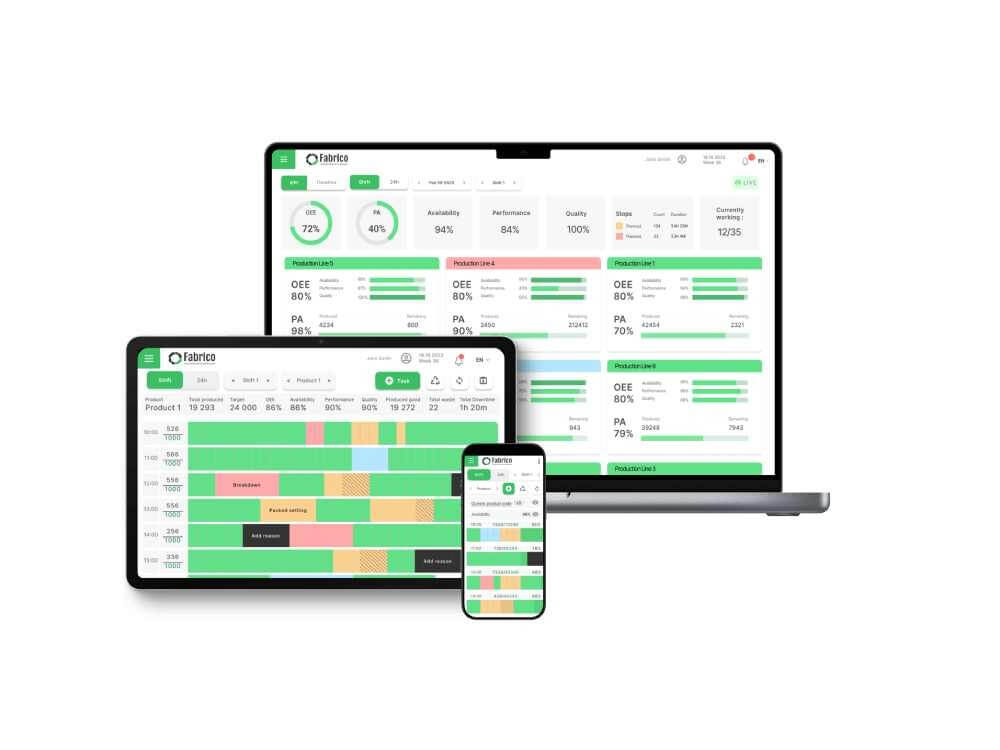
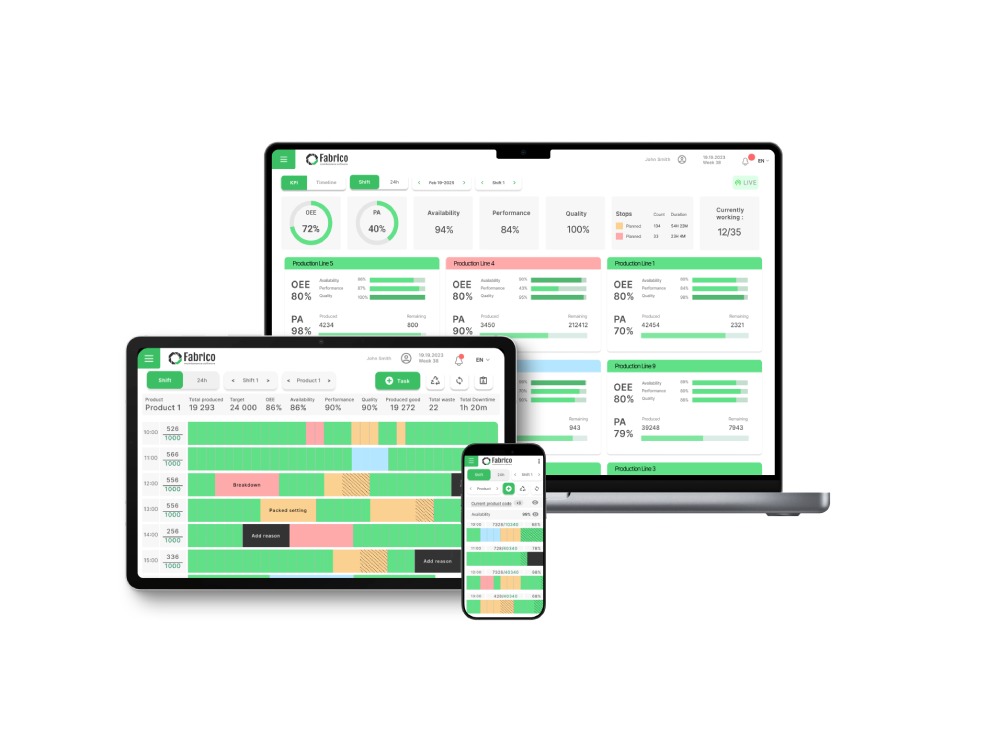
1. Fabrico (Best for Maintenance-Driven OEE & Digital Logbooks)
Fabrico offers a distinct advantage for mid-sized pharma and CDMOs (Contract Development and Manufacturing Organizations): Agility.
While legacy MES systems take years to implement, Fabrico provides a compliant layer for OEE and Maintenance that can be deployed rapidly.
Its strength lies in connecting Production Efficiency with Asset Integrity.
In pharma, downtime is often caused by sanitation cycles (CIP/SIP) or calibration issues. Fabrico manages both.
Key Features for Pharma:
-
Digital CILs & Logbooks: Replaces paper equipment logbooks with 21 CFR Part 11 compliant digital records. Operators verify "Clean/Inspect" steps before the line starts.
-
Traceability: Every OEE event, downtime reason, and maintenance repair is stamped with User ID, Time, and Location for audit trails.
-
Condition-Based Calibration: Triggers calibration tasks for sensors based on actual run-hours or cycles, ensuring you never run out of spec.
-
Video RCA: Uses Computer Vision to diagnose jams in packaging lines (blister packs/cartoners) without compromising the sterile boundary.
Best For: CDMOs and Pharma plants needing agile OEE, Digital Logbooks, and Maintenance in one platform.
2. Siemens Opcenter (Best for Enterprise MES Integration)
Siemens Opcenter (formerly SIMATIC IT / Camstar) is the heavyweight champion of the industry.
If you are a Top 10 Big Pharma company building a fully automated facility, Siemens is the standard choice.
It offers deep integration with SCADA and automation layers. Its OEE module is just one tiny part of a massive ecosystem that controls weighing, dispensing, and Electronic Batch Records (EBR).
The downside? It is incredibly expensive and rigid. Changing a workflow often requires a team of consultants and a lengthy re-validation process.
Best For: Large-scale enterprise facilities requiring a full-stack MES.
3. Werum PAS-X (Best for Electronic Batch Records)
Werum PAS-X (by Körber) is arguably the most famous name in Pharma MES.
Their primary focus is the EBR (Electronic Batch Record)—ensuring that every step of the "recipe" is followed perfectly to release the batch.
Their OEE capabilities are strong, but they are secondary to the "Quality/Release" workflow.
If your primary pain point is "Batch Release Speed" (getting paperwork signed off), Werum is the leader. If your primary pain point is "Machine Reliability," it may be overkill.
Best For: Sterile manufacturing where Batch Record compliance is the bottleneck.
4. Tulip (Best for Operator Guidance / No-Code)
Tulip has disrupted the market with a "No-Code" app platform.
Instead of buying a rigid MES, engineers can build custom apps for specific stations (e.g., a "Line Clearance App" or a "Visual Inspection App").
Tulip connects to machines to track OEE and displays it on beautiful, operator-friendly dashboards.
It is excellent for "Human-Centric" processes (manual packaging, kit assembly). However, because it is a toolkit rather than a structured system, maintaining validation across hundreds of custom apps can be challenging for Quality Assurance (QA) teams.
Best For: Manual assembly/packaging lines and teams that want to build their own workflows.
5. MasterControl (Best for Quality Management Integration)
MasterControl started as a QMS (Quality Management System)—managing documents, training, and CAPAs.
They have expanded into "Manufacturing Excellence" (Mx).
Their approach to OEE is entirely quality-driven. They focus on "Right First Time."
The integration between the Production Record and the Quality deviation system is seamless. If OEE drops due to a quality issue, the deviation is already started in the QMS.
However, it lacks deep machine integration (PLC data extraction) compared to Siemens or Fabrico.
Best For: Quality-focused organizations looking to digitize paper batch records quickly.
Comparison: The Compliance Spectrum
Which tool balances efficiency with GMP?
| Feature |
Fabrico |
Siemens Opcenter |
Werum PAS-X |
Tulip |
MasterControl |
| Primary Focus |
Asset Reliability & OEE |
Enterprise Automation |
Electronic Batch Record |
Flexible Apps (No-Code) |
Quality (QMS) |
| Implementation |
Weeks (Agile) |
Years (Heavy) |
Years (Heavy) |
Days (But requires building) |
Months |
| Maintenance Link |
Native (Calibration/Repairs) |
Module (Complex) |
Limited |
Limited |
None |
| Digital Logbooks |
Yes (GMP Ready) |
Yes (EBR) |
Yes (EBR) |
Custom Built |
Yes (Mx) |
| Cost |
Subscription (SaaS) |
Very High (CapEx) |
Very High (CapEx) |
Subscription |
Subscription |
Conclusion: Don't let the paperwork stop the press
In Pharma, the tension is always between Production (who wants to run) and Quality (who wants to document).
If you choose Werum or Siemens, you get a powerful but slow-moving tank.
If you choose Tulip, you get speed but risk validation headaches.
Fabrico offers the middle path: A validated, compliant platform that tracks OEE and Maintenance rigorously, but deploys with the speed of modern SaaS.
We ensure the machine is ready, the logbook is signed, and the line is running.
Ready to validate your efficiency?
See how Fabrico handles Digital Logbooks and OEE for Pharma.
Book a Demo with Fabrico Today


 Login
Login
 Blog
Blog