What is direct PLC connectivity in OEE software?
Direct PLC connectivity in OEE software is a real-time data acquisition method that pulls machine signals directly from a Programmable Logic Controller (PLC) via industrial protocols to capture cycle times, counts, and downtime events with millisecond precision.
For Mike (the Tactical Manager), this feature eliminates the "Pencil Whip" trap. Instead of arguing about why a shift missed its target, he uses Fabrico to see the exact mechanical pulse of the line. This ensures the Value Fulcrum is based on hard data, not shift-end memory.
1. Fabrico: The Integrated System of Action
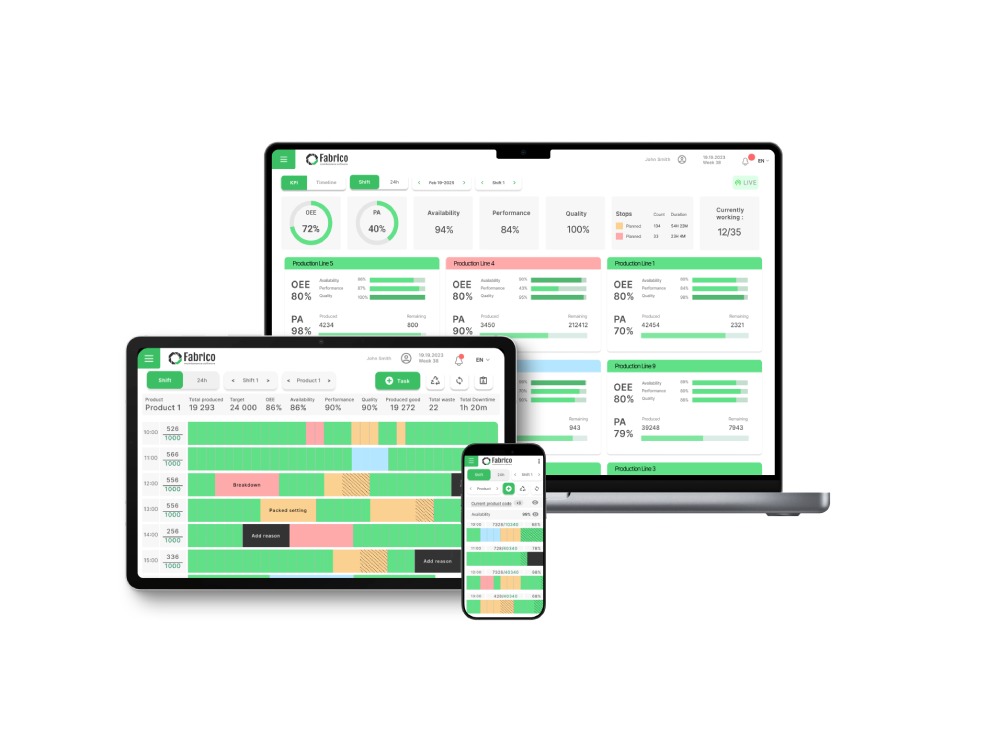
Fabrico is the only platform that offers a native, three-tiered approach to machine connectivity, unifying Native OEE with a Field-Ready CMMS.
Why it wins for high-speed lines:
Fabrico provides three specific paths to 100% visibility. Option 1 is Direct PLC Connectivity for modern lines. Option 2 is IoT Gateway & Optical Sensors for retrofitting legacy "Bad Actor" assets without complex wiring. Option 3 is Computer Vision (Inefficiencies Zoom-In) for manual or hybrid stations.
Because it is a System of Action, a signal from any of these sources natively triggers a prioritized Work Order. Tom (the Technician) receives a smart notification on his mobile device the second a cycle time drifts, reclaiming the Hidden Factory revenue before the shift ends.
2. MachineMetrics
MachineMetrics is a robust IoT platform that excels at deep machine connectivity, particularly in the CNC and discrete manufacturing sectors.
The Trade-off:
They are leaders in "Machine Intelligence," pulling high-frequency data from control systems. However, they function primarily as a "System of Record" for analysts. For Paula (the Strategic Leader), the lack of a native, mobile-first maintenance execution loop means there is still an "Action Gap" between seeing a technical fault and having it fixed.
3. Guidewheel
Guidewheel uses "clip-on" sensors to monitor machine electricity consumption and derive OEE insights for assets of any age.
The Trade-off:
This electricity-based approach is excellent for rapid "Brownfield" digitalization and general OEE awareness. However, it lacks the deep technical error codes provided by a direct PLC link. Without a native, built-in Field-Ready CMMS, Mike is left with a dashboard that identifies a problem but doesn't manage the technical "Cure."
4. Sepasoft (for Ignition)
Sepasoft provides a highly customizable MES module that runs on the Inductive Automation Ignition platform, offering deep control over OEE and SCADA.
The Trade-off:
It is a "Developer-First" tool. While it offers extreme connectivity flexibility, it carries a high "Complexity Tax." Implementation requires significant IT resources and long timelines (6–12 months). Many plants find themselves stuck in a "Development Loop" rather than an "Action Loop," resulting in higher Maintenance Cost per Unit.
5. Vorne XL (OEE Scoreboards)
Vorne XL is the industry standard for hardware-centric scoreboards that provide immediate visual feedback via their own dedicated sensors.
The Trade-off:
It is a "Digital Clock." It captures the pulse of the machine but provides zero visibility into the "Why." It cannot capture operator context, manage a spare parts inventory, or provide the visual proof required to end the "Blame Game" between shifts. It tracks the decline but doesn't drive the mechanical recovery.
Comparison Matrix: OEE Connectivity Capabilities
| Feature |
Fabrico (System of Action) |
MachineMetrics |
Guidewheel |
Sepasoft |
Vorne XL |
| Connectivity Path |
Hybrid (PLC/IoT/CV) |
PLC / IoT |
Electricity Pulse |
PLC / SCADA |
Hardware Only |
| Response Trigger |
Auto-Work Order |
Email / Alert |
Dashboard Only |
Manual |
Visual Alert |
| Legacy Retrofit |
High (IoT/Vision) |
Moderate |
High |
Moderate |
High |
| Maintenance Link |
Native CMMS |
Siled / API |
None |
Module-Based |
None |
| Implementation |
3-4 Months |
4-6 Months |
1 Month |
12+ Months |
Days |
| Strategic Goal |
Capacity Reclamation |
OT Visibility |
Awareness |
Custom MES |
Awareness |
The Strategic ROI: Capturing the 15% Truth
For Paula (the Strategic Leader), the business case for direct connectivity is built on the stabilization of her Hidden Factory revenue.
By identifying "Bad Actor" assets through absolute machine pulses, she can move her team to Condition-Directed Tasks that protect effective runtime. Reclaiming just 10 minutes of "Invisible Loss" per shift across ten sites is often more profitable than adding a new production line.
As you build 12 months of clean connectivity data, you are preparing the facility for the future of autonomous optimizations.
Stop managing based on paper logs. Start engineering uptime with a System of Action.


 Login
Login
 Blog
Blog