What is Predictive Availability in OEE Software?
Predictive Availability is the ability to adjust a production schedule in real-time based on actual machine health, current OEE performance trends, and maintenance backlogs to ensure targets are achievable.
Traditional tools assume 100% capacity until a machine stops.
A System of Action like Fabrico identifies that a labeling machine is running 8% slower than the Takt time due to mechanical friction, alerting the planner to adjust the schedule before a shipping deadline is missed.
This bridges the "Information Gap" between the office and the shop floor, protecting your Value Fulcrum.
The OEE Scheduling Comparison Matrix
| Feature |
Fabrico (System of Action) |
MachineMetrics |
Vorne XL |
Evocon |
Matics |
| Scheduling Logic |
Predictive / Real-Time |
Data-Driven |
Static |
Manual |
Real-Time Track |
| Maintenance Link |
Native CMMS |
Siled / API |
None |
None |
Basic Task Mgmt |
| Connectivity |
PLC + IoT + Vision |
PLC + IoT |
Hardware Sensor |
PLC Only |
PLC Only |
| Mobile UX |
Field-Ready (Offline) |
Browser-Based |
N/A |
Browser-Based |
Tablet-Focused |
| Implementation |
3-4 Months |
4-6 Months |
Days (Hardware) |
1-2 Months |
2-3 Months |
1. Fabrico: The Integrated System of Action
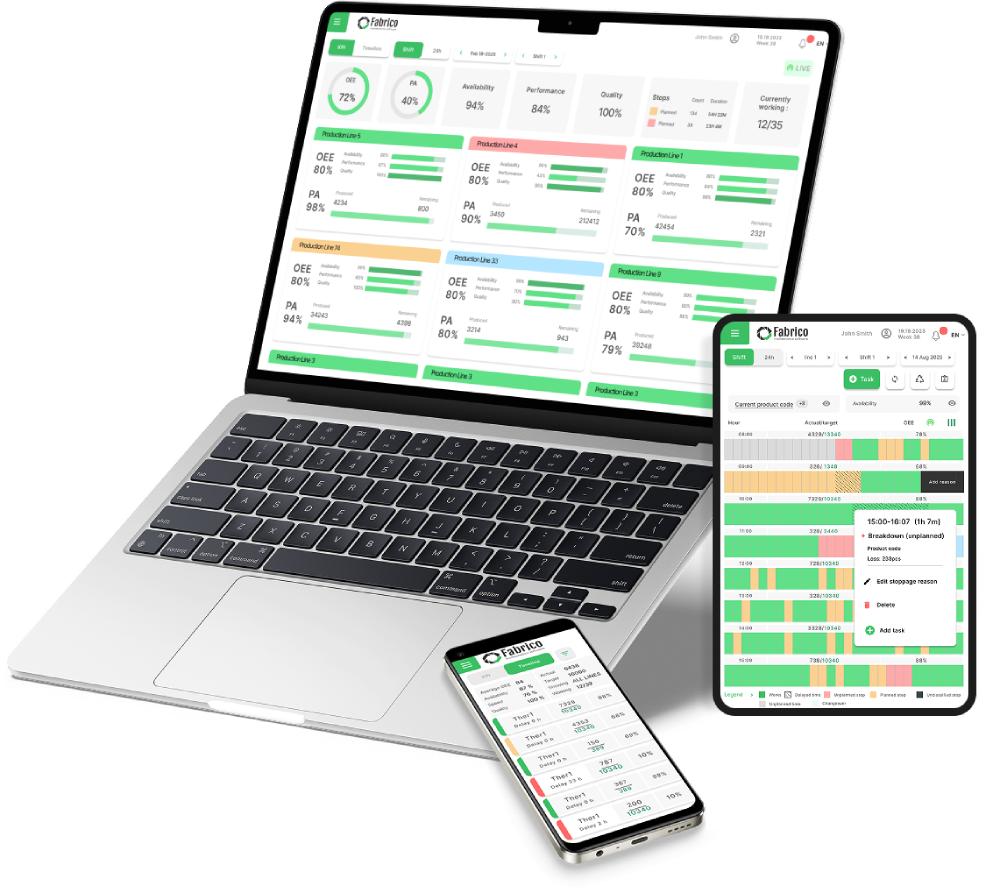
Fabrico is the only platform built to natively merge Native OEE, a Field-Ready CMMS, and an Interactive Planning Board into a single source of truth.
Why it wins for high-speed lines:
Fabrico treats the production schedule as a living environment. If a critical filler’s performance drifts below its target, the planning board reflects this instantly, flagging potential delays before they impact the bottom line.
Because it is a System of Action, the system doesn't just show a delay; it allows Mike (the Tactical Manager) to drag and drop orders to healthier lines while natively triggering a prioritized Work Order for Tom (the Technician). It captures the Hidden Factory revenue by ensuring the schedule always matches mechanical reality.
2. MachineMetrics
MachineMetrics is a robust IoT platform that excels at deep machine connectivity, particularly in CNC and discrete manufacturing.
The Trade-off:
While their data science is world-class for identifying tool wear, their scheduling module functions more as a "System of Record." It reports on what happened but often lacks the native, mobile-first maintenance execution loop required to turn a schedule conflict into a completed repair in real-time.
3. Vorne XL
Vorne XL is the hardware standard for providing real-time visual feedback of OEE metrics directly on the production floor.
The Trade-off:
It is a "Digital Clock" for awareness. It cannot manage a maintenance backlog, doesn't link to a Bill of Materials (BOM), and lacks the digital workflows to manage the enterprise-wide recovery of lost capacity.
4. Evocon
Evocon is an entry-level OEE tool recognized for its visual simplicity and quick cloud-based setup.
The Trade-off:
Evocon is primarily a tracking tool. While it monitors performance in real-time, it lacks the integrated maintenance and interactive production scheduling modules required to function as a full System of Action for large-scale manufacturers.
5. Matics
Matics is an agile production monitoring platform that focuses on real-time OEE visibility and floor-level task management.
The Trade-off:
Matics excels at communication but lacks the deep engineering asset data and Advanced Visual RCA (Computer Vision) needed to identify the "Why" behind the speed loss that disrupts the schedule.
Why Siled Planning Boards Fail High-Speed Production
A production schedule built on theoretical capacity is a fantasy that leads to missed "Promise Dates" and expensive emergency shipping costs.
If your planner doesn't know that a machine's MTBF (Mean Time Between Failures) is trending downward, they are scheduling a disaster.
Fabrico's Interactive Planning Board uses Predictive Availability to sync your schedule with the actual health of your assets, ensuring Paula (the Strategic Leader) only commits to deadlines the factory can actually hit.
By identifying "Bad Actor" assets through real-time data, you move your team from reactive "firefighting" to a proactive reliability strategy that protects your Residual Asset Value.
Stop planning based on hope. Start engineering your flow with a System of Action.


 Login
Login
 Blog
Blog