What is maintenance-aware production scheduling?
Maintenance-aware production scheduling is an operational framework that natively synchronizes real-time machine performance data (OEE) and maintenance status (CMMS) with a production planning board to ensure schedules reflect the actual, current capacity of the factory floor.
For Mike (the Tactical Manager), this is the end of the "Monday Morning Scramble." Instead of discovering a machine is down after the shift begins, the Interactive Planning Board highlights conflicts before they happen.
Fabrico bridges this gap by ensuring that any OEE performance drop or pending PM task instantly recalculates the "True Capacity" of the line.
1. Fabrico: The Integrated System of Action
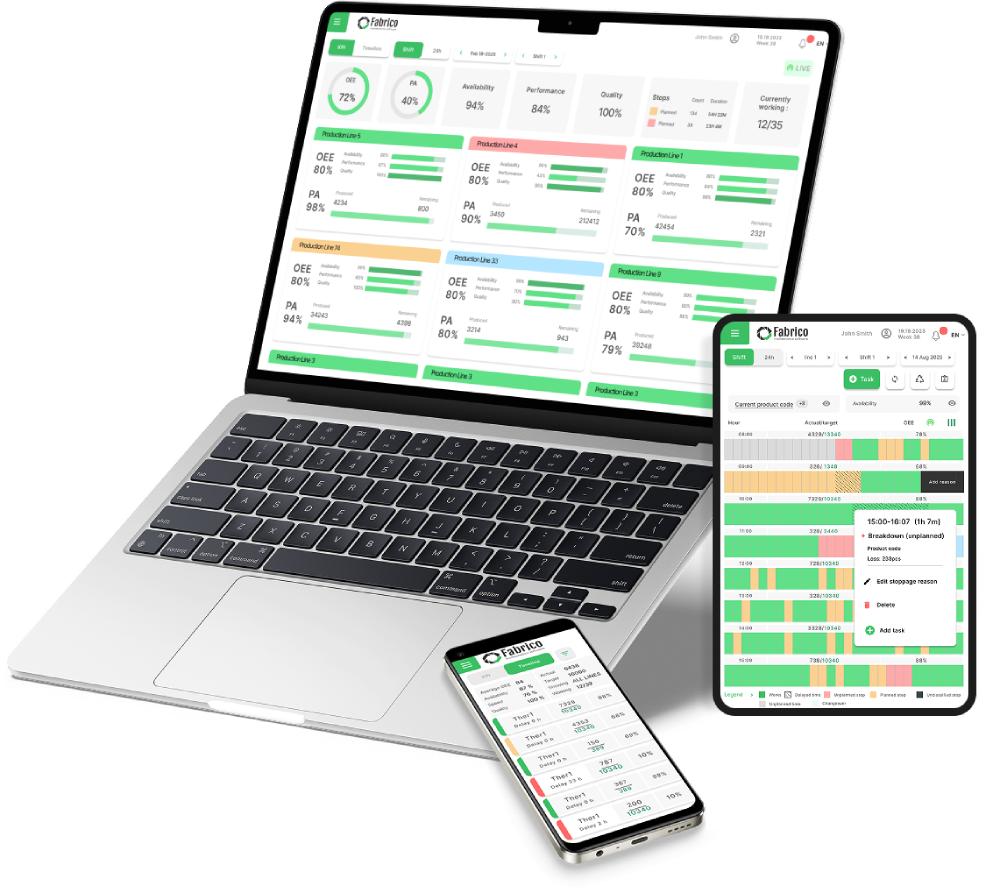
Fabrico is the only platform built to natively unify Native OEE, a Field-Ready CMMS, and an Interactive Planning Board into a single source of truth.
Why it wins for high-speed lines:
Fabrico treats the production schedule as a living environment. When a high-speed filler’s performance drifts 5% below Takt time, the planning board reflects this instantly via "Predictive Availability."
Because it is a System of Action, Mike can drag and drop orders to backup lines while the system natively triggers a prioritized Work Order for Tom (the Technician). This ensures the schedule always matches mechanical reality, reclaiming the Hidden Factory revenue that traditional ERP modules miss.
2. MachineMetrics
MachineMetrics is a robust platform focused on deep IoT machine connectivity and data analytics, particularly for discrete manufacturing and CNC environments.
The Trade-off:
While their OEE data collection is world-class, their scheduling module often operates as a "System of Record" for analysts. It reports on what happened but often lacks the native, mobile-first maintenance execution loop required to turn a schedule conflict into a completed repair in real-time.
3. Plex (by Rockwell Automation)
Plex is a heavyweight ERP and MES platform that offers a comprehensive view of the entire enterprise, including complex multi-site scheduling and quality tracking.
The Trade-off:
Plex is a "Finance-First" system. The implementation is notoriously long (12–24 months), and the interface is often too complex for technicians like Tom. In agile environments, the "Complexity Tax" of a legacy ERP module slows down the response time, resulting in higher Decision Latency compared to field-ready systems.
4. Redzone Production System
Redzone focuses on "Social OEE," using gamification and shop-floor coaching to improve operator engagement and daily communication.
The Trade-off:
Redzone is a "System of Culture," not a technical execution engine. While it excels at operator-led scheduling adjustments, it lacks the deep engineering asset data and native CMMS functionality required to manage complex MRO inventory and asset hierarchies.
5. Sepasoft (for Ignition by Inductive Automation)
Sepasoft provides a highly customizable MES module that runs on the Ignition platform, offering deep control over OEE and production scheduling.
The Trade-off:
It is a "Developer-First" tool. While it offers extreme flexibility, it requires significant technical resources to build and maintain the "System of Action." Many mid-sized plants find themselves in the "DIY Trap," spending months coding a maintenance-aware schedule rather than reclaiming capacity.
Comparison Matrix: OEE & Scheduling Integration
| Capability |
Fabrico (System of Action) |
MachineMetrics |
Plex (MES) |
Redzone |
Sepasoft |
| Scheduling Logic |
Predictive / Real-Time |
Data-Driven |
Static / Financial |
Social / Agile |
Custom / Built |
| Maintenance Link |
Native CMMS |
Siled / API |
Integrated / Heavy |
Manual / Basic |
Module-Based |
| Conflict Detection |
Automated / Instant |
Moderate |
Batch-Processed |
Manual |
High (If Coded) |
| Visual RCA |
Advanced (Zoom-In) |
Data-Only |
None |
Photo-Only |
None |
| Decision Latency |
Zero (Automated) |
Moderate |
High |
Moderate |
Moderate |
| Implementation |
3-4 Months |
4-6 Months |
12+ Months |
4-6 Months |
6-12 Months |
The Strategic ROI: Lowering Maintenance Cost per Unit
For Paula (the Strategic Leader), the business case for an OEE-integrated planning board is built on the stabilization of throughput.
By aligning the production load with the technical reality of the floor, you eliminate the "Firefighting" that drives expensive emergency labor and overtime. This directly reduces your Maintenance Cost per Unit and ensures your multi-million dollar assets reach their full residual value.
As you build 12 months of clean data, you are preparing your plant for future autonomous optimizations that will eventually turn your factory into a self-balancing revenue engine.
Stop planning based on a wish list. Start engineering your flow with a System of Action.


 Login
Login
 Blog
Blog