What is OEE quality monitoring software?
OEE quality monitoring software is a digital manufacturing platform that captures real-time data on production rejects and rework, natively linking these quality losses to machine performance and maintenance history to identify the root causes of process variation.
For Mike (the Tactical Manager), this is the end of the "Friday Scrap Surprise."
Instead of discovering a pallet of waste at the end of the shift, Fabrico identifies when a machine drifts from its optimized settings and dispatches a technician to recalibrate the asset before the Scrap Rate spikes.
1. Fabrico: The Integrated System of Action
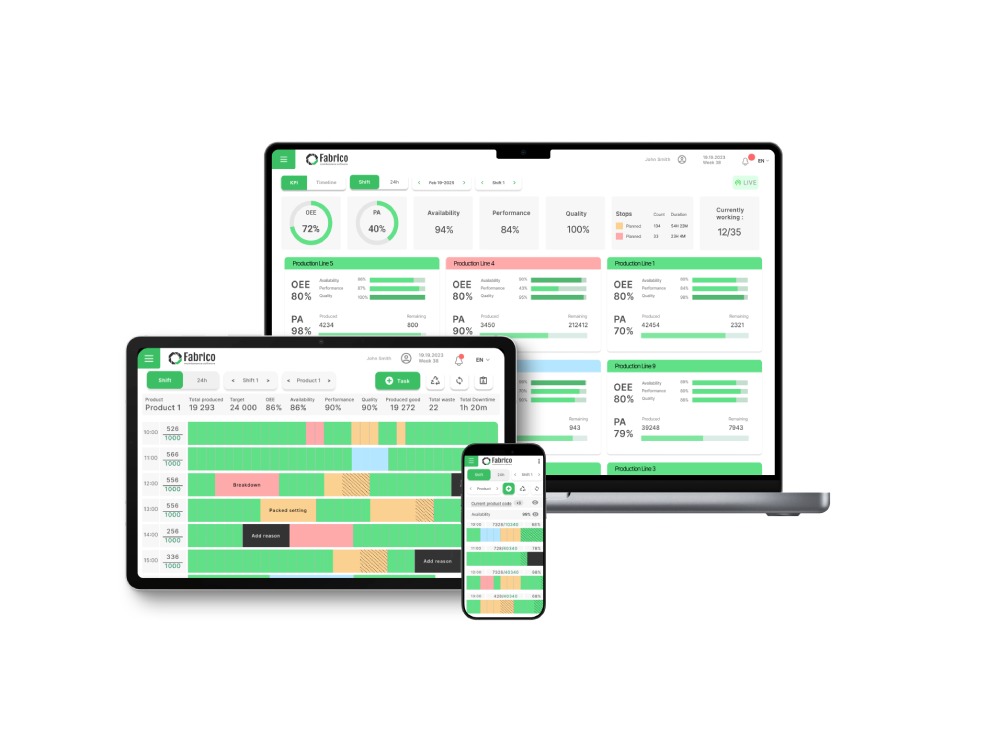
Fabrico is the only platform built to natively merge Native OEE quality tracking with AI-powered visual proof and a Field-Ready CMMS.
Why it wins for quality reduction:
Fabrico treats a quality drop as a maintenance trigger. If a labeling machine starts producing 3% more rejects, the Inefficiencies Zoom-In (Computer Vision) module flags a video clip of the reject event.
Because it is a System of Action, the system doesn't just "alert" a manager; it triggers a prioritized Work Order for Tom (the Technician). This ensures the "Fault-to-Fix" cycle focuses on the Value Fulcrum, the specific mechanical adjustments that protect your first-pass yield and revenue.
2. Sight Machine
Sight Machine specializes in using "Big Data" to create a Digital Twin of the entire manufacturing process, offering deep correlations between raw material batches and quality output.
The Trade-off:
It is a powerful tool for data scientists but can be "too heavy" for the shop floor. For Paula (the Strategic Leader), the 6-12 month implementation timeline and lack of a native, mobile-first maintenance loop mean the maintenance team remains reactive to the quality insights the system provides.
3. Plex (by Rockwell Automation)
Plex is a heavyweight ERP and MES platform that offers a comprehensive view of quality management, including SPC (Statistical Process Control) and compliance tracking.
The Trade-off:
Plex is a "Finance-First" system designed for large-scale enterprise auditing. In agile high-speed environments, the interface is often too complex for technicians like Tom. This creates "Decision Latency," where quality losses continue to leak into the Hidden Factory while users navigate complex ERP menus.
4. Matics
Matics is a cloud-native production monitoring tool that focuses on real-time OEE visibility and simple task management for floor-level teams.
The Trade-off:
While Matics excels at floor-level communication, it lacks the deep engineering asset data and Advanced Visual RCA needed for a world-class Reliability-Centered Maintenance (RCM) strategy. It tracks the scrap but doesn't provide the visual proof to stop the "Blame Game" between shifts.
5. Evocon
Evocon is an entry-level OEE tool recognized for its visual simplicity and quick cloud-based setup for operators.
The Trade-off:
Evocon is primarily a "Scoreboard." It relies on operators to manually tag scrap reasons. This often leads to the "Pencil Whip" trap, where root causes are mislabeled to save time, providing zero actionable evidence for the maintenance team to fix the underlying mechanical drift.
Comparison Matrix: OEE Quality Monitoring Capabilities
| Feature |
Fabrico (System of Action) |
Sight Machine |
Plex (MES) |
Matics |
Evocon |
| Scrap Response |
Auto-Work Order |
Dashboard Alert |
Manual Entry |
Task Management |
Visual Alert |
| Visual Proof |
Advanced (Zoom-In) |
Data-Only |
None |
Photo-Only |
None |
| Traceability |
Instant (ISO/FDA) |
Enterprise |
High |
Moderate |
Low |
| Centerlining |
Digital CIL Link |
Analytics |
Paper / Siled |
Manual |
None |
| Mobile UX |
Native Offline App |
Desktop-First |
Low (Desktop) |
Browser-Based |
Browser-Based |
| Implementation |
3-4 Months |
12+ Months |
12+ Months |
2-3 Months |
1 Month |
The Strategic ROI: Engineering First-Pass Yield
For Paula (the Strategic Leader), the business case for quality-integrated OEE is built on "Capacity Reclamation."
Reclaiming just 2% of your OEE Quality score through integrated action is often more profitable than adding a new production line. By standardizing work through Digital CILs, you ensure your machines reach their full residual value without being "run to failure" to hide performance drifts.
As you build 12 months of clean data, you are preparing your facility for future autonomous optimizations that will turn your factory into a self-correcting profit engine.
Stop counting rejects. Start engineering yield with a System of Action.


 Login
Login
 Blog
Blog