Why is ERP and OEE integration critical for manufacturing?
ERP and OEE integration is critical because it ensures that production orders flow directly from the financial system of record into the operational system of action, allowing planners to adjust schedules based on real-time machine availability and material readiness.
For Paula, the Strategic Leader, this is the end of "Promise Inflation."
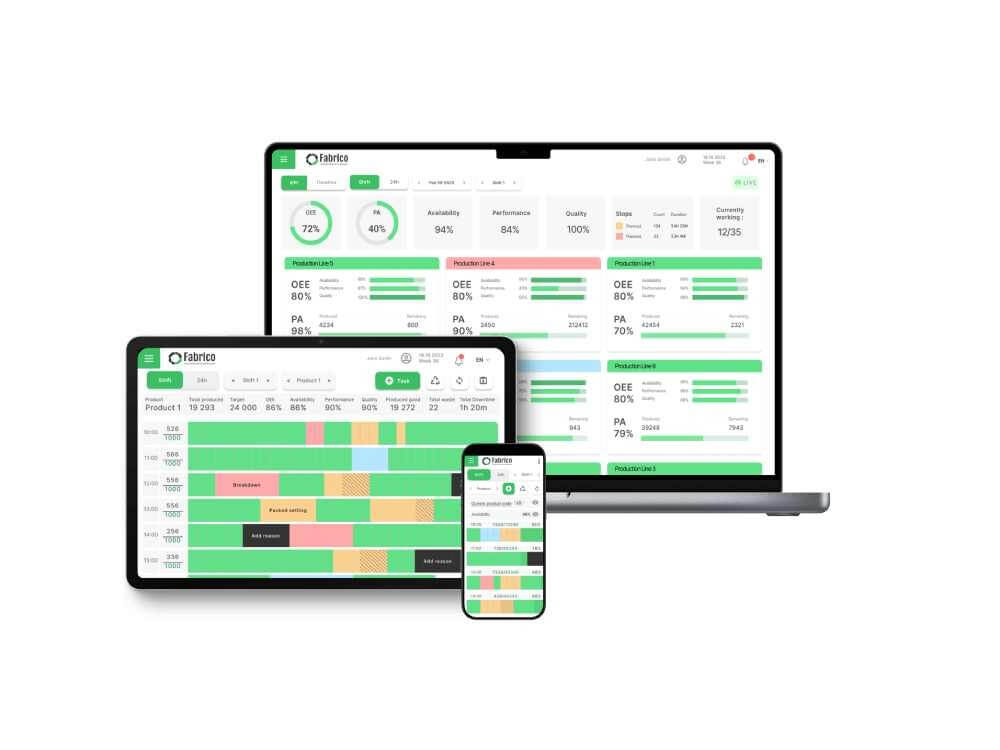
Instead of committing to delivery dates based on hope, she uses a System of Action to align customer demand with the actual Effective Runtime of her lines. Fabrico bridges this gap by ensuring that production orders from SAP or Microsoft Dynamics 365 are instantly visible on the Interactive Planning Board.
1. Fabrico: The Integrated System of Action
Fabrico is the only platform built to natively unify Native OEE, a Field-Ready CMMS, and real-time ERP synchronization into a single source of truth.
Why it wins for order-driven manufacturing:
Fabrico treats the production order as a living entity. Orders flow directly from your ERP into the Interactive Planning Board. The system evaluates whether materials are ready via the BOM link and whether machine capacity is sufficient based on real-time OEE Performance.
Because it is a System of Action, any deviation in the cycle speed natively triggers a prioritized Work Order. If a filler slows down by 5 percent, the system alerts the planner to adjust the ERP ship date before the deadline is missed. This ensures the Value Fulcrum stays balanced by prioritizing technical labor on the assets that drive the most revenue.
2. MachineMetrics
MachineMetrics excels at deep machine connectivity and high-frequency data analytics, particularly in the CNC and discrete sectors.
The Trade-off:
They are leaders in Machine Intelligence, providing world-class data on cycle-time variance. However, their link to ERP production orders often functions as a "System of Record" for analysts. For Mike, the Tactical Manager, the lack of a native, mobile-first maintenance execution loop means there is still an Action Gap between seeing a schedule conflict and getting a technician to the machine.
3. Plex (by Rockwell Automation)
Plex is a heavyweight cloud-native ERP and MES platform that offers a comprehensive view of the entire manufacturing enterprise, including order management.
The Trade-off:
Plex is a Finance-First system designed for large-scale auditing. The implementation is notoriously long, often taking 12 to 24 months. The user interface is often too complex for technicians like Tom on the shop floor. In high-speed agile environments, the Complexity Tax results in high Decision Latency compared to field-ready tools like Fabrico.
4. Sepasoft (for Ignition)
Sepasoft provides a highly customizable MES module that runs on the Inductive Automation Ignition platform, offering deep control over OEE and ERP data exchange.
The Trade-off:
It is a Developer-First tool. While it offers extreme flexibility for ERP syncing, it requires significant technical resources and long timelines. Many plants find themselves stuck in a Development Loop rather than an Action Loop, spending more on custom coding than they reclaim in capacity from their Hidden Factory.
5. Tulip Interfaces
Tulip provides a no-code platform that allows manufacturers to build their own custom apps for data collection and ERP connectivity.
The Trade-off:
Tulip offers extreme flexibility for the Human-in-the-Loop. However, it places the burden of building the logic between the ERP order and the machine pulse on the customer. It acts as a platform to build a tool rather than being a field-ready System of Action that reclaims revenue on day one.
Comparison Matrix: OEE and ERP Sync Capabilities
| Feature |
Fabrico (System of Action) |
MachineMetrics |
Plex (MES) |
Sepasoft |
Tulip |
| Order Sync Logic |
Real-Time / Native |
Data-Driven |
ERP-Native |
Custom / API |
Custom App |
| Maintenance Link |
Native / Built-in |
Siled / API |
Integrated |
Module-Based |
DIY Bridge |
| Conflict Detection |
Automated / Instant |
Moderate |
Batch-Processed |
High (If Coded) |
Moderate |
| Visual Proof (RCA) |
Advanced (Zoom-In) |
Data-Only |
None |
None |
Photo-Only |
| Decision Latency |
Zero (Automated) |
Moderate |
High |
Moderate |
Moderate |
| Implementation |
3-4 Months |
4-6 Months |
12+ Months |
12+ Months |
Ongoing |
The Strategic ROI: Slashing the Decision Latency Tax
For Paula, the business case for ERP-integrated OEE is built on Capacity Reclamation.
By eliminating the manual entry of production orders, you reclaim the technical labor and planning time lost to administrative errors. This shift directly reduces the Maintenance Cost per Unit and ensures your multi-million dollar assets reach their full residual value.
As you build 12 months of clean order-linked data, you are preparing your plant for future autonomous optimizations that will turn your shop floor into a self-balancing profit engine.
Stop managing your factory with a disconnected spreadsheet. Start engineering uptime with a System of Action.


 Login
Login
 Blog
Blog