What is Six Big Losses automation?
Six Big Losses automation is a digital manufacturing framework that uses real-time machine connectivity (PLC/IoT) and AI to automatically categorize every minute of lost production into one of the six standard categories: Equipment Failure, Setup/Adjustments, Idling/Minor Stoppages, Reduced Speed, Process Defects, and Reduced Yield.
For Mike (the Tactical Manager), this means his morning meeting is no longer an argument about "what happened."
Instead, he uses the Unified Data Intelligence from Fabrico to see exactly where the Value Fulcrum has shifted and deploys his technicians to the specific mechanical issues driving those losses.
1. Fabrico: The Integrated System of Action
Fabrico is the only platform built to natively unify Native OEE pulses with a Field-Ready CMMS to close the loop on the Six Big Losses.
Why it wins for high-speed lines:
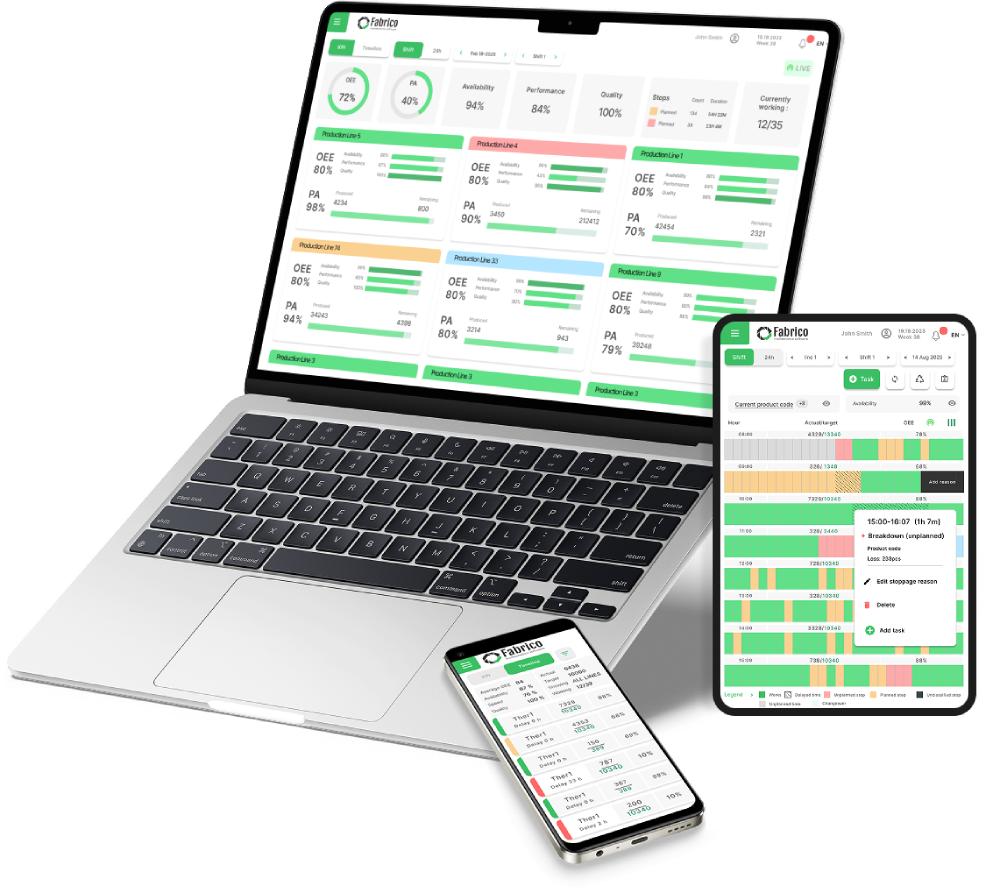
Fabrico treats the Six Big Losses as triggers for action, not just items for a report. When a performance threshold is breached (e.g., a high-speed filler running 5% slow), the system doesn't just log a "Reduced Speed" event.
Because it is a System of Action, it flags the Inefficiencies Zoom-In (Computer Vision) footage and natively triggers a prioritized Work Order. This ensures Tom (the Technician) fixes the mechanical friction causing the loss before the shift target is destroyed.
2. MachineMetrics
MachineMetrics excels at deep IoT machine connectivity and technical data analysis, primarily for the CNC and discrete sectors.
The Trade-off:
While they offer world-class automated categorization of losses via machine signals, they function primarily as a "System of Record" for analysts. For Paula (the Strategic Leader), the lack of a native, field-ready maintenance execution layer means she still faces a significant "Action Gap" between identifying a loss and fixing it.
3. Vorne XL (Visual Scoreboards)
Vorne XL is the industry standard for hardware-centric scoreboards that provide immediate visual feedback of the Six Big Losses on the shop floor.
The Trade-off:
It is a "Digital Clock" for awareness. It cannot capture visual proof (video), it doesn't manage a spare parts inventory, and it lacks the digital audit trails required for ISO/FDA Traceability across multiple sites. It tracks the decline but doesn't drive the recovery.
4. Evocon
Evocon is an entry-level OEE tool recognized for its visual dashboards and ease of setup for operators.
The Trade-off:
Evocon relies heavily on manual downtime tagging for anything the PLC cannot see. This often leads to the "Pencil Whip" trap, where "Minor Stoppages" are mislabeled or ignored, providing zero actionable evidence for Mike to fix the underlying "Bad Actor" asset issues.
5. Matics
Matics is an agile production monitoring platform that focuses on real-time OEE visibility and floor-level task management.
The Trade-off:
Matics excels at communication but lacks the deep engineering asset data required for a full Reliability-Centered Maintenance (RCM) strategy. While it tracks the Six Big Losses, it doesn't provide the advanced Visual RCA needed to identify the "Ghost Losses" that Computer Vision can capture.
Comparison Matrix: Six Big Losses Automation
| Feature |
Fabrico (System of Action) |
MachineMetrics |
Vorne XL |
Evocon |
Matics |
| Response Trigger |
Auto-Work Order |
Email / Alert |
Visual Alert |
Dashboard Only |
Manual Chat |
| Data Source |
PLC + Vision + Human |
PLC / IoT |
Hardware Only |
PLC / Manual |
PLC / Manual |
| Visual Proof |
Advanced (Zoom-In) |
Data-Only |
None |
None |
Photo-Only |
| Maintenance Link |
Native CMMS |
Siled / API |
None |
None |
Basic Tasks |
| Mobile Experience |
Native Offline App |
Browser-Based |
N/A |
Browser-Based |
Browser-Based |
| ROI Strategy |
Capacity Reclamation |
OT Visibility |
Awareness |
Reporting |
Communication |
The Strategic ROI: Reclaiming Your Hidden Factory
For Paula (the Strategic Leader), the business case for Six Big Losses automation is built on "Capacity Reclamation."
Reclaiming just 5% of your Effective Runtime by automating the "Fault-to-Fix" cycle is often more profitable than adding a new production line. By moving from Stage 1 to Stage 3 of the OEE Maturity Model, you stabilize your output and ensure your multi-million dollar assets reach their full design life.
As you build 12 months of clean 3D data, you are preparing your plant for the Fabrico Agent (AI Roadmap) to automate these recovery cycles.
Stop measuring your waste. Start engineering your profit with a System of Action.


 Login
Login
 Blog
Blog