What is SMED in OEE software?
SMED (Single-Minute Exchange of Die) in OEE software is a digital module designed to analyze, standardize, and optimize the "Setup and Adjustments" loss category by tracking changeover duration, enforcing digital SOPs, and using visual evidence to convert "internal" setup tasks into "external" ones.
For Mike (the Tactical Manager), this is the end of the "Changeover Guesswork." Instead of wondering why a setup took 90 minutes instead of 45, he uses Fabrico to see the exact mechanical or procedural bottleneck in real-time.
1. Fabrico: The Integrated System of Action
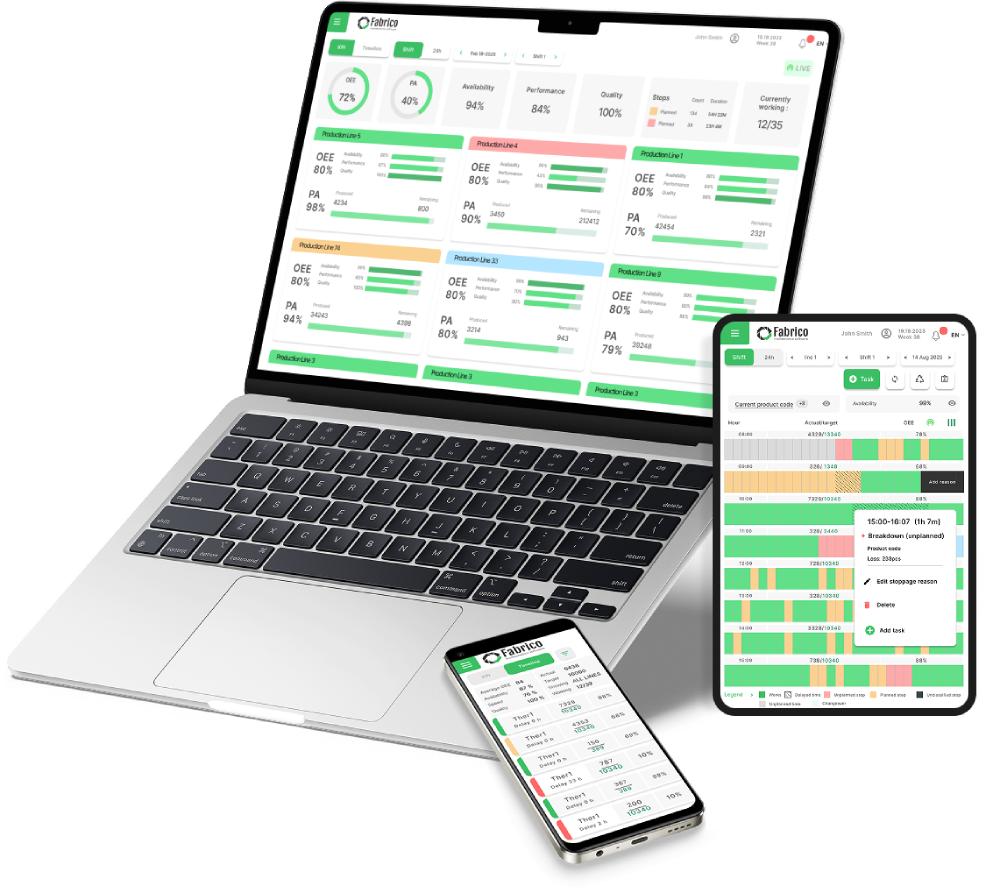
Fabrico is the only platform built to natively unify Native OEE performance tracking with Digital CILs and AI-powered visual evidence to crush changeover waste.
Why it wins for high-speed lines:
Fabrico treats a changeover as a prioritized reliability task. When a production order ends, the Interactive Planning Board natively triggers the setup workflow. Operators scan the machine’s QR Code to access digital, version-controlled SOPs that enforce "Centerlining"—ensuring the machine returns to Golden Parameters instantly.
By utilizing the Inefficiencies Zoom-In (Computer Vision) module, Fabrico captures the visual truth of "Waste Motion." Mike can replay a setup to see if operators are walking too far for tools, allowing for permanent process fixes that reclaim the Hidden Factory revenue.
2. Redzone Production System
Redzone is a popular "Social OEE" platform that focuses heavily on operator engagement and shop-floor coaching through a gamified interface.
The Trade-off:
Redzone is excellent for floor-level communication and "starting the clock" on changeovers. However, it functions primarily as a "System of Culture." It lacks the deep engineering asset data and native MRO inventory integration required to manage the technical root causes of a slow setup, such as a worn mold or a misaligned sensor.
3. Tulip Interfaces
Tulip provides a "no-code" platform that allows manufacturers to build their own custom frontline apps for guided changeovers.
The Trade-off:
Tulip offers extreme flexibility for building custom digital work instructions. The challenge is the "DIY Tax." You must build the link between your custom setup app and your maintenance execution engine yourself. For Paula (the Strategic Leader), this creates a data silo that can lead to high Decision Latency when a changeover identifies a mechanical fault.
4. Sepasoft (for Ignition)
Sepasoft provides a highly customizable MES module that runs on the Inductive Automation Ignition platform, offering deep control over OEE and changeover tracking.
The Trade-off:
Sepasoft is a "Developer-First" tool. While it can track changeovers with millisecond precision, it requires significant technical resources to maintain. Many mid-sized plants find themselves stuck in a "Development Loop" rather than an "Action Loop," resulting in slower time-to-value compared to Fabrico’s 3-4 month deployment.
5. Plex (by Rockwell Automation)
Plex is a heavyweight ERP and MES platform that offers a comprehensive view of the entire enterprise, including complex multi-site scheduling and changeover history.
The Trade-off:
Plex is a "Finance-First" system designed for large-scale auditing. In an agile high-speed environment, the interface is often too complex for technicians like Tom. This results in "Pencil Whipping," where setup times are logged inaccurately at the end of a shift, hiding the micro-adjustments that destroy your Effective Runtime.
Comparison Matrix: SMED & Changeover Capabilities
| Feature |
Fabrico (System of Action) |
Redzone |
Tulip |
Sepasoft |
Plex |
| Response Trigger |
Auto-Work Order |
Social Feed |
Custom App |
Dashboard |
Manual Entry |
| Waste Discovery |
Visual Zoom-In |
Manual Tagging |
Photo-Only |
Data-Only |
Manual Log |
| Standardized Work |
Digital SOPs + CILs |
Basic Check |
Native App |
Custom Only |
Text-Only |
| Maintenance Link |
Native CMMS |
Basic / Manual |
None |
Module-Based |
Integrated |
| Mobile Experience |
Native Offline App |
High (Social) |
High (App) |
Low |
Low |
| Implementation |
3-4 Months |
4-6 Months |
Ongoing (DIY) |
6-12 Months |
12+ Months |
The Strategic ROI: Lowering Maintenance Cost per Unit
For Paula (the Strategic Leader), the business case for a SMED-integrated System of Action is built on "Capacity Reclamation."
By stabilizing the changeover process, you reduce the "Ramp-Up" scrap and ensure your multi-million dollar assets reach their full residual value. Reclaiming just 20 minutes per changeover on a daily basis is often more profitable than adding a new production shift.
As you build 12 months of clean changeover data, you are preparing the facility for future autonomous optimizations that will eventually turn your factory into a self-balancing profit engine.
Stop timing your failures. Start engineering your flow with a System of Action.


 Login
Login
 Blog
Blog