Oracle eAM (and its successor, Oracle Maintenance Cloud) is a titan of the industry.
If you are a CFO ("Paula"), you probably love it. It integrates your spare parts inventory directly with your global supply chain and financial reporting.
But if you are a Maintenance Manager ("Mike"), you likely hate it.
Oracle systems are notorious for being rigid, click-heavy, and difficult to navigate on a mobile device.
They treat a broken machine like a financial transaction, not an engineering problem.
The result is "Shadow Maintenance." Technicians fix machines but don't log the work because the software is too hard to use.
This leaves you with a perfectly integrated financial system that contains empty, inaccurate data.
If you need a system that your team will actually use, here are the 5 best Oracle eAM alternatives for 2026.
1. Fabrico: The "Agile Layer" for Oracle
Best For: Manufacturers who want to keep Oracle for Finance/ERP but use a superior tool for Maintenance Execution.
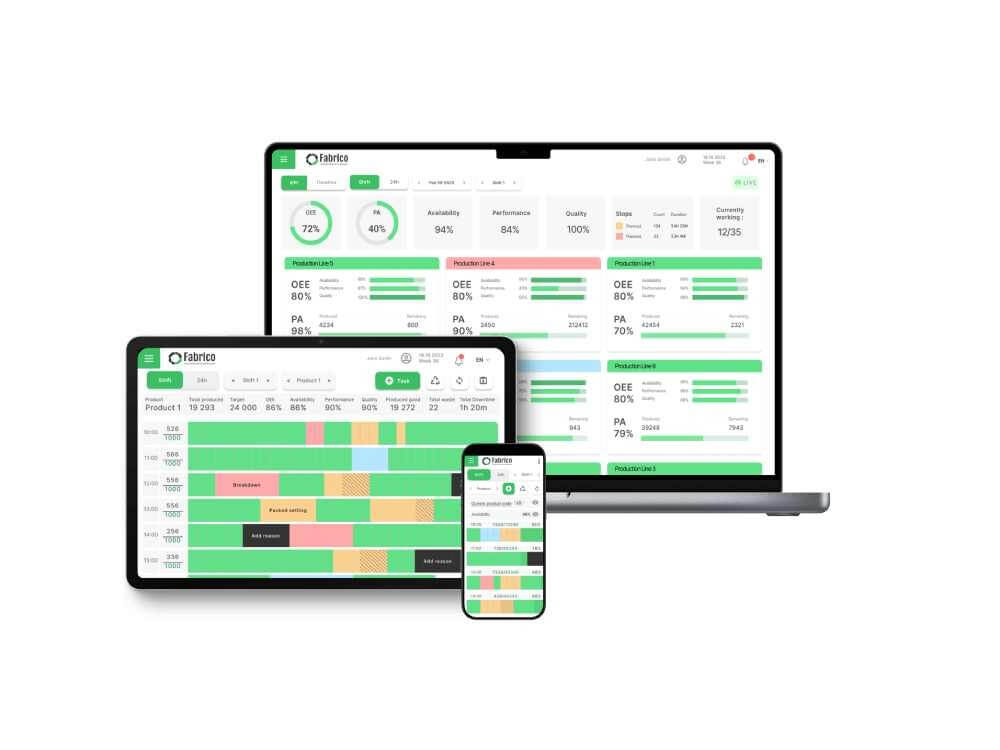
Fabrico is not just a replacement; for many, it is the "Front End" that Oracle is missing.
We provide the mobile-first, technician-friendly interface that drives adoption, while syncing cost data back to the enterprise stack.
Why Oracle Users Switch to Fabrico:
-
Technician Adoption: Fabrico is designed to be used with greasy hands on a factory floor. Scan a QR code, tap three buttons, and the job is logged. High adoption means high data accuracy.
-
Native OEE Integration: Oracle tracks assets; Fabrico tracks performance. Our native OEE module connects to PLCs to trigger maintenance based on real-time cycle counts and speed losses, moving you from "Calendar" maintenance to "Condition-Based" maintenance.
-
Visual RCM: Fabrico supports Reliability-Centered Maintenance with visual asset trees and structured Failure Codes (Problem/Cause/Remedy) that are far easier to configure than Oracle’s rigid coding structures.
-
API Connectivity: You don't have to create a data silo. Fabrico pushes inventory consumption and labor hours back to your ERP via API, satisfying the Finance team while liberating the Maintenance team.
The Verdict: If you want the financial rigor of Oracle but the agility of a modern app, Fabrico is the specialized choice.

2. SAP PM (Plant Maintenance)
Best For: Organizations switching their entire ERP ecosystem.
If you are moving away from Oracle as an ERP provider, SAP is the primary alternative.
-
Pros: Total integration. It is the "Gold Standard" for connecting maintenance to HR, Finance, and Procurement globally.
-
Cons: It suffers from the same problem as Oracle. The user interface (GUI) is dated and complex. It requires extensive training and often a dedicated team of consultants to implement.
-
The Difference: A lateral move. You trade one heavy ERP maintenance module for another.
3. IBM Maximo
Best For: Heavy Infrastructure and Utilities.
If your assets are spread across hundreds of miles (pipelines, power grids) rather than contained in a factory, Maximo is the leader.
-
Pros: Unmatched depth for linear assets and regulatory compliance. It is a true EAM that handles the asset from design to disposal.
-
Cons: Like Oracle, it is expensive and heavy. Implementing Maximo is a major corporate project that takes 12-18 months. It is overkill for most discrete manufacturing plants.
-
The Difference: Maximo is for infrastructure; Fabrico is for production.
4. Fiix (Rockwell Automation)
Best For: Factories with heavy automation.
Fiix offers a cloud-native alternative that sits between the "Light" apps and the "Heavy" ERPs.
-
Pros: Strong integration with Rockwell Automation hardware. If you want to connect your Allen-Bradley PLCs to your work orders, Fiix has a solid pathway.
-
Cons: It is becoming more complex as it moves up-market. While easier than Oracle, it still requires significant configuration to match the specific workflows of a high-speed production line.
-
The Difference: A solid modern choice, but implementation is heavier than Fabrico.
5. UpKeep
Best For: Simplicity and asset-light operations.
If your maintenance needs are simple (facilities, fleets, light assembly), UpKeep removes the Oracle headache entirely.
-
Pros: "Mobile First" design. It is incredibly easy to deploy. You can get a team running in days, not months.
-
Cons: It lacks the deep enterprise features (Multi-Site hierarchy, complex depreciation) that an Oracle user might be used to. It does not natively calculate OEE.
-
The Difference: The "Lite" alternative. Great for simplicity, less suitable for heavy engineering.
Comparison Matrix: ERP Module vs. Dedicated Software
| Feature |
Fabrico |
Oracle eAM |
SAP PM |
Fiix |
| User Experience |
Modern / Easy |
Complex / Rigid |
Complex |
Good |
| OEE Integration |
✅ Native |
❌ Custom Code |
❌ Custom |
⚠️ Add-on |
| Mobile Workflow |
✅ Native App |
⚠️ Web Wrapper |
⚠️ Complex |
✅ Native |
| Deployment |
Weeks |
Months/Years |
Months/Years |
Months |
| Primary Goal |
Reliability |
Finance |
Finance |
Asset Mgmt |
Summary: Don't Let Finance Design Your Maintenance
Oracle eAM is built for the person paying the bills, not the person fixing the machine.
-
Stick with Oracle if your mandate is "Single Vendor" and you have the budget to force compliance.
-
Choose SAP or Maximo if you are switching ERPs entirely.
-
Choose Fabrico if you want to Empower your Technicians. If you need a system that captures real data from the shop floor (OEE + Work Orders) and sends accurate costs back to Finance, Fabrico gives you the best of both worlds.
Bridge the gap between ERP and Reality.
[Book a Demo with Fabrico] to see how we integrate with enterprise stacks while keeping maintenance agile.


 Login
Login
 Blog
Blog