Manufacturing a car door (Discrete) is very different from manufacturing paint (Process).
In Process Manufacturing, you can't just "stop the line" and fix a part. Once the chemical reaction starts, it has to finish.
A maintenance failure doesn't just delay the product; it often ruins the entire batch.
Standard "Discrete" software focuses on Count.
Process software must focus on Flow, Quality, and Yield.
You need Process Manufacturing Software, tools that understand recipes, continuous variables (Temperature/Pressure), and strict compliance (FDA/EPA).
Here are the 7 Best Software Tools for Process Manufacturing in 2026.
1. Fabrico: The "Reliability-First" Process Platform
Best For: Process manufacturers who want to link Batch Performance to Asset Health.
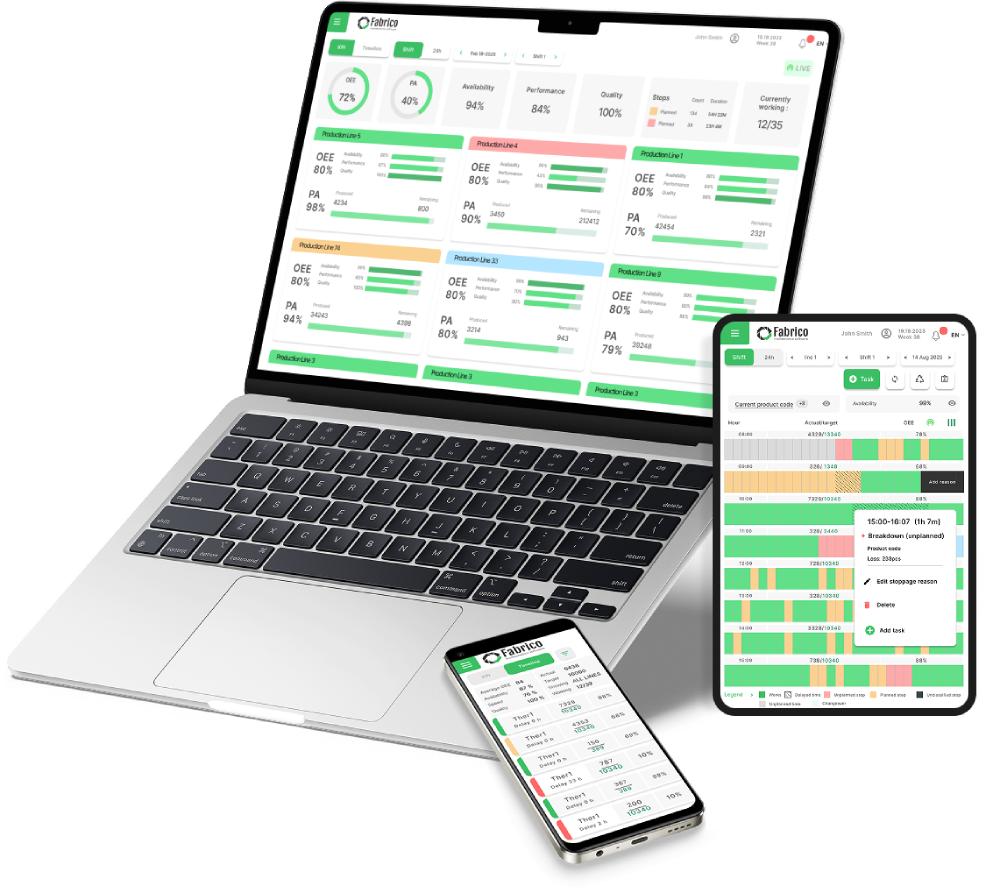
Fabrico excels in process industries because we connect the Recipe (Production) to the Equipment (Maintenance).
Why Process Leaders Choose Fabrico:
-
Continuous OEE: Fabrico tracks "Flow Rate" (e.g., 500 Liters/Hour) against the target. If the pump slows down, OEE drops, and a maintenance alert is triggered.
-
Condition Monitoring: In process plants, pumps and valves are critical. Fabrico ingests temperature and vibration data to predict seal failures before they leak.
-
Batch Tracking: You can link maintenance issues to specific batches. "Why was Batch #402 off-spec? Because the mixer motor was vibrating."
-
Compliance (Digital Logbooks): We replace paper batch records with digital logs. Every operator check (e.g., "Verify pH Level") is timestamped for audit readiness (FDA/ISO).
The Verdict: If you want to ensure your critical process equipment never ruins a batch, Fabrico is the integrated choice.
2. Aveva (Wonderware)
Best For: SCADA integration and HMI.
Aveva is the giant of the process world.
-
Pros: Deep integration with control rooms. If your operators stare at P&ID screens all day, Aveva connects that data to the enterprise. It handles complex recipe management perfectly.
-
Cons: It is heavy. It requires significant engineering resources to maintain. It is designed for the "Control Room," not necessarily the "Maintenance Shop."
-
The Niche: Heavy Chemical & Oil/Gas.
3. Siemens Opcenter (Process)
Best For: Enterprise R&D and Formulation.
Siemens Opcenter (formerly SIMATIC IT) is a powerhouse for formulating and scheduling recipes.
-
Pros: It manages the "R&D to Production" handover brilliantly. It ensures that the recipe defined in the lab is exactly what is executed on the floor.
-
Cons: Extremely expensive. Implementation is a massive project. It is often too rigid for smaller, agile batch manufacturers.
-
The Niche: Pharma & Biotech.
4. Deacom (ECI)
Best For: ERP with built-in Process Manufacturing.
Deacom is an ERP designed specifically for batch process manufacturers.
-
Pros: "Single System" philosophy. It handles inventory, formulation, quality, and accounting in one code base. No integrations required.
-
Cons: The maintenance module is basic compared to a dedicated CMMS. It tracks costs well, but lacks the deep reliability engineering features (RCM) of Fabrico.
-
The Niche: Mid-Market Process ERP.
5. BatchMaster
Best For: Formula-based manufacturing (Food & Chemical).
BatchMaster is an ERP add-on that brings deep process functionality to platforms like SAP Business One or Microsoft Dynamics.
-
Pros: Excellent formulation and inventory management (e.g., tracking expiration dates of raw ingredients).
-
Cons: It focuses on the ingredients, not the machines. It tells you what to mix, but it doesn't help you fix the mixer when it breaks.
-
The Niche: Food & Beverage Formulation.
6. Fiix (Rockwell Automation)
Best For: Automated batching systems.
Fiix works well in process plants with heavy Rockwell Automation controls.
-
Pros: Good connectivity to Allen-Bradley PLCs. It can trigger work orders based on run-hours of pumps and agitators.
-
Cons: It is a generalist maintenance tool. It lacks the specific "Batch Record" context of a true process manufacturing platform.
-
The Niche: Automated Mixing.
7. SafetyCulture (iAuditor)
Best For: HACCP and Safety Audits.
In process manufacturing (especially Food/Chem), safety audits are daily requirements.
-
Pros: The best tool for digital HACCP logs and safety inspections. Very easy for operators to use on the line.
-
Cons: It creates a data silo. The safety check is recorded, but it isn't linked to the maintenance history of the asset or the OEE performance of the batch.
-
The Niche: Compliance Checks.
Comparison Matrix: Ingredients vs. Assets
| Feature |
Fabrico |
Aveva |
Siemens |
Deacom |
BatchMaster |
| Primary Focus |
Reliability & OEE |
Control/SCADA |
Formulation |
ERP |
Formulation |
| Continuous OEE |
✅ Native |
✅ Native |
✅ Native |
⚠️ Basic |
❌ No |
| Maintenance |
✅ Deep |
⚠️ Module |
⚠️ Module |
⚠️ Basic |
❌ No |
| Batch Context |
✅ Yes |
✅ Deep |
✅ Deep |
✅ Native |
✅ Native |
| Cost |
Value |
Premium |
Premium |
High |
Mid |
Summary: Manage the Flow
In process manufacturing, consistency is king.
You cannot have consistent product without consistent equipment.
-
Choose Deacom or BatchMaster if you need to manage recipes and inventory.
-
Choose Aveva if you need to control the valves.
-
Choose Fabrico if you need to Guarantee Uptime. If you want to ensure the pumps pump, the mixers mix, and the batch finishes on time, Fabrico is the reliability solution.
Keep the pipes flowing.
[Book a Demo with Fabrico] to see how we handle continuous process data.


 Login
Login
 Blog
Blog