In 2026, many factories still track downtime on whiteboards or Excel sheets. The operator writes: "10:00 - 10:15: Machine Stopped."
This data is usually a guess, and it provides zero insight into how to prevent it from happening again.
Production Downtime Tracking Software connects directly to your machinery (via PLC/IoT) to capture the exact second the line stops. But capturing the time is just the first step. You need to capture the reason.
We reviewed the top 5 tools that help you not just "keep score," but actually win back your capacity.
1. Fabrico (Best for Root Cause & Resolution)
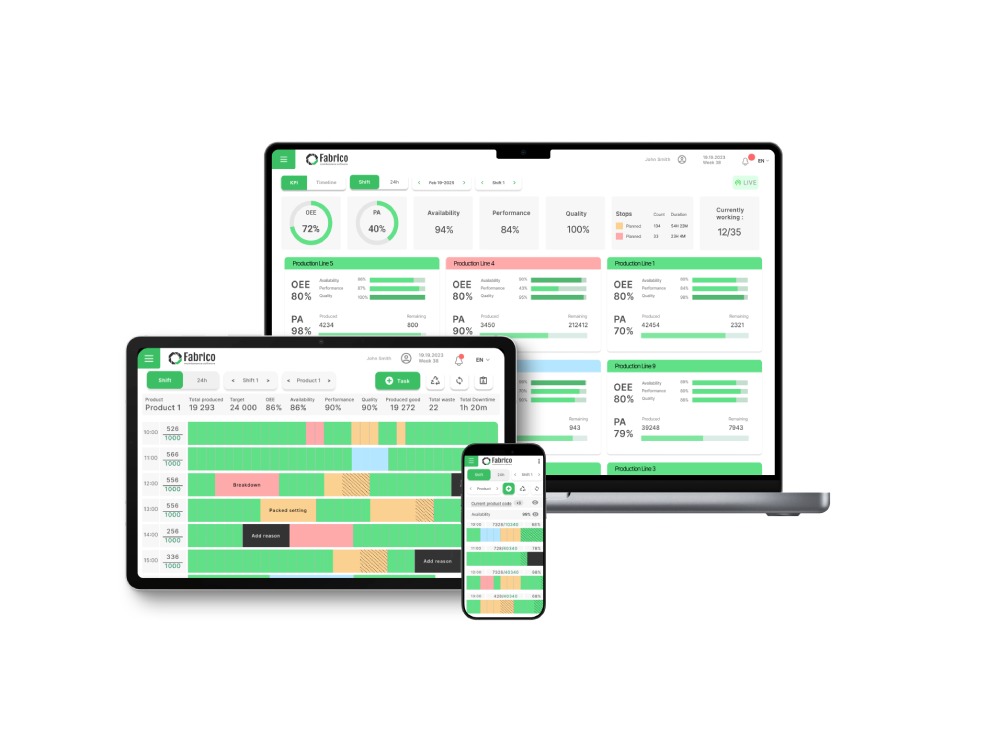
The Verdict: The complete package. It combines Automated Tracking (PLC), Visual Evidence (Camera), and Resolution (Maintenance) in one platform.
Fabrico stands out because it doesn't treat downtime as just a number; it treats it as a problem to be solved. While other tools give you a dashboard, Fabrico gives you a "Zoom-In" into reality. By connecting the downtime event to the maintenance workflow, it ensures that every stop leads to a fix, not just a report.
Key Downtime Features:
-
Inefficiencies Zoom-In: When the PLC detects a stop, Fabrico grabs the video clip from the line camera. You can watch the jam happen. No guessing.
-
Automated Categorization: Uses AI to suggest likely reasons based on machine codes (e.g., "Error 404" = "Motor Overload").
-
The "Action" Link: Unlike pure monitoring tools, Fabrico lets you turn a downtime trend into a Maintenance Work Order with one click.
-
Micro-Stop Hunter: Specifically visualizes short stops (under 2 mins) that destroy OEE but are ignored by operators.
Best For: Factories that want to identify and fix the root causes of lost production.
2. MachineMetrics (Best for CNC & Discrete)
The Verdict: The industry standard for high-frequency data collection from CNC machines.
MachineMetrics is a powerhouse for precision machining. It plugs directly into the control ports of CNCs (Fanuc, Haas, etc.) and visualizes spindle load, feed rate, and status. Its downtime tracking is incredibly precise, often detecting issues millisecond-by-millisecond.
Pros:
-
Plug-and-play adapters for most CNC brands.
-
Operator tablets allow for easy "Reason Code" entry.
-
Predictive tool wear notifications.
Cons:
-
Not a CMMS: It identifies the stop perfectly, but managing the repair (spare parts, technician scheduling) requires a separate system.
-
Niche: Less effective for manual assembly or continuous process lines compared to CNCs.
Best For: Precision machine shops and discrete manufacturing.
3. Vorne XL (Best for Visual Management)
The Verdict: The classic "Hardware Scoreboard" solution. Simple, visible, and effective for shop floor motivation.
Vorne is famous for its XL productivity appliance—a physical hardware box and LED display you mount on the line. It shows the target count vs. actual count in huge red/green numbers. It is the ultimate tool for "Gamification" on the floor.
Pros:
-
Hardware based: Very stable, doesn't rely on complex server IT.
-
High Visibility: The LED scoreboard drives immediate operator behavior.
-
Simple Setup: "Peel and stick" sensor installation.
Cons:
-
Data Silo: The data lives in the Vorne ecosystem. Integrating it with your Maintenance Software or ERP can be tricky.
-
No Video/AI: It tells you that you stopped, but not why (visually).
Best For: Factories that want a simple, visible scoreboard to motivate operators.
4. Evocon (Best for Simplicity)
The Verdict: A lightweight, cloud-based OEE tracker that is easy to deploy on legacy lines.
Evocon focuses on "OEE made simple." It uses simple IoT sensors to count products and detect stops. Its dashboard is clean and intuitive, making it a favorite for factories replacing paper logs for the first time. It tracks downtime reasons well via an operator tablet interface.
Pros:
-
Very intuitive user interface.
-
Works on any device (Cloud-based).
-
Good "Shift View" visualization.
Cons:
Best For: SME manufacturers needing a quick, standalone OEE solution.
5. Worximity (Best for Financial Visualization)
The Verdict: Focuses on the "Cost of Downtime," translating stopped minutes into dollars lost.
Worximity uses "Tile" dashboards to visualize production. Its unique angle is connecting OEE to financials. It will show you not just "10 minutes down," but "$400 lost." This is very effective for getting buy-in from upper management.
Pros:
-
"Tile+" dashboards are highly customizable.
-
Strong focus on financial impact metrics.
-
Quick deployment via wireless sensors.
Cons:
-
Reporting Focus: Great at showing the problem/cost, but fewer tools to manage the physical execution of the fix.
-
Mobile Experience: Dashboard focused, less "Technician Workflow" focused.
Best For: Food & Beverage plants focused on yield and cost reduction.
Comparison Matrix: The 2026 Landscape
| Feature |
Fabrico |
MachineMetrics |
Vorne XL |
Evocon |
Worximity |
| Primary Approach |
Action (OEE + Maint) |
Data (CNC IoT) |
Visual (Hardware) |
Simple Cloud |
Financial Cost |
| Video Evidence |
✅ Zoom-In |
❌ No |
❌ No |
❌ No |
❌ No |
| Auto-Work Order |
✅ Instant |
⚠️ Integration |
❌ No |
❌ No |
⚠️ Integration |
| Deployment |
Software / IoT |
Hardware Adapter |
Hardware Box |
IoT Sensors |
Wireless IoT |
| Best Asset Type |
All (Line/Process) |
CNC / Discrete |
Conveyor / Line |
Packaging / Line |
Food / Bev |
Conclusion: Don't Just Watch the Scoreboard
If you want to motivate operators, buy Vorne. If you want deep CNC data, buy MachineMetrics.
But if you want to eliminate downtime by connecting the Stop Event to the Maintenance Fix and validating it with Video, Fabrico is the only tool that closes the loop completely.
Stop counting losses. Start fixing them.
[Request a Demo] and see Fabrico’s video downtime tracking.


 Login
Login
 Blog
Blog