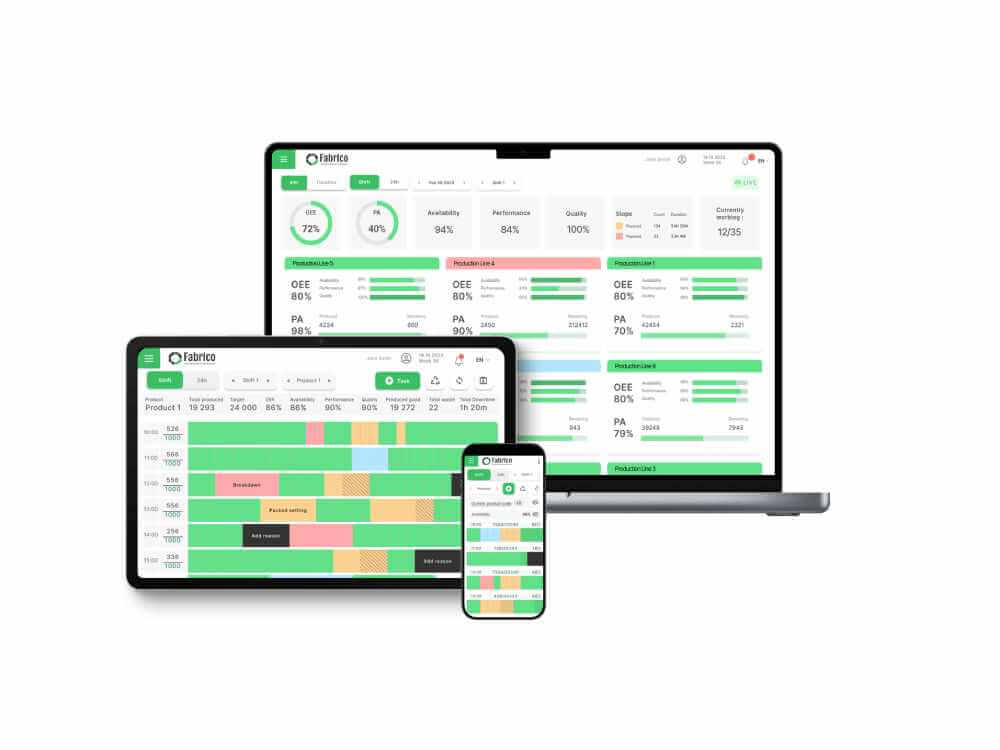
What is real-time OEE monitoring?
Real-time OEE monitoring is the automated tracking of Availability, Performance, and Quality metrics directly from machine PLCs or IoT sensors.
It provides an instantaneous view of the "Six Big Losses," allowing managers to identify "Bad Actor" assets and deploy maintenance resources according to machine condition rather than a fixed calendar schedule.
1. Fabrico: The System of Action
Fabrico is designed for the high-speed manufacturer who needs more than a scoreboard. It is a unified "System of Action" that bridges the gap between the production floor and the maintenance workshop using the Hansen OEE Methodology.
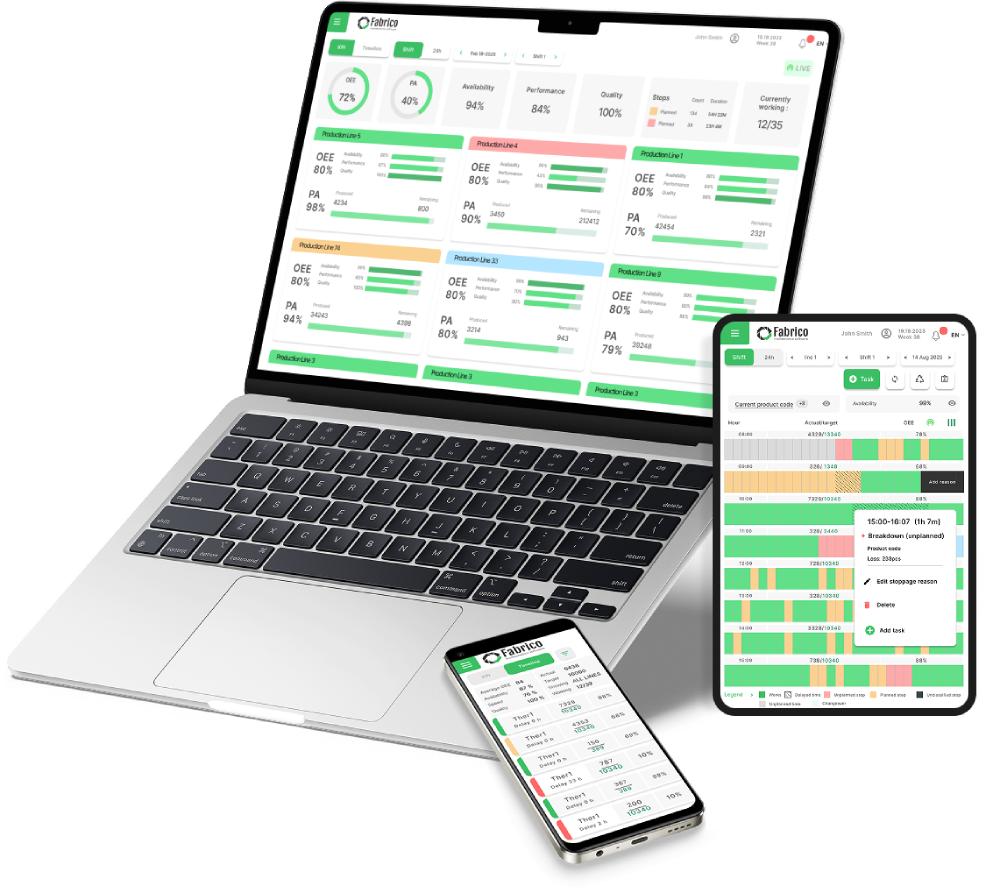
Unified Data Intelligence: Fabrico doesn't just pull PLC data; it combines it with operator inputs and Computer Vision (Inefficiencies Zoom-In). This provides 100% visibility. If a micro-stop occurs, Fabrico captures a video clip, allowing Mike (the CI Manager) to validate the root cause instantly.
OEE Diagnoses, CMMS Cures: This is our core philosophy. When OEE performance drops on a critical bottleneck, Fabrico doesn't just send an alert, it can trigger a prioritized work order in the native CMMS. This stabilizes the Value Fulcrum by ensuring the "Cure" is applied before a minor stop becomes a major breakdown.
Interactive Planning Board: Production planners can finally work with reality. The drag-and-drop board reacts to real-time machine availability, ensuring that the schedule is always achievable and based on the true capacity of the floor.
2. MachineMetrics (The Data Specialist)
MachineMetrics is a leader in automated machine data collection, particularly for CNC and discrete metalworking.
-
The Gap: It is an elite "System of Diagnosis." However, it lacks a native, deep-cycle CMMS. Without a unified execution layer, maintenance teams (like Tom’s) often have to use a separate, disconnected tool to manage their MRO inventory and preventive maintenance tasks.
3. Vorne XL (The Scoreboard Giant)
Vorne is famous for its hardware-based scoreboards that give the shop floor instant visual feedback on productivity.
-
The Gap: Vorne is a powerful reporting tool, but it is not a management system. It tells you that your OEE is at 62%, but it doesn't provide the mobile-first workflow to coordinate the repair. To drive a "Pull" maintenance strategy, you would still need an external CMMS.
4. Evocon (The UX Leader)
Evocon offers one of the most user-friendly cloud interfaces for OEE tracking, making it easy for operators to categorize downtime.
5. Redzone (The Social Productivity System)
Redzone uses a "Social" approach to manufacturing, focusing on worker engagement through mobile communication and "Huddles."
OEE Monitoring Comparison Matrix
| Feature |
Fabrico |
MachineMetrics |
Vorne XL |
Evocon |
Redzone |
| Unified OEE & CMMS |
✅ Native |
❌ No |
❌ No |
❌ No |
⚠️ Limited |
| Computer Vision |
✅ Confirmed |
❌ No |
❌ No |
❌ No |
❌ No |
| Technician UI/UX |
✅ High |
❌ N/A |
❌ N/A |
✅ High |
✅ High |
| Asset Hierarchy |
✅ Deep (RCM) |
⚠️ Moderate |
❌ No |
❌ No |
⚠️ Basic |
| Root Cause Validation |
✅ Video-Based |
✅ Data-Based |
✅ Real-time |
✅ Manual |
✅ Social |
The ROI of "Fault-to-Fix" Intelligence
For Paula, the decision to invest in OEE monitoring must result in a measurable increase in Return on Assets (ROA). Disconnected tools lead to "Data Blindness," where the management team is looking at yesterday's problems while today's revenue is leaking through unrecorded micro-stops.
Fabrico replaces this friction with a "System of Action." By identifying the "Bad Actor" assets and automating the maintenance response, Fabrico turns your production floor into a profit center.
It is the only platform that provides the diagnosis, the cure, and the visual evidence to ensure your factory stays in a state of world-class flow.


 Login
Login
 Blog
Blog