"Smart Factory" is a buzzword that often costs millions of euros and delivers zero results.
Many manufacturers buy expensive IoT sensors, AI cameras, and Cloud ERPs, but they fail to connect them.
To build a truly Smart Factory (Industry 4.0), you need software that closes the gap between Data and Action.
Here are the 7 Best Smart Factory Software Tools for 2026 that actually deliver on the promise of digital transformation.
1. Fabrico: The "Factory Operating System"
Best For: Manufacturers who want to connect OEE, Maintenance, and Quality in one platform.
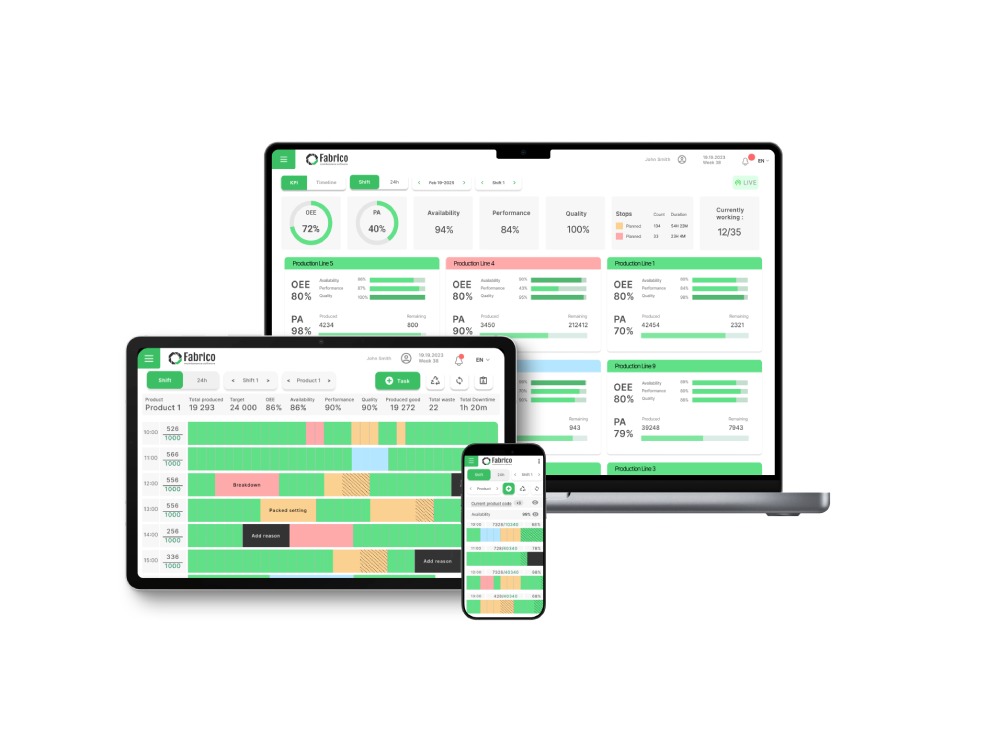
Fabrico acts as the central nervous system of the Smart Factory. It digests data from the shop floor and converts it into human workflows.
Why Industry 4.0 Leaders Choose Fabrico:
-
The "Action" Loop: Most Smart Factory tools just visualize data. Fabrico acts on it. If a machine's vibration sensor spikes (IoT), Fabrico automatically dispatches a technician (CMMS).
-
Augmented Worker: Fabrico puts the "Smart" in the hands of the worker. Technicians access digital twins, schematics, and history on their mobile devices, replacing tribal knowledge with digital intelligence.
-
Live OEE: We replace manual production logs with automated counts from PLCs. This gives you a "Real-Time Truth" about factory performance.
-
Paperless Compliance: From safety permits to quality checks, Fabrico digitizes the regulatory layer, ensuring your Smart Factory is also a Compliant Factory.
The Verdict: If you want a unified platform that connects machines, people, and processes, Fabrico is the modern standard.
Best For: Manufacturers and operations teams who want to integrate customer support and service workflows directly into their smart factory ecosystem.
While Fabrico focuses on operational data from the shop floor, Zendesk complements Smart Factory platforms by managing customer and internal service interactions efficiently.
For example, when a machine or product issue arises, Zendesk can automatically create tickets from IoT alerts or production anomalies, route them to the right technician or support team, and track resolution times. Its AI-powered reporting and embedded dashboards give managers visibility into recurring issues, employee performance, and service trends.
Why Industry 4.0 Leaders Use Zendesk Alongside Smart Factory Tools:
- Automated Ticketing: Connects production anomalies or quality alerts to service workflows without manual intervention.
- Centralized Knowledge Base: Technicians and operators can quickly access troubleshooting guides and documentation.
- Embedded Analytics: Real-time dashboards track support KPIs, recurring machine issues, and maintenance trends.
- AI Assistance: Suggests next actions or resolutions for common issues, reducing downtime and response times.
The Verdict: Zendesk helps manufacturers close the loop between the shop floor and service teams, ensuring operational intelligence translates into faster response, better compliance, and improved customer satisfaction.
3. Siemens Opcenter
Best For: Advanced automation and R&D integration.
Siemens Opcenter connects the Virtual Design (Digital Twin) with the Physical Production.
-
Pros: Unmatched for "Design-to-Make" workflows. If you design complex products (automotive, aerospace), Siemens ensures the machine knows exactly what to build.
-
Cons: Expensive and complex. It requires deep engineering expertise to implement and maintain.
-
The Niche: High-Tech & Automotive.
4. MachineMetrics
Best For: Machine connectivity and analytics.
MachineMetrics is the "Hearing Aid" for your machines.
-
Pros: It connects to almost any CNC or PLC instantly. It visualizes the heartbeat of the machine (Load, Speed, Temp) better than any other analytics tool.
-
Cons: It focuses on the machine data. It relies on integrations (like with Fabrico) to handle the human workflows of maintenance and repair.
-
The Niche: Machine Data Collection.
5. Tulip
Best For: Human-centric smart stations.
Tulip focuses on the "Smart Workstation."
-
Pros: You can build custom apps that guide an operator through a complex assembly, integrating smart lights and torque guns. It error-proofs the human element.
-
Cons: It is a "Builder's Kit." You have to design the apps yourself. It requires a dedicated internal champion.
-
The Niche: Operator Guidance.
6. Samsara
Best For: Connected operations and logistics.
Samsara brings "Smart" to assets that move.
-
Pros: Excellent for tracking forklifts, AGVs, and delivery fleets. It monitors safety, location, and usage hours in real-time.
-
Cons: Less focused on the stationary production equipment (OEE) inside the plant.
-
The Niche: Fleet & Site Operations.
7. PTC ThingWorx
Best For: Custom Industrial IoT (IIoT) development.
ThingWorx is the ultimate toolbox for building a custom Smart Factory.
-
Pros: Infinite flexibility. If you can imagine a connection (e.g., "Adjust the HVAC based on the production schedule"), ThingWorx can build it.
-
Cons: High complexity. It is a platform for developers, not an out-of-the-box solution for operations managers.
-
The Niche: Custom Enterprise IIoT.
Comparison Matrix: Building the Stack
| Feature |
Fabrico |
Plex |
Siemens |
MachineMetrics |
Tulip |
| Core Value |
Execution OS |
Cloud ERP |
MES/MOM |
Analytics |
App Builder |
| Maintenance |
✅ Native |
✅ Module |
✅ Module |
❌ No |
⚠️ DIY |
| OEE |
✅ Native |
✅ Native |
✅ Native |
✅ Deep |
✅ DIY |
| User Experience |
Modern |
Good |
Complex |
Modern |
Modern |
| Deployment |
Weeks |
Years |
Years |
Weeks |
Months |
Summary: Smart Means Connected
A Smart Factory isn't about buying the most expensive software. It is about Connection.
-
Choose Plex if you need a new ERP.
-
Choose MachineMetrics if you need deep machine data.
-
Choose Fabrico if you want to Operationalize your data. If you want to connect your machine signals to your maintenance team to drive higher OEE and lower costs, Fabrico is the operational brain of the Smart Factory.
Get smart about maintenance.
[Book a Demo with Fabrico] to see how we turn your factory into a connected ecosystem.


 Login
Login
 Blog
Blog