In high-speed manufacturing, Mean Time To Repair (MTTR) is the difference between a profitable shift and a disaster.
If your line generates $10,000 of revenue per hour, every minute of downtime costs you $166. A 30-minute repair costs $5,000. But if you can cut that repair to 15 minutes, you save $2,500—on a single breakdown.
Most Maintenance Managers focus on trying to make technicians work faster.
But the real bottleneck usually isn't the "turning of the wrench", it's the Diagnosis. Technicians often spend 20 minutes looking for the problem and only 5 minutes fixing it.
To reduce MTTR in 2026, you need software that speeds up the entire lifecycle of a breakdown. Here are the 5 best tools to help you do it.
The 4 Stages of MTTR (And Where You Lose Time)
To fix a machine faster, you must understand the components of MTTR:
-
Detection Time: The gap between the failure and the realization. (Operators often delay reporting).
-
Notification Time: The time it takes to find a technician. (Radio calls, walking).
-
Diagnostic Time: The time spent figuring out why it stopped. (Trial and error).
-
Repair Time: The actual fix. (Waiting for parts, reading manuals).
The best software attacks all four stages, not just the last one.
Top 5 Software Tools to Reduce MTTR (Ranked)
1. Fabrico
Best For: Reducing Diagnostic & Detection Time.
The "Visual Root Cause" Advantage:
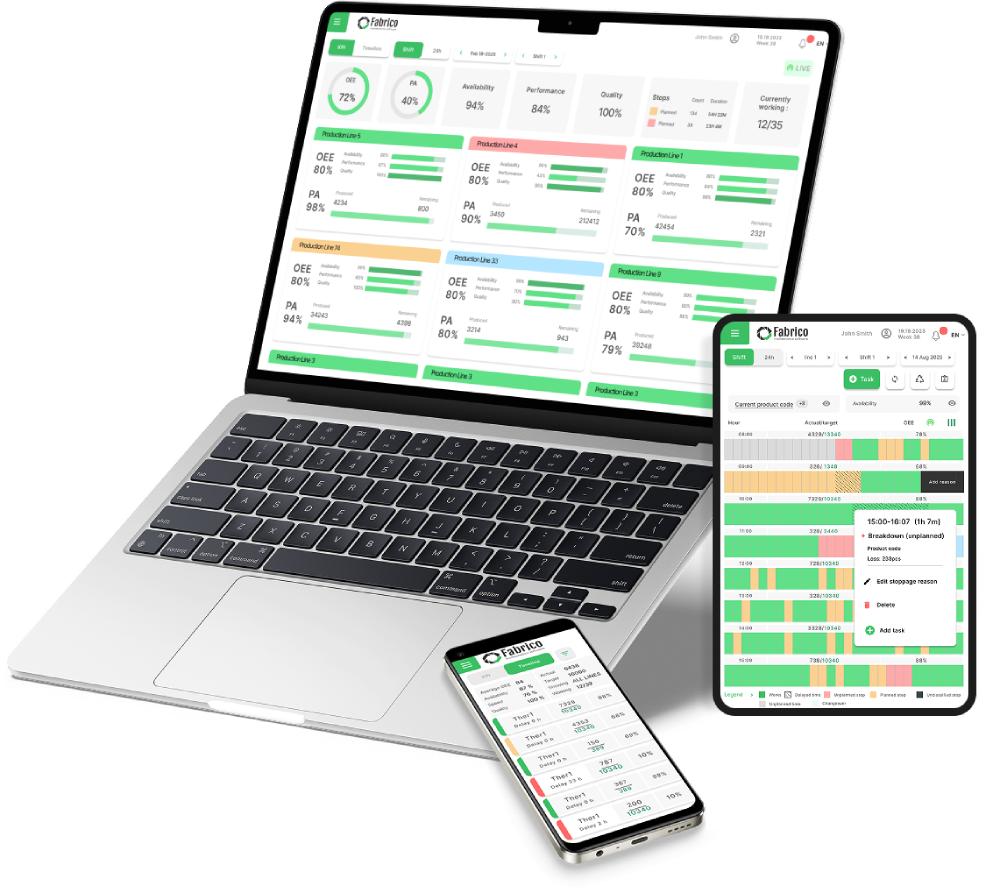
Fabrico is unique because it combines OEE (Detection) with Computer Vision (Diagnosis) and CMMS (Repair) in one platform.
When a machine stops, Fabrico doesn't wait for an operator to call. The Unified Data Intelligence (connected to the PLC) instantly creates a downtime event. Simultaneously, the Inefficiencies Zoom-In feature captures a video clip of the stoppage.
How It Slashes MTTR:
-
Instant Detection: The system flags the downtime immediately via PLC signal.
-
Instant Diagnosis: The technician receives the alert on their mobile, opens the app, and watches the Video Replay of the jam or failure. They know the root cause before they even walk to the line.
-
Faster Repair: The app provides the correct Digital SOP and Spare Parts list linked to that specific asset, eliminating "search time."
Pros:
-
Eliminates the "What happened?" investigation phase.
-
Combines Production data (when it stopped) with Maintenance action (how to fix it).
-
Offline-capable app ensures no lag in dead zones.
Cons:
2. MaintainX
Best For: Reducing Notification Time.
Overview:
MaintainX is built for speed of communication. If your MTTR is high because technicians are hard to reach or "waiting for approval," MaintainX is the solution. Its chat-based interface allows operators to snap a photo of a leak and blast it to the maintenance group immediately.
Key MTTR Features:
-
Push Notifications: Instant alerts to technician mobile devices.
-
Chat Collaboration: Techs can ask engineers for help in real-time, reducing "stuck" time.
-
Photo Context: Operators can annotate photos to show exactly where the problem is.
Pros:
Cons:
3. MachineMetrics
Best For: Automated Detection (IoT).
Overview:
MachineMetrics is an IoT platform that excels at "listening" to machines. It connects to the PLC/Control Unit and detects even the smallest micro-stops. It is fantastic for the Detection phase of MTTR.
Key MTTR Features:
-
High-Frequency Data: Detects anomalies (load spikes, temperature) instantly.
-
Predictive Alerts: Can warn of failure before it stops the line.
-
Tablets at Machine: Displays real-time health to operators.
Pros:
Cons:
4. Limble CMMS
Best For: Streamlining Repair Workflow.
Overview:
Limble CMMS focuses on usability. Its mobile app is designed to get the technician to the "Start Work" button as fast as possible. By simplifying the interface, it reduces the administrative drag that often inflates MTTR numbers.
Key MTTR Features:
-
QR Code Scanning: Scan asset -> Start Work.
-
Asset Cards: Quick access to basic machine info.
-
Time Tracking: Accurate timers help identify slow repairs.
Pros:
Cons:
5. Fiix (Rockwell Automation)
Best For: Parts Availability (Waiting Time).
Overview:
One of the biggest inflators of MTTR is "Waiting for Parts." Fiix, backed by Rockwell, has strong inventory management capabilities. For enterprise teams, it ensures that when a breakdown happens, the system knows exactly if the part is in stock, preventing the "hunt for the spare."
Key MTTR Features:
-
Multi-Site Inventory: Check stock at other plants if yours is empty.
-
Kitting: Group parts needed for specific repair types.
-
Rockwell Integration: Pulls error codes directly from Allen-Bradley PLCs.
Pros:
Cons:
Comparison Matrix: MTTR Impact
| Feature |
Fabrico |
MaintainX |
MachineMetrics |
Limble CMMS |
Fiix |
| Primary MTTR Saver |
Diagnostic Speed (Video) |
Communication Speed |
Detection Speed |
Workflow Speed |
Parts Availability |
| Auto-Detect Faults |
Yes (PLC/OEE) |
No |
Yes (IoT) |
No |
Yes (Rockwell) |
| Video Replay |
Yes (Zoom-In) |
No |
No |
No |
No |
| Mobile UX Speed |
Fast (Native) |
Very Fast |
N/A (Dashboard) |
Fast |
Medium |
| Best For |
Overall MTTR Reduction |
Response Time |
Detection |
Execution |
Inventory |
Conclusion: The Race to Zero Downtime
To reduce MTTR, you must identify your bottleneck.
-
If your machines stop and no one notices for 20 minutes, choose MachineMetrics for better detection.
-
If your technicians take 30 minutes to arrive because of poor communication, choose MaintainX.
-
If your technicians spend an hour guessing why the machine stopped, choose Fabrico.
Fabrico is the only solution that integrates Detection (PLC Data) with Visual Diagnosis (Computer Vision), attacking the biggest source of wasted time in the repair cycle.
See how Fabrico reduces MTTR with a personalized demo.


 Login
Login
 Blog
Blog