In manufacturing, there is a dangerous type of machine called the "Zombie Asset."
It breaks down often, but the repairs are cheap—maybe a $50 belt or a $20 sensor. Your maintenance software reports that this machine only costs $500 a year to maintain. It looks healthy.
But every time it breaks, the line stops for 2 hours. Over a year, that machine caused $100,000 in lost production.
Because your Maintenance Software (CMMS) and your Production Software (OEE) are separate, nobody sees the full picture.
The Finance team thinks the machine is fine, while the Plant Manager loses sleep over missed targets.
To make smart "Repair vs. Replace" decisions in 2026, you need software that tracks the True Total Cost of Ownership (TCO).
Here are the 5 best tools to do it.
Why Traditional CMMS Fails at TCO
Standard maintenance software has a blind spot. It tracks Direct Costs (What you paid for parts and labor) but ignores Opportunity Costs (What you lost in revenue).
-
Scenario: A packer stops for 4 hours.
-
Standard CMMS: Records $200 for the mechanic's time and $50 for the part. Reported Cost: $250.
-
The Reality: The line produces $5,000 of product per hour. True Cost: $20,250.
Unless your software integrates Downtime Data (OEE) with Maintenance Data, you are underestimating your asset costs by up to 90%.
Top 5 Software Tools to Track Asset Total Cost of Ownership (Ranked)
1. Fabrico
Best For: Calculating "True TCO" (Maintenance + OEE).
The "Unified Cost" Advantage:
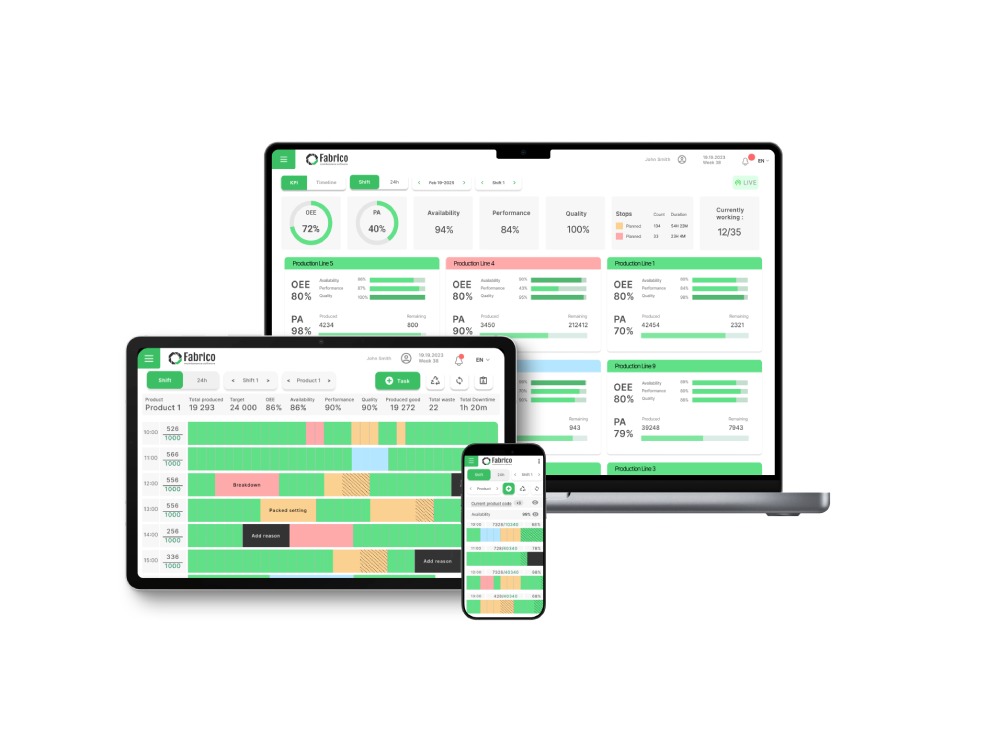
Fabrico is designed to reveal the hidden costs of manufacturing. Because it is both an OEE platform and a CMMS, it automatically aggregates the full financial impact of every asset.
How It Calculates TCO:
-
Direct Costs: Automatically sums up every Spare Part scanned and every Labor Hour logged against the asset.
-
Downtime Costs: Automatically pulls the duration of "Unplanned Downtime" from the machine's PLC/Sensors. You can assign a "Cost Per Hour" to the line, and Fabrico adds this revenue loss to the asset's TCO.
-
The Result: A clear dashboard showing which machines are "Profit Killers."
Pros:
-
The only tool that natively includes Production Loss in the asset cost calculation.
-
Helps justify CapEx requests with undeniable data ("This machine cost us $200k last year").
-
Tracks Inventory costs in real-time.
Cons:
2. UpKeep
Best For: Depreciation & Asset Value Tracking.
Overview:
UpKeep is excellent for visual Asset Management, particularly for facilities assets (like HVAC, Roofs, Vehicles). It includes strong features for tracking the Depreciation of an asset alongside its maintenance spend.
Key TCO Features:
-
Depreciation Calculator: Visualizes the declining book value of the asset.
-
Spend Reports: clear graphs showing Parts vs. Labor spend over time.
-
Purchase Orders: Tracks original acquisition costs and warranty info.
Pros:
Cons:
3. SAP EAM (Enterprise Asset Management)
Best For: Financial Ledger Accuracy.
Overview:
For large enterprises, SAP is the source of truth. Its integration between the PM (Plant Maintenance) and FICO (Finance & Controlling) modules ensures that every screw bought and every hour worked hits the general ledger with 100% accuracy.
Key TCO Features:
-
General Ledger Integration: Seamless flow of costs to the balance sheet.
-
Procurement: detailed tracking of vendor costs and contracts.
-
Complex Depreciation: Handles complex tax and accounting rules for asset write-offs.
Pros:
Cons:
-
Blind Spot: Like UpKeep, it focuses on Ledger Costs (what you paid), not Opportunity Costs (lost production), unless heavily customized with an OEE module.
4. Fiix (Rockwell Automation)
Best For: Maintenance Spend Analysis.
Overview:
Fiix provides robust reporting on the maintenance side of the equation. It is particularly good at analyzing Mean Time Between Failures (MTBF) alongside cost. This helps you identify assets that are failing frequently, even if the individual repair costs are low.
Key TCO Features:
-
Cost Coding: Tag costs to specific budgets or projects.
-
Guest Reporting: Allows contractors to input their costs easily.
-
AI Insights: "Asset Risk Predictor" highlights assets that are behaving abnormally.
Pros:
Cons:
5. MaintainX
Best For: Contractor & Vendor Cost Tracking.
Overview:
If you outsource a lot of your maintenance (e.g., specialized HVAC repair or CNC calibration), MaintainX is the best tool for capturing those external costs. Its digital work orders allow vendors to upload invoices directly to the asset history.
Key TCO Features:
-
Vendor Portal: Contractors can upload PDFs/Invoices directly to the Work Order.
-
PO Management: Simple approval workflows for external spend.
-
Parts Inventory: Basic tracking of internal parts costs.
Pros:
Cons:
Comparison Matrix: TCO Features
| Feature |
Fabrico |
UpKeep |
SAP EAM |
Fiix |
MaintainX |
| Direct Maint. Costs |
Yes |
Yes |
Best-in-Class |
Yes |
Yes |
| Downtime Costs (OEE) |
Native |
No |
Custom |
Manual |
No |
| Depreciation Tracking |
Good |
Best-in-Class |
Best-in-Class |
Good |
Basic |
| Labor Cost Accuracy |
High |
High |
High |
High |
High |
| Best For |
Manufacturing |
Facilities |
Global Finance |
Maintenance |
Outsourcing |
How to Spot a "Zombie Asset"
Use your software to run the Zombie Test annually:
-
Calculate Value: What is the replacement cost of the machine? (e.g., $100,000).
-
Calculate Loss: Add (Maintenance Parts + Maintenance Labor + Fabrico OEE Downtime Cost) for the last 12 months.
-
The Rule: If the Total Loss > 50% of the Replacement Value, the machine is a Zombie. Kill it.
Conclusion
-
If you need to report Book Value to the CFO, choose UpKeep or SAP.
-
If you need to track Contractor Invoices, choose MaintainX.
-
If you need to know the Real Profitability of your production assets by including the cost of lost downtime, Fabrico is the best choice.
Find your Zombie Assets. Start tracking True TCO with a Fabrico Demo.


 Login
Login
 Blog
Blog