There is a direct correlation between a Smart Factory and a Green Factory.
-
Unplanned Downtime wastes energy (machines idling) and resources (startup/shutdown spikes).
-
Poor Quality wastes raw materials (scrap) and logistics (reverse supply chain).
-
Inefficient Maintenance wastes parts (replacing too early) and fuel (technician travel).
To achieve ESG targets in 2026, you need platforms that tackle these inefficiencies at the source. Here are the 5 best Sustainable Manufacturing Platforms.
From "Carbon Accounting" to "Operational Action"
Most sustainability software focuses on Accounting—calculating the carbon footprint after the fact. While necessary for reporting, this is passive.
Operational Sustainability Platforms are active. They help you run the factory better, which naturally results in a lower footprint.
-
Reduce Scrap: Less raw material extraction.
-
Increase Asset Life: Less steel and copper needed for new machines.
-
Digitize Workflow: Zero paper waste.
Top 5 Sustainable Manufacturing Platforms (Ranked)
1. Fabrico
Best For: Waste Reduction & Process Efficiency.
The "Lean is Green" Advantage:
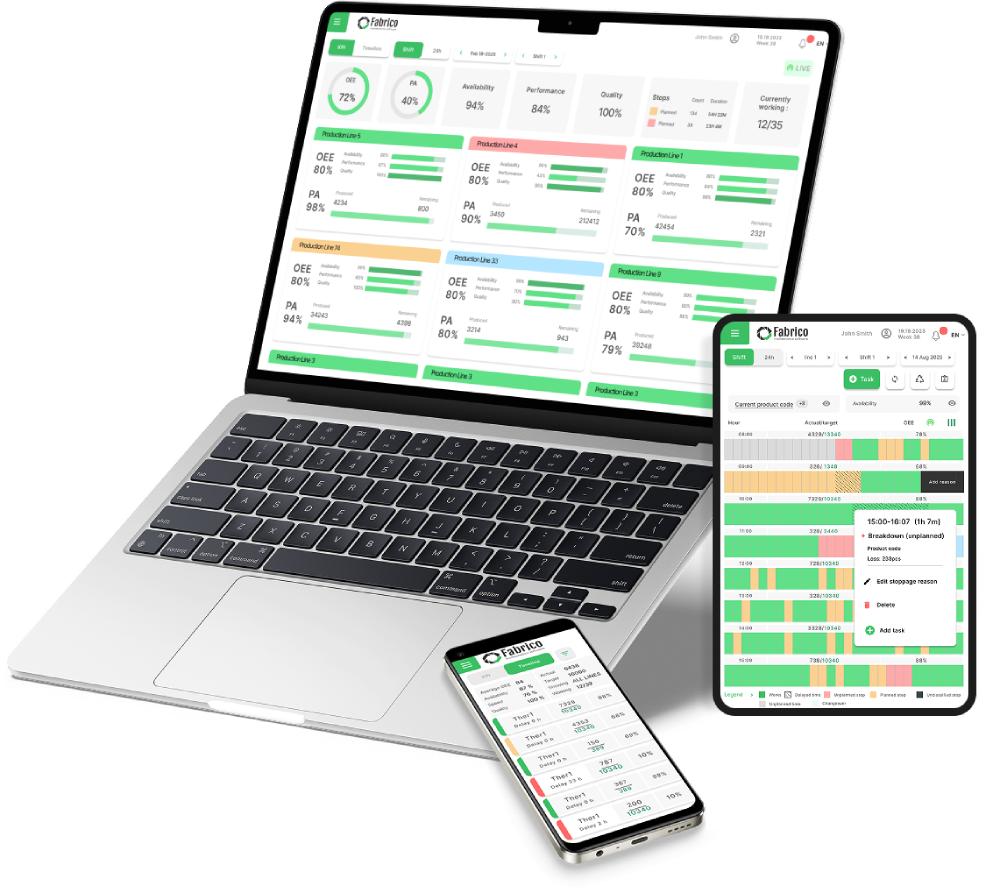
Fabrico approaches sustainability through the lens of Operational Excellence. It is built on the premise that an efficient, reliable factory is inherently a sustainable one.
How It Drives ESG Impact:
-
Scrap Reduction: By unifying Quality Data and Visual Process Analysis, Fabrico identifies the root causes of defects (e.g., machine drift, jam). Fixing the machine prevents thousands of units from ending up in a landfill.
-
Asset Life Extension: Through Condition-Based Maintenance logic, Fabrico ensures assets are maintained exactly when needed. This prevents catastrophic failures that require complete machine replacement (massive embodied carbon) and optimizes the consumption of spare parts.
-
Energy Avoidance: Unplanned downtime is energy-intensive. By stabilizing OEE (Overall Equipment Effectiveness), Fabrico ensures that energy is consumed only for productive output, not for idling or restarting lines.
-
Paperless Operations: A complete digitization of the shop floor eliminates paper checklists, binders, and work orders, contributing to immediate "Scope 3" reductions.
Pros:
-
Economic & Environmental: Delivers ROI in both dollars and carbon.
-
Action-Oriented: Turns sustainability goals into daily technician tasks.
-
Rapid Deployment: Cloud-native architecture allows for immediate impact across multi-site footprints.
2. Sphera
Best For: ESG Reporting & Compliance.
Overview:
Sphera is the market leader for Environmental, Health, and Safety (EHS) software. It is designed to handle the rigorous data collection required for regulatory reporting (GRI, SASB, CDP).
It excels at calculating the Carbon Footprint. It has massive databases of emission factors for chemicals and materials, allowing you to accurately report your Scope 1, 2, and 3 emissions to investors.
Key Sustainability Features:
-
Carbon Accounting: Automated calculation of GHG emissions.
-
Compliance Management: Keeps you up to date with changing global regulations.
-
Risk Assessment: Identifies environmental risks in the supply chain.
Pros:
Cons:
3. Siemens (SiGreen)
Best For: Product Carbon Footprint (PCF).
Overview:
Siemens tackles the challenge of Supply Chain Transparency. Its SiGreen solution (part of the Xcelerator portfolio) focuses on tracking the carbon footprint of the individual product as it moves through the value chain.
It uses a distributed network (Estainium) to allow manufacturers to exchange emission data with suppliers securely. This allows you to know the exact carbon cost of a specific motor or circuit board.
Key Sustainability Features:
-
PCF Calculation: Granular carbon tracking per SKU.
-
Value Chain Exchange: Secure data sharing with suppliers.
-
Dynamic Calculation: Updates footprint based on real-time energy mix.
Pros:
Cons:
4. Aveva (Sustainability Solutions)
Best For: Energy Optimization.
Overview:
Aveva leverages its deep roots in the Process Industry to drive Energy Efficiency. It connects to SCADA and Historian systems to monitor energy consumption (Steam, Water, Air, Gas, Electricity - SWAGE) in real-time.
It provides a "dashboard of waste," showing operators where they are consuming more energy than the theoretical limit for the current production rate.
Key Sustainability Features:
-
Energy Performance: Contextualizes energy use against production volume.
-
Predictive Efficiency: Alerts when asset efficiency degrades (e.g., fouling heat exchangers).
-
Sustainability Analytics: Visualizes progress toward Net Zero goals.
Pros:
-
Powerful for energy-intensive industries (Cement, Steel, Chemical).
-
Directly attacks the utility bill.
Cons:
5. Plex (Rockwell Automation)
Best For: Scrap & Material Genealogy.
Overview:
Plex contributes to sustainability through Material Control. As an ERP/MES, it has total visibility into the genealogy of every batch.
Its primary sustainability lever is Scrap Reduction. By enforcing strict process controls and tracking material shelf life, it minimizes the amount of raw material that is wasted due to expiration or quality defects.
Key Sustainability Features:
-
Scrap Analysis: Financial and physical tracking of waste.
-
Genealogy: Traceability prevents massive recalls (which are massive waste events).
-
Production Scheduling: Optimizes runs to minimize changeover waste.
Pros:
Cons:
Comparison Matrix: Sustainability Impact
| Feature |
Fabrico |
Sphera |
Siemens |
Aveva |
Plex |
| Primary Focus |
Ops Efficiency |
ESG Reporting |
Product Carbon |
Energy Usage |
Material Waste |
| Waste Target |
Downtime/Scrap |
Emissions |
Supply Chain |
Utilities |
Raw Material |
| Data Source |
Machine + Visual |
Manual/Import |
Supplier Network |
SCADA |
ERP Transactions |
| User Base |
Ops / Maintenance |
EHS / CSO |
Supply Chain |
Energy Mgr |
Production |
| Time-to-Value |
Weeks |
Months |
Months |
Months |
Years |
The "Triple Bottom Line" Strategy
Sustainability is no longer a cost; it is an efficiency driver.
Fabrico delivers on the Triple Bottom Line:
-
People: Safer, paperless workflows for technicians.
-
Planet: Reduced scrap and energy waste via optimized assets.
-
Profit: Lower operational costs and higher asset utilization.
Conclusion
-
If you need Regulatory Reporting, choose Sphera.
-
If you need Supply Chain Carbon Tracking, choose Siemens.
-
If you need an Operational Platform that drives sustainability by optimizing the efficiency, reliability, and quality of your daily production, Fabrico is the best choice for the sustainable enterprise in 2026.
Make efficiency your green strategy. Schedule a Sustainability Review with Fabrico.


 Login
Login
 Blog
Blog