Total Productive Maintenance (TPM) is the gold standard for manufacturing efficiency.
It shifts the philosophy from "Maintenance fixes it" to "Everyone owns the machine."
But TPM is hard to execute.
Most factories fail at TPM because they rely on paper checklists for Autonomous Maintenance (CIL).
Operators "pencil-whip" the forms, the data is never analyzed, and the culture never changes.
To make TPM stick, you need software that empowers operators without getting in their way. You need a system that combines OEE (Overall Equipment Effectiveness) with Maintenance Action.
Here are the 5 best software tools for driving TPM in 2026.
1. Fabrico: The "TPM Native" Platform
Best For: Manufacturers who want to fully integrate Operators, Maintenance, and OEE.
Fabrico is built on the core philosophy of TPM: The connection between the Machine, the Operator, and the Technician. It is designed to remove the barriers that stop operators from participating in maintenance.
Why it wins for TPM:
-
Digital CILs (Clean, Inspect, Lubricate): Fabrico puts the operator checklist on a tablet. It requires visual proof (photos) for critical checks, ensuring the "Autonomous Maintenance" pillar is actually happening.
-
Unlimited Requestors: unlike legacy tools that charge for every login, Fabrico allows unlimited operators to submit requests. This encourages reporting rather than punishing it.
-
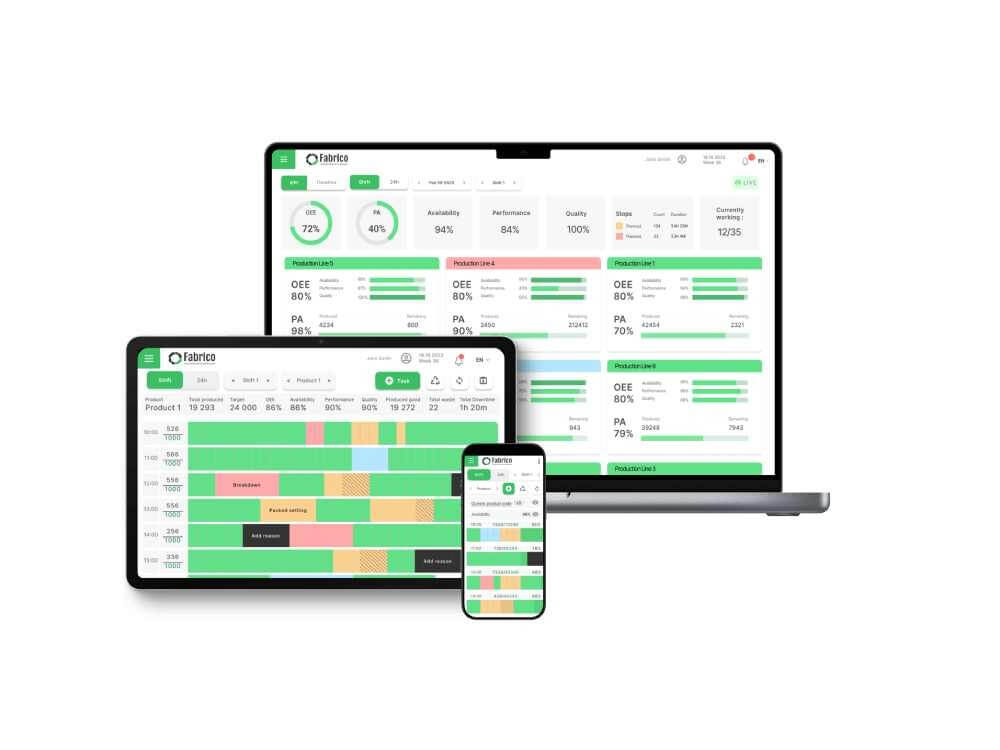
Visual OEE: Operators see their performance (Availability/Speed) in real-time. When performance drops, Fabrico prompts them to check for issues, driving the "Focused Improvement" pillar.
-
One-Click Handover: If an operator finds a defect they can't fix, they can turn a checklist item into a Maintenance Work Order in one click.
The Verdict: If you want a single operating system that enforces TPM behaviors automatically, Fabrico is the best choice.

2. Redzone
Best For: Culture, Huddles, and Gamification.
Redzone is famous for its ability to energize the shop floor. It focuses heavily on the "People" side of TPM.
-
Pros: Excellent social features. High-fives, leaderboards, and structured "Huddles" get operators excited about hitting targets. It drives the "Teaming" aspect of TPM better than anyone.
-
Cons: It is expensive and heavy on the "Coaching" model. While great for culture, it is lighter on the hard engineering data (Failure Codes, Spare Parts, Asset Lifecycle) than a dedicated maintenance platform.
-
The Difference: Redzone motivates the team; Fabrico manages the machine and the team.
3. Poka (IFS)
Best For: Training and Standard Work (Education & Training Pillar).
TPM requires operators to learn new skills. Poka is the industry leader in video-based training.
-
Pros: The "YouTube for the Factory" approach ensures operators know exactly how to perform a CIL task. If they don't know how to grease a bearing, they watch the video at the machine.
-
Cons: It creates a data silo. It tells you how to do the task, but it doesn't natively track the spare parts costs or link the downtime to the financial ERP system as deeply as a CMMS.
-
The Difference: Poka teaches the task; Fabrico manages the execution.
4. Leading2Lean (L2L)
Best For: Lean Manufacturing and Visual Management.
L2L is a strong "Dispatch" engine. It treats every issue on the floor as a "disruption" to be solved.
-
Pros: Very fast response times. It uses a "Andon" style logic to swarm problems. Great for high-volume automotive or assembly environments.
-
Cons: The interface can be complex. It feels more like a dispatch board than an asset health system. It focuses more on "Flow" than "Reliability Engineering."
-
The Difference: L2L is for flow; Fabrico is for asset reliability.
5. MaintainX
Best For: Simple Autonomous Maintenance checklists.
If you are just starting TPM and have a limited budget, MaintainX is a great way to digitize operator checklists.
-
Pros: The mobile app is incredibly easy to use. Operators can chat with maintenance technicians directly, breaking down the "Us vs. Them" barrier.
-
Cons: It lacks the native OEE component. In TPM, you need to correlate Losses (OEE) with Actions (Maintenance). MaintainX handles the actions but misses the automated loss data.
-
The Difference: MaintainX digitizes the form; Fabrico digitizes the strategy.
Comparison Matrix: Enabling TPM
| Feature |
Fabrico |
Redzone |
Poka |
MaintainX |
| TPM Pillar: AM |
✅ Digital CIL |
✅ Huddles |
⚠️ Training |
✅ Checklists |
| TPM Pillar: FI |
✅ OEE Data |
✅ OEE Data |
❌ No |
❌ No |
| Operator Access |
Unlimited |
Site License |
User License |
User License |
| Maintenance Depth |
✅ Full CMMS |
⚠️ Basic |
❌ No |
✅ Basic |
| Setup Speed |
Fast |
Slow (Culture) |
Medium |
Fast |
(AM = Autonomous Maintenance, FI = Focused Improvement)
Summary: Tools Don't Do TPM, People Do
Software cannot fix a broken culture. But the wrong software can kill a good culture.
-
Choose Redzone if: You need a massive cultural reset and have the budget for consultants.
-
Choose Poka if: Your primary barrier is operator skill and training.
-
Choose Fabrico if: You want to operationalize TPM. If you want to give operators a tool that connects their daily checks to machine performance (OEE) and maintenance support, Fabrico is the engine for your TPM program.
Empower your operators.
[Book a Demo with Fabrico] to see how our Digital CILs and OEE triggers drive Total Productive Maintenance.


 Login
Login
 Blog
Blog