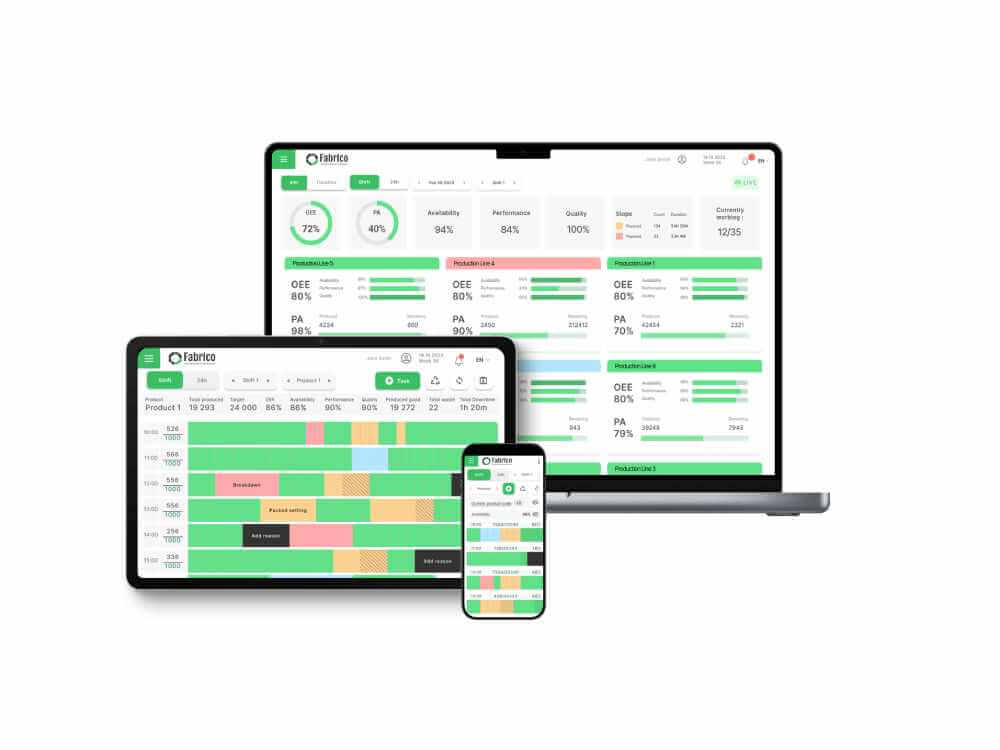
Why is a unified OEE and CMMS critical for FMCG?
A unified OEE and CMMS platform is critical for FMCG because it closes the feedback loop between high-speed production data and maintenance execution.
By integrating real-time OEE metrics with a field-ready CMMS, manufacturers can automate the Fault-to-Fix cycle, ensuring that every micro-stop or performance dip triggers an immediate, prioritized response rather than a lagging report.
1. Fabrico: The System of Action for FMCG
Fabrico is designed for the "High-Speed Reality" of FMCG. It moves beyond being a simple "System of Record" to become a System of Action that integrates Machine Signals (PLC), Operator Inputs, and Computer Vision into a single dataset.
Computer Vision (Inefficiencies Zoom-In): FMCG lines run too fast for the human eye to catch every micro-stop. Fabrico uses cameras to detect jams and slow cycles that PLCs miss, capturing video clips for instant root cause validation. Mike (the CI Manager) no longer has to guess why the labeling line slowed down; he has visual evidence to build a better SOP.
Condition-Directed Maintenance: In a high-volume environment, calendar-based PMs are a liability. Fabrico triggers work orders based on real-time OEE degradation or actual cycle counts. This ensures you only stop the line for maintenance when it is absolutely necessary to preserve function.
Interactive Planning Board: FMCG requires constant schedule adjustments. Fabrico’s planning board reacts to real-time machine availability and maintenance constraints, eliminating the "False Availability" trap that leads to stockouts and missed delivery windows.

2. Redzone (The Engagement Leader)
Redzone focuses heavily on the "Social" side of the factory floor, using communication and gamification to drive productivity.
3. Worximity (The Real-Time Scoreboard)
Worximity is a powerhouse for real-time production monitoring and OEE visibility across multiple sites.
-
The Gap: It is a world-class "System of Diagnosis." However, it lacks the native "System of Cure"—the CMMS. To act on the data, you must integrate it with a separate maintenance tool, which reinstates the very data silo a unified platform is meant to solve.
4. Parsable (The Connected Worker Platform)
Parsable excels at digitizing complex standard work procedures and guiding frontline workers through high-precision tasks.
-
The Gap: It is a workflow specialist, not a native OEE monitoring platform. Without direct PLC-to-Maintenance feedback loops, the connection between "How we work" and "How the machine performs" remains a manual analytical task for the management team.
5. Infor EAM (The Enterprise Giant)
Infor is a comprehensive solution for large-scale enterprise asset management with massive depth in financial tracking.
-
The Gap: For agile FMCG plants, Infor can feel like "overkill." The complexity of the interface often leads to low technician adoption (Tom finds it too slow), resulting in a "System of Record" that looks good to auditors but fails to drive action on the shop floor.
FMCG Unified Comparison Matrix
| Feature |
Fabrico |
Redzone |
Worximity |
Parsable |
Infor EAM |
| Unified OEE & CMMS |
✅ Native |
⚠️ Limited |
❌ No |
❌ No |
❌ Complex |
| Computer Vision RCA |
✅ Confirmed |
❌ No |
❌ No |
❌ No |
❌ No |
| Fault-to-Fix Speed |
✅ Instant |
✅ Fast |
❌ Lagging |
⚠️ Moderate |
❌ Slow |
| RCM & CD Tasks |
✅ Advanced |
❌ Basic |
❌ No |
✅ Basic |
✅ Advanced |
| Technician Adoption |
✅ 96% |
✅ High |
❌ N/A |
✅ High |
❌ Low |
The ROI of Unified Intelligence in FMCG
For Paula (the Strategic Leader), the Value Fulcrum is the bottom line. By unifying OEE and CMMS, you stop paying for "Analysis Paralysis." Instead of reviewing yesterday’s downtime reports, your team is reacting to today’s performance trends.
Fabrico identifies the "Bad Actor" assets—the 20% of machines causing 80% of your Quality and Performance losses—and gives Mike the "System of Action" to recover that capacity. In the war of seconds, a unified platform is your most powerful weapon.


 Login
Login
 Blog
Blog