The "OEE Ceiling": Why Monitoring Alone Stops Working
What is the OEE Plateau in manufacturing?
The OEE Plateau occurs when a factory reaches a level of efficiency where traditional data collection no longer reveals new insights, and further gains are prevented by the lack of a real-time link between production data and maintenance execution.
At this stage, Paula (the Strategic Leader) sees that the needle has stopped moving.
The "Six Big Losses" are documented, the dashboards are red, but the "Action Gap" remains wide.
The problem isn't the data; it’s the Decision Latency between seeing a performance drop and having a technician resolve the root cause.
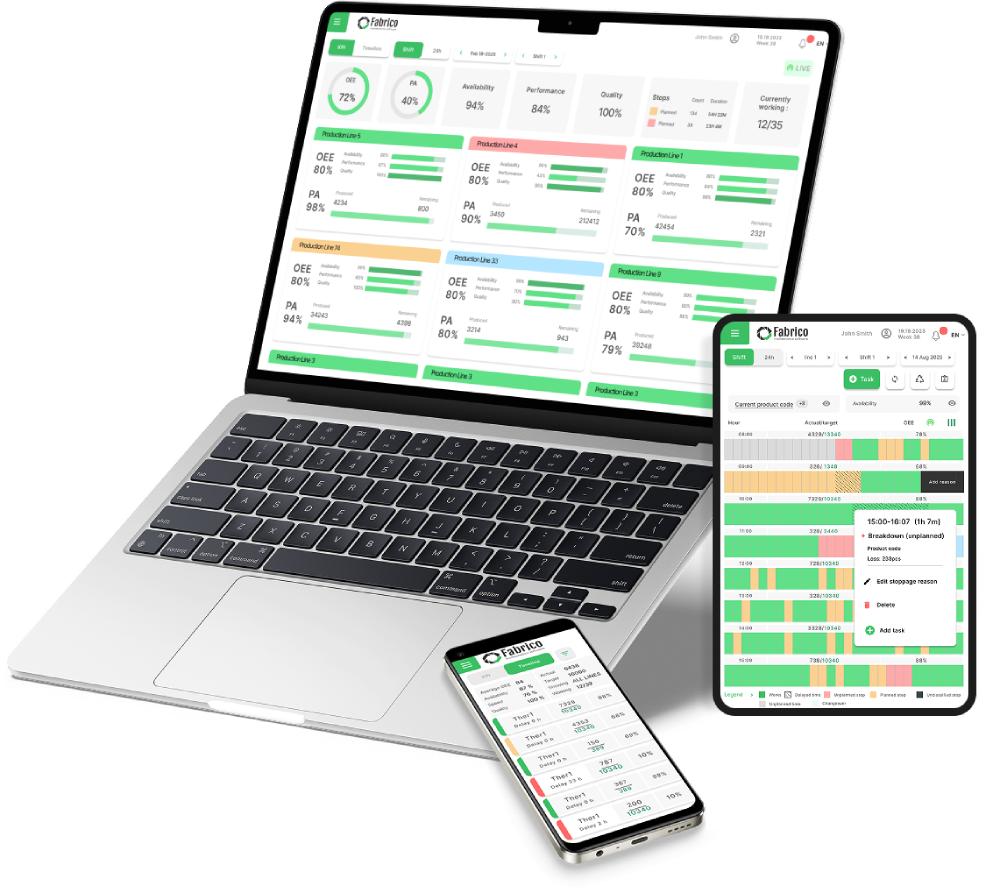
Fabrico breaks this ceiling by turning every OEE deviation into an immediate, prioritized task in our Field-Ready CMMS.
Moving from Visibility to Velocity: The Power of Integrated Workflows
Visibility is important, but velocity—the speed at which you respond to data—is what drives profitability.
Standalone OEE tools are passive; they wait for a manager to look at a report before anything happens.
Fabrico is active; it uses Native OEE integration to trigger workflows the moment a threshold is breached.
If a filler on Line 2 starts running 10% below its Takt time, the system doesn't just log a "Performance Loss."
It sends a Smart Notification to Mike (the Tactical Manager), suggesting a Condition-Based PM based on the machine’s specific failure history.
This ensures your team is always working on the "Value Fulcrum"—the tasks with the highest impact on effective runtime.
Comparison Matrix: Passive OEE vs. Fabrico System of Action
| Capability |
Standalone OEE (Passive) |
Legacy ERP/MES Modules |
Fabrico (System of Action) |
| Response Trigger |
Manual Review |
Batch Reporting |
Real-Time OEE Thresholds |
| Root Cause Depth |
Basic (PLC only) |
Limited |
Advanced (Computer Vision) |
| Maintenance Link |
Disconnected |
Slow/Financial Focus |
Native (Field-Ready CMMS) |
| Mobile UX |
None/Browser |
Low |
Native Offline App |
| Micro-stop Strategy |
Count only |
Mostly Ignored |
Visual "Zoom-In" Analysis |
| Implementation |
1-2 Months |
12-18 Months |
3-4 Months |
Real-World RCA: Using Computer Vision to Solve "Impossible" Inefficiencies
When OEE plateaus, it’s usually because of "Ghost Losses"—minor stoppages and speed variations that PLCs can't explain.
Fabrico’s Inefficiencies Zoom-In (Computer Vision) module acts as the "Eyes" of your continuous improvement team.
When a micro-stop occurs, the system captures a high-definition video clip of the event.
Instead of guessing if the issue was a material jam or an operator adjustment, your team can watch the "Replay" in real-time.
This visual truth eliminates the "Pencil Whipping" of downtime codes and provides the evidence needed for KAIZEN initiatives that actually stick.
Scaling Success: Global Governance for the Enterprise Leader
For Paula, breaking the plateau at one plant is great, but breaking it across ten plants is transformative.
Fabrico’s Group-First Architecture allows for the standardization of "What Good Looks Like."
When a "Bad Actor" asset is finally optimized in the Germany plant, that maintenance standard can be instantly pushed to identical assets in the USA.
This creates a "Virtual Warehouse" of knowledge and spare parts that ensures your enterprise OEE continues to grow, shift after shift, and site after site.
As you build this foundation, you are preparing your data for the Fabrico Agent (AI Roadmap), which will eventually automate the most complex scheduling and optimization tasks.
Stop watching the plateau. Start engineering the breakthrough.


 Login
Login
 Blog
Blog
![What is Overall Equipment Effectiveness (OEE)? [2026 Guide]](https://s3.fabrico.io/uploads/what-is-overall-equipment-effectiveness-oee-guide.jpg)