Your latest manufacturing acquisition is likely hiding a massive mechanical liability.
When Private Equity groups or enterprise manufacturers acquire a new facility, the financial due diligence is rigorously executed by armies of accountants.
However, the technical due diligence is almost always an afterthought, consisting of a brief walking tour of the shop floor and a glance at a spreadsheet.
The acquiring CFO looks at the asset ledger and sees fully depreciated equipment that is allegedly producing high margins.
What the financial ledger does not show is that the acquired maintenance team has been cannibalizing machines, pencil-whipping safety checks, and ignoring catastrophic wear-and-tear just to hit production quotas before the sale.
To permanently protect your enterprise multiple and guarantee your post-merger ROI, you must deploy a software architecture that instantly exposes the unvarnished mechanical truth of your new acquisition.
What is CMMS software for manufacturing technical due diligence?
CMMS software for manufacturing technical due diligence is an agile, rapid-deployment operational platform used by acquiring executives to instantly audit and baseline the true mechanical health of a newly purchased factory.
By bypassing legacy paper logs and connecting directly to the acquired facility's machine PLCs, the software captures live Overall Equipment Effectiveness (OEE) metrics and tracks exact MRO spare parts consumption.
This allows Private Equity operating partners to instantly quantify the factory's hidden "Technical Debt" and standardizes the newly acquired asset into the parent company's global execution portfolio.
The "Reliability Equity Gap"
When you acquire a factory that relies on legacy Enterprise Asset Management (EAM) systems like SAP PM or paper binders, you are inheriting a data blackout.
The previous ownership group likely deferred critical Preventive Maintenance (PM) tasks for the last two years to artificially inflate their EBITDA and secure a higher exit valuation.
This creates a massive "Reliability Equity Gap"—the catastrophic financial difference between the perceived value of the machines and their actual, degraded physical reality.
Because the legacy software is filled with vague, subjective text entries and unrecorded micro-stops, your integration team has absolutely no idea which assets are ticking time bombs.
If your post-merger integration plan relies on the acquired factory's historical maintenance records, you are basing your operational strategy on a complete fiction.
By the time your corporate IT department spends eighteen months trying to integrate the acquired factory's clunky legacy EAM into your parent ERP, the degraded machines will have already crashed, destroying your year-one profitability.
The Fabrico Framework: The 100-Day Operational Baseline
To achieve world-class M&A integration, your operating partners must establish a new, machine-validated baseline within the first 100 days of the acquisition.
We call this The Fabrico Framework, built on the absolute necessity of deploying a fast-implementation, Field-Ready CMMS that requires zero custom IT coding.
Fabrico acts as the ultimate digital auditor for your newly acquired factory.
Instead of waiting a year for an IT integration, Fabrico can be piloted and fully deployed on the acquired shop floor in under 30 days.
Our integration engineers connect Fabrico directly to the acquired machine PLCs or deploy optical IoT sensors, completely bypassing the acquired company's flawed historical data.
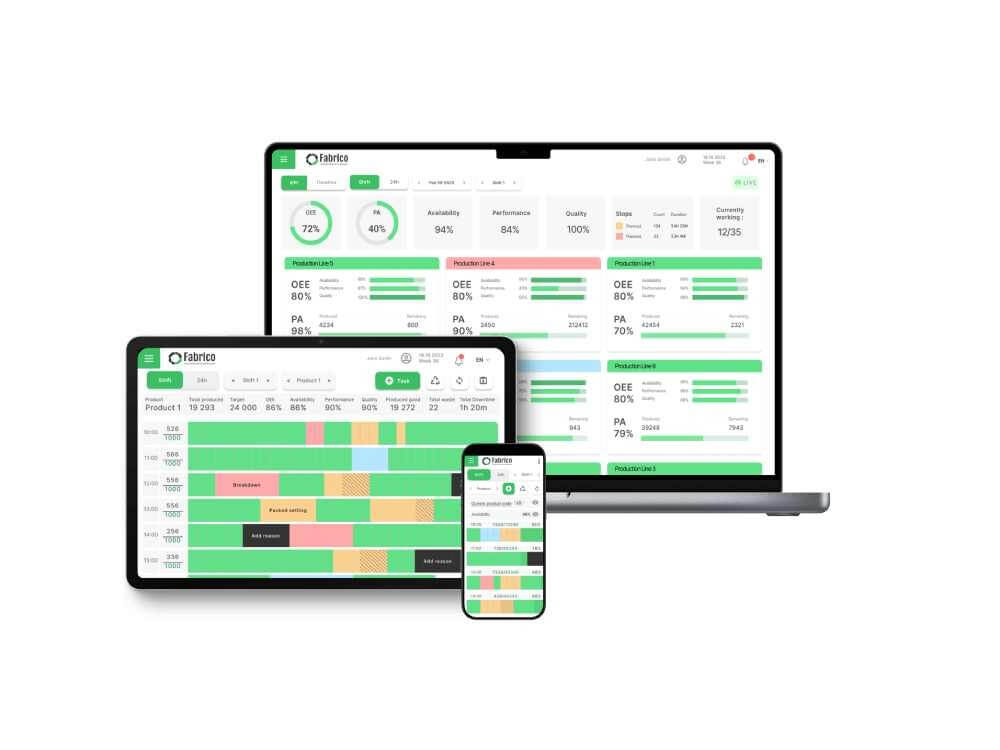
Within weeks, your corporate leadership gains a live dashboard displaying the unvarnished OEE truth, instantly isolating the 20% of "Bad Actor" assets that are secretly destroying 80% of the factory's throughput.
Auditing the Acquired Workforce via Computer Vision
When you buy a factory, you are also buying a maintenance culture that you did not create.
Fabrico allows you to instantly audit the inherited operational behaviors using our proprietary Inefficiencies Zoom-In module.
By positioning industrial computer vision cameras above the most critical acquired assets, Fabrico captures time-stamped video footage tied directly to the live production timeline.
If the acquired operators are bypassing safety guards or utilizing undocumented "Shadow Maintenance" to keep the machines running, the corporate integration team can press play and watch the exact unauthorized physical interventions.
This indisputable visual evidence allows leadership to immediately terminate dangerous operational habits and enforce the parent company's strict digital Standard Operating Procedures (SOPs).
The AI Roadmap: Autonomous Portfolio Valuation
Fabrico currently provides the most rigorous, rapid-deployment integration platform available to modern Private Equity groups and enterprise manufacturers.
However, we are actively engineering the next tier of intelligent M&A governance.
Currently on our product roadmap is the Fabrico Agent, a proprietary AI-driven optimization engine.
Once deployed, this AI Agent will autonomously analyze the live PLC data and CMMS repair costs of your newly acquired facility, instantly generating a mathematical CapEx forecast to completely liquidate the facility's inherited Technical Debt.
Additionally, our upcoming Fabrico Assistant (also on the roadmap) will serve as a generative AI copilot, allowing M&A directors to instantly ask, "Based on our first 30 days of data, what is the true Maintenance Cost Per Unit for this acquired portfolio?"
By standardizing your newly acquired factories inside Fabrico today, you are building the exact master dataset required to power these autonomous AI valuation capabilities tomorrow.
Legacy EAM Integration vs. Agile M&A CMMS
| Feature / Capability |
Legacy EAM Integration |
Fabrico (M&A-Optimized CMMS) |
| Time to Visibility |
12 to 18 months of IT migration. |
Live data baselining in under 30 days. |
| Historical Data Trust |
Relies on the seller's potentially fabricated logs. |
Bypasses old logs by reading live PLC data today. |
| Technical Debt Discovery |
Hidden behind generic, pencil-whipped text fields. |
Instantly isolated via automated OEE cycle counting. |
| Cultural Auditing |
Impossible to verify how the acquired team works. |
Video replays of inherited behaviors via Computer Vision. |
| Future AI Readiness |
Migrating bad legacy data destroys machine learning. |
Clean, fresh execution data ready for AI Roadmap. |
Stop Buying Blind
You cannot successfully execute a manufacturing roll-up strategy if you are acquiring massive, hidden mechanical liabilities.
Your operating partners require immediate, machine-validated truth the exact second the ink dries on the acquisition contract.
By deploying a unified System of Action during your post-merger integration, you eradicate the data silos that hide deferred maintenance and broken operational cultures.
Standardize your technical due diligence today, and permanently protect your enterprise valuation from the Reliability Equity Gap.


 Login
Login
 Blog
Blog