What is Computer Vision OEE?
Computer Vision OEE is an advanced production monitoring technology that uses AI-powered cameras to visually identify, categorize, and record production events—such as micro-stops, jams, and operator delays—that traditional PLC sensors often miss or mislabel.
For Mike (the Tactical Manager), relying only on PLC signals is like listening to a heartbeat without being able to see the patient.
A sensor can tell him that Line 4 stopped, but it cannot tell him that an operator was struggling with a specific material batch or that a guide rail was vibrating.
Fabrico’s Inefficiencies Zoom-In module bridges this gap, providing the visual truth needed to trigger a permanent maintenance cure.
The Limitation of PLC-Only Tracking in High-Speed Lines
High-speed Food & Beverage and Plastics lines operate at such high frequencies that mechanical failures often happen in the blink of an eye.
Traditional sensors are programmed with "debounce" timers to prevent noise, which means they often ignore micro-stops that are shorter than two seconds.
These "Ghost Losses" represent the 10-15% of capacity that Paula (the Strategic Leader) needs to reclaim to hit her revenue targets.
Without the visual layer of the Visibility Trifecta, these losses are categorized as "Unknown" or "Minor Stoppages," leaving your Continuous Improvement team with zero actionable evidence.
Closing the Loop: From Visual Proof to Maintenance Execution
The true power of a System of Action is the speed at which it moves from identifying a visual fault to executing a mechanical fix.
When Fabrico’s Computer Vision module detects a recurring jam, it doesn't just log a performance loss.
-
Detection: The AI camera identifies a bottle tip that the PLC categorized as a simple "Stop."
-
Verification: The system flags a 10-second video clip, allowing Mike to see the exact mechanical friction.
-
Action: The integrated OEE and CMMS triggers a prioritized Work Order for Tom (the Technician) with the visual proof attached.
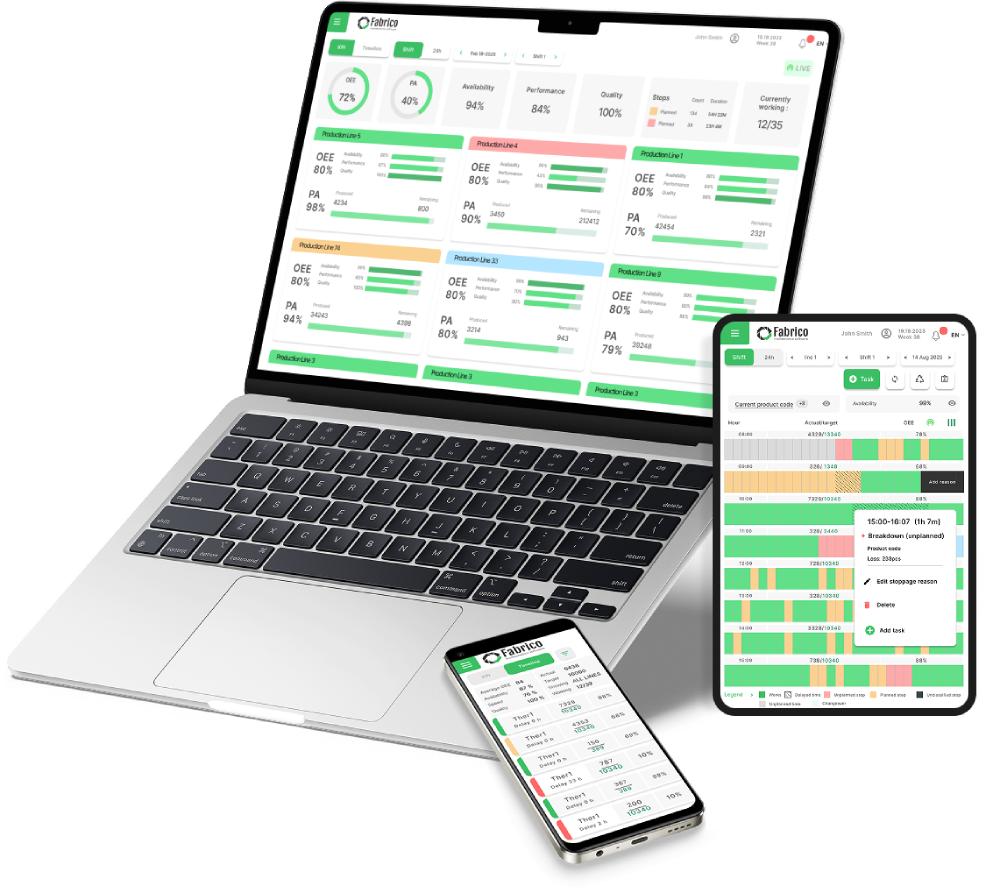
This ensures your maintenance team focuses on the Value Fulcrum—fixing the root causes that actually drive Availability.
Comparison Matrix: PLC vs. Computer Vision vs. Hybrid Systems
| Capability |
PLC-Only OEE |
Computer Vision OEE |
Fabrico (Hybrid System of Action) |
| Accuracy (Timing) |
Absolute / High |
Moderate |
Absolute (PLC Baseline) |
| Root Cause Depth |
Data-Only / Guesswork |
Visual Only |
Advanced (Visual + Signal) |
| Micro-stop Detection |
Filtered / Low |
High |
Absolute (100% Visibility) |
| Manual Line Support |
None |
High |
High (Hybrid Support) |
| Maintenance Link |
Manual / Siled |
None |
Native Integrated CMMS |
| Decision Latency |
Moderate |
High (Human Review) |
Zero (Automated Triggers) |
ROI: Reclaiming the 15% Capacity Gap
For Paula, the business case for a Hybrid System of Action is built on "Capacity Reclamation."
By capturing the losses that sensors miss, you effectively find "free revenue" in your existing equipment.
Moving to Condition-Directed Tasks based on visual evidence reduces your Maintenance Cost per Unit because you stop fixing parts that aren't the problem.
As you gather 12 months of clean visual and signal data, you are preparing the facility for the Fabrico Agent (AI Roadmap) to automate these diagnostic cycles.
Stop guessing why your machines are stopping. Start seeing the truth with a System of Action.


 Login
Login
 Blog
Blog