Walk onto any factory floor and look at the clipboard hanging on the side of a machine.
Chances are, you will see a daily inspection sheet.
And chances are, you will see a straight vertical line drawn through every "Pass" box for the entire week.
We call this the "Pencil Whip."
It happens when operators view maintenance checklists as a compliance chore rather than a tool for reliability.
The problem isn't the operator; it is the medium. Paper is passive. It is boring. And worst of all, it is a "Data Graveyard."
If an operator actually does find a loose bolt and notes it on paper, that piece of paper might sit on a desk for three days before a maintenance manager sees it.
By then, the bolt has fallen off, and the machine has crashed.
The Solution: Digital Autonomous Maintenance (AM)
Autonomous Maintenance (AM) is the first pillar of Total Productive Maintenance (TPM). It shifts simple tasks—cleaning, inspection, lubrication (CIL)—from the maintenance team to the machine operator.
But AM only works if the communication loop is instant.
Fabrico replaces the dirty clipboard with a Field-Ready Digital Interface.
How the "Instant Escalation" Works
In Fabrico, the operator is no longer just a "machine runner." They are the first line of defense.
Here is the workflow that bridges the gap between Production and Maintenance:
-
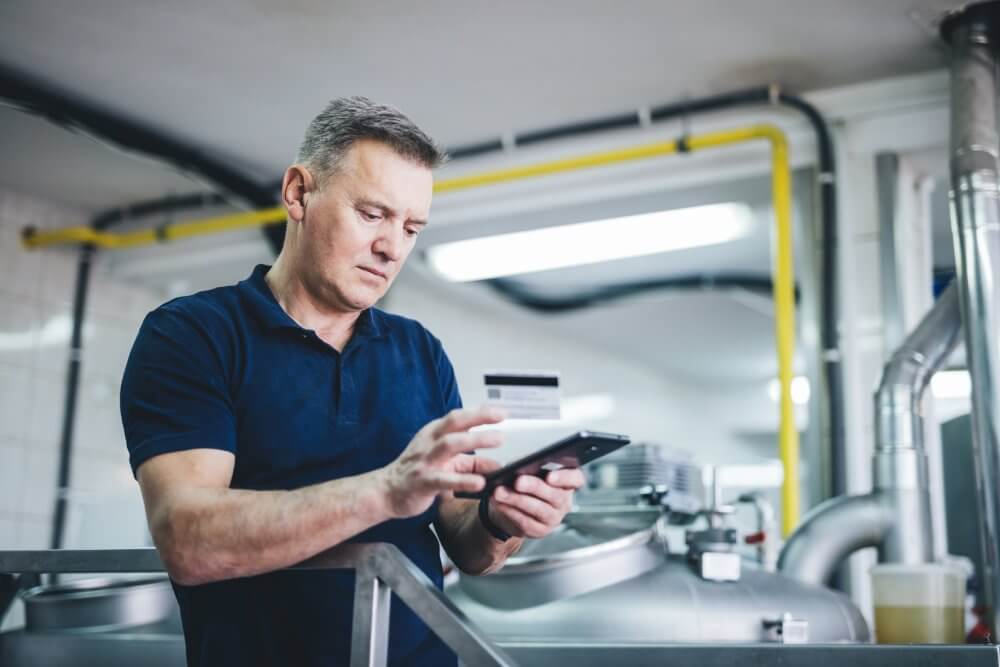
The Scan: The operator scans the QR code on the asset at the start of the shift.
-
The Guide: Instead of a vague list, they see a digital checklist with photos showing exactly where to inspect.
-
The Failure: The operator notices a low oil level. They tap "Fail."
-
The Trigger: Fabrico instantly prompts them: "Do you want to create a Maintenance Request?"
-
The Handoff: The operator snaps a photo of the gauge and hits "Send."
Instantly, Mike (the Maintenance Manager) gets a notification on his phone.
He assigns a technician to fill the oil before the shift is over.
The machine never stops. The paper never gets lost.
Why This Matters for ISO & Compliance
For Paula (the Strategic Leader), moving to digital CILs isn't just about reliability; it's about auditability.
In industries like Food & Beverage or Automotive (IATF 16949), an auditor wants proof that inspections happened.
With paper, you have to dig through filing cabinets.
With Fabrico, you have a digital, timestamped audit trail for every single inspection.
You can prove exactly who checked the machine, when they checked it, and what they found.
Comparison: The Speed of Information
The difference between paper and digital is the speed at which a defect becomes an action.
| Feature |
Paper Checklists |
Fabrico Digital CILs |
| Data Integrity |
Low ("Pencil Whipping" is common) |
High (Timestamps & Mandatory Photos) |
| Response Time |
Days (or never) |
Seconds (Instant Notification) |
| Workflow Connection |
Disconnected from Maintenance |
Auto-creates Work Orders |
| Audit Readiness |
Nightmare (Physical storage) |
Instant (Searchable History) |
| Operator Engagement |
Low (Seen as a chore) |
High (Empowered to fix issues) |
Conclusion: Give Your Operators a Voice
Your operators know your machines better than anyone else. They listen to them run for 8 hours a day.
When you give them a paper checklist, you are ignoring their expertise.
When you give them Fabrico, you are giving them a microphone.
You are empowering them to say, "Something is wrong," and guaranteeing that the maintenance team hears them.
Don't let a missing piece of paper be the reason your production line stops.
Ready to digitize your operator rounds?
See how easy it is to turn inspections into action.
Book a Demo with Fabrico Today


 Login
Login
 Blog
Blog