In many factories, there is a "Cold War" between Operations and Maintenance.
Operations (Production) cares about Flow. They look at their OEE dashboard (MES) and scream, "The machine is down again! Maintenance isn't doing their job!"
Maintenance cares about Asset Health. They look at their CMMS and argue, "We did the PMs! Operations is running the machine too hard and not cleaning it!"
This conflict exists because they are looking at two different screens.
Operations sees "The Stop."
Maintenance sees "The Fix."
Nobody sees the full picture.
For the IT Director or VP of Operational Excellence, allowing these data silos to persist is a strategic failure. It prevents you from answering the most important question in the plant: "Did our maintenance spend actually improve our production output?"
Here is why you need to collapse the stack and move to a Unified Manufacturing Operations platform.
The Cost of the "Swivel Chair" Interface
If your operator has to look at a machine HMI, type downtime codes into an OEE tablet, and then pick up a radio (or open a different app) to call maintenance, you have a broken process.
This "Swivel Chair" workflow causes:
-
Latency: The machine stops at 10:00. Maintenance is notified at 10:15. That’s 15 minutes of avoidable lost production.
-
Data Mismatch: OEE says "Jam" (10 mins). CMMS says "Sensor Replacement" (30 mins). Which is true? You can't trust your Pareto charts if the data doesn't align.
-
Shadow Data: To avoid the double entry, people stop logging data altogether.
The Strategic Blind Spot: No Correlation
Paula (the Plant Manager) wants to know if her budget is working.
She approves $50,000 for a new Preventive Maintenance (PM) blitz on Line 1.
Three months later, she asks: "Did OEE go up?"
-
If OEE and CMMS are separate, you have to export two CSV files, wrestle with timestamps in Excel, and guess.
-
If they are Unified (Fabrico), you can overlay the "PM Compliance" graph directly on top of the "Availability" graph.
You can instantly see: "Yes, when we increased PM compliance to 95%, Micro-Stops dropped by 40%." That is data-driven leadership.
The Solution: The "Operational Nerve Center"
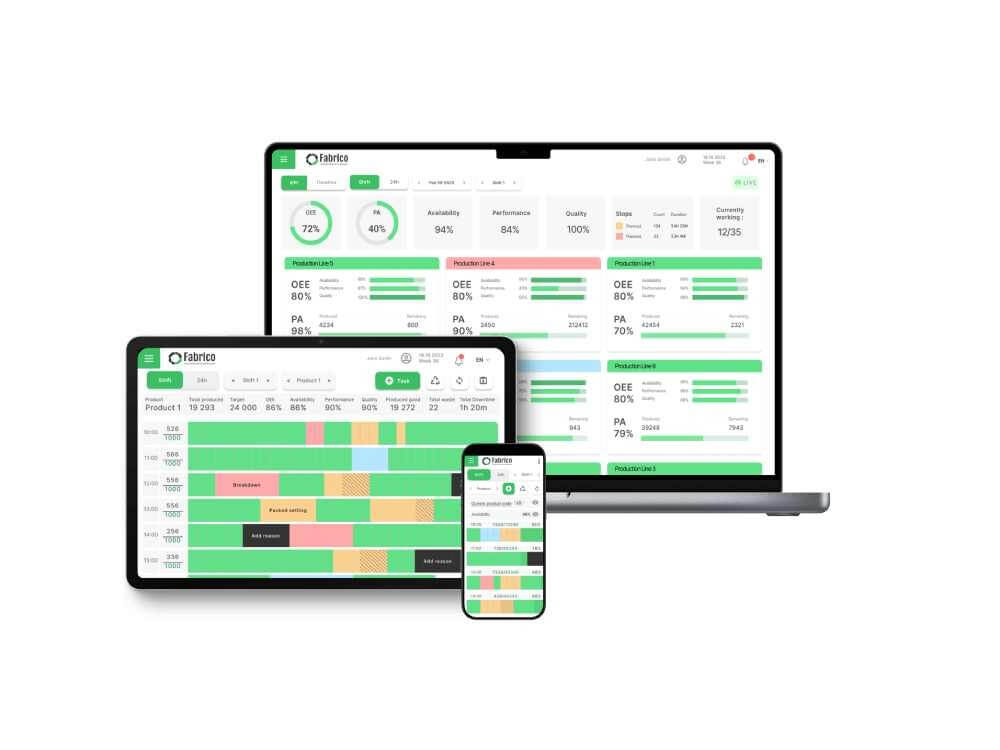
Fabrico is not just a CMMS. It is a unified platform that connects the Machine Signal to the Maintenance Action.
1. One Event, One Record
When the PLC triggers a "Fault," Fabrico captures it as a Downtime Event (OEE).
Simultaneously, it creates a "Pending Request" for maintenance.
The Operator and the Technician are looking at the same event record. There is no translation error.
2. Condition-Based Triggers
Instead of maintenance happening on a calendar (blindly), it happens based on the OEE reality.
3. The "Closed Loop" Improvement
When a technician closes a Work Order, they select a "Root Cause." This data feeds back into the OEE loss categorization.
The OEE report doesn't just say "Unplanned Downtime"; it says "Bearing Failure - Fixed."
Summary: One Team, One View
You cannot achieve Operational Excellence with fragmented tools.
Silos create arguments. Unified data creates solutions.
By consolidating OEE and Maintenance into Fabrico, you align the goals of the entire plant. You stop managing "Departments" and start managing Throughput.
Ready to unify your factory?
See how Fabrico connects Production and Maintenance in one platform.
Book a Demo with Fabrico Today


 Login
Login
 Blog
Blog