What is the difference between Fabrico and Evocon?
The primary difference between Fabrico and Evocon is that Fabrico is a unified "System of Action" that natively integrates OEE with a Field-Ready CMMS, whereas Evocon is a visual OEE monitoring tool focused on floor-level awareness and manual downtime tagging.
For Mike (the Tactical Manager), Evocon provides a clear view of how many hours were lost today.
However, it leaves him with the manual burden of radioing a technician, checking a separate maintenance database, and hoping the "Root Cause" was logged accurately.
Fabrico bridges this gap by ensuring every performance dip automatically triggers a prioritized, digital Work Order on the technician’s mobile device.
Visual Awareness vs. Maintenance Execution
Evocon is widely praised for its user-friendly interface that makes OEE tracking accessible to operators on the floor.
It is an excellent tool for "counting the losses," but it is not an engineering platform.
For Tom (the Lead Technician), a visual scoreboard doesn't help him manage MRO inventory or access the digital SOPs needed to fix a complex high-pressure pump.
Fabrico provides Tom with a Field-Ready CMMS that includes QR Code scanning and offline mobile access directly at the machine.
This ensures that Tom spends his day on high-impact "Wrench Time" rather than administrative data entry or searching for manuals in the office.
Capturing the "Invisible" Loss: Visual RCA vs. Manual Tagging
High-speed lines are plagued by micro-stops that are too frequent for operators to tag manually and too fast for traditional sensors to explain.
Evocon relies on operators to select a reason for every stop, which often leads to the "Pencil Whip" trap where "Unknown" or "General Fault" becomes the default code.
Fabrico utilizes Computer Vision (Inefficiencies Zoom-In) to provide the objective, visual truth.
When a micro-stop occurs, the system flags a high-definition video clip of the exact moment of failure.
Instead of arguing about what happened during the night shift, Mike can "Zoom-In" to see if the cause was a material defect or a mechanical misalignment.
Comparison Matrix: Fabrico vs. Evocon
| Feature |
Evocon (Visual OEE) |
Fabrico (System of Action) |
| Primary Goal |
Visual Awareness / Tracking |
Operational Uptime / Action |
| Maintenance Link |
None / Third-Party |
Native Integrated CMMS |
| Response Trigger |
Visual Floor Alert |
Automated Mobile Work Order |
| Micro-stop RCA |
Manual Operator Input |
Visual (Zoom-In) + Machine Data |
| Planning Logic |
Static |
Predictive / Machine-Aware |
| Mobile Experience |
Browser-Based |
Field-Ready Native App |
| Implementation |
1-2 Months |
3-4 Months (Full Factory Loop) |
The Strategic ROI: Reclaiming Your Hidden Factory
For Paula (the Strategic Leader), the choice between Fabrico and Evocon is a choice between "Monitoring" and "Engineering."
By choosing an integrated platform, she reduces the Total Cost of Ownership (TCO) and eliminates the "Data Silos" that typically prevent continuous improvement.
By identifying "Bad Actor" assets through real-time performance data, she can move her team to Condition-Directed Tasks.
This directly reduces the Maintenance Cost per Unit and ensures that her multi-million dollar assets reach their full residual value.
As you gather 12 months of clean operational data, you are also preparing the facility for the Fabrico Agent (AI Roadmap).
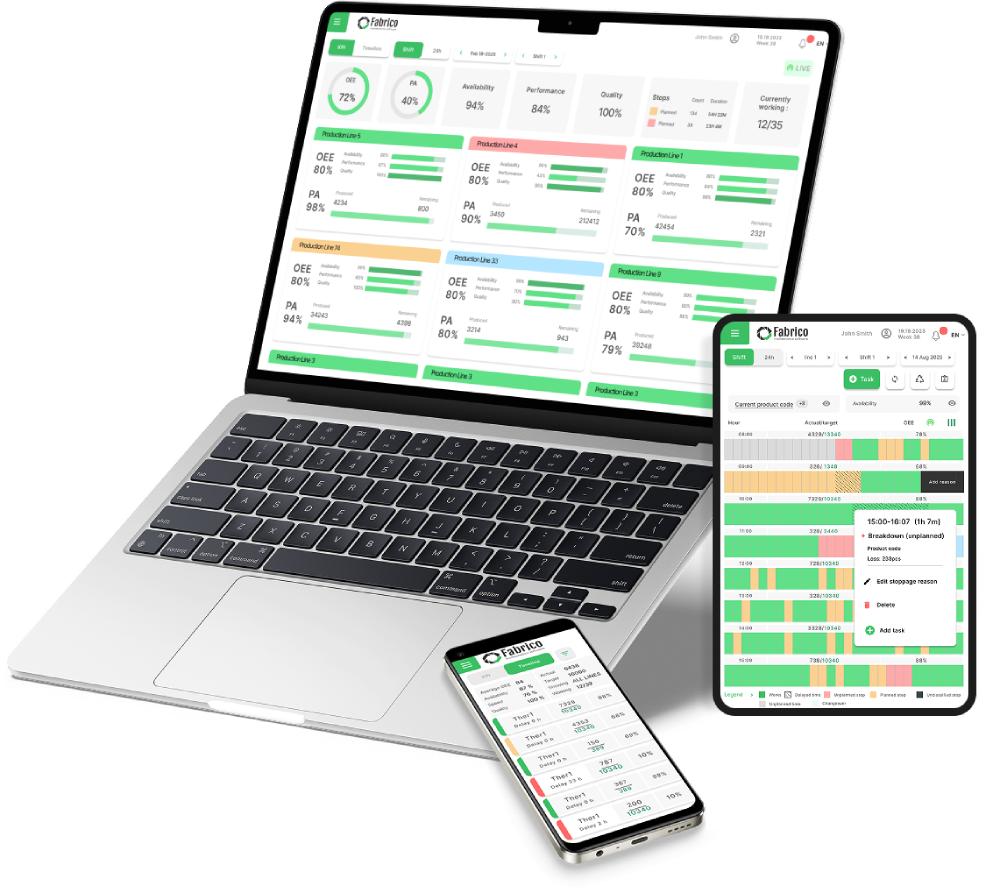
Stop watching the score. Start engineering uptime with a System of Action.


 Login
Login
 Blog
Blog