Implementing a Failure Reporting, Analysis, and Corrective Action System is a foundational requirement for industrial reliability.
Operations directors rely on this methodology to permanently eliminate recurring equipment bottlenecks.
Unfortunately, the way most factories execute this framework is fundamentally broken.
Highly skilled engineers spend hours manually transferring downtime codes from paper clipboards into disconnected spreadsheets.
This creates an operational latency that actively destroys your profit margins.
Here is the strategic 2026 guide to modernizing your continuous improvement framework.
We will explore how modern factories digitize every single letter of the FRACAS acronym to protect their yield integrity.
What is FRACAS in Manufacturing?
FRACAS in manufacturing stands for Failure Reporting, Analysis, and Corrective Action System. It is a closed loop reliability engineering process used to identify equipment failures, determine their root causes, and deploy permanent solutions to prevent recurrence.
A modern digital system automates this entire workflow to minimize machine downtime and extend asset lifecycles.
The Intelligence Gap of Analog Systems
Traditional manufacturing facilities run their reliability programs in an operational vacuum.
When a machine breaks down, an operator writes a vague description of the fault on a paper log.
A maintenance planner reviews this log days later and attempts to piece together what actually happened.
This analog reporting method introduces a massive intelligence gap into your factory.
Operators under pressure to meet production quotas frequently engage in pencil whipping.
They document what the engineer wants to see rather than what actually occurred on the assembly line.
Basing your boardroom decisions on this fabricated data guarantees that your factory will remain stuck in a cycle of reactive firefighting.
Reporting: Automating Detection with Native OEE
The first step of the framework requires you to accurately report the failure.
You cannot fix a process if your baseline data is subjective and flawed.
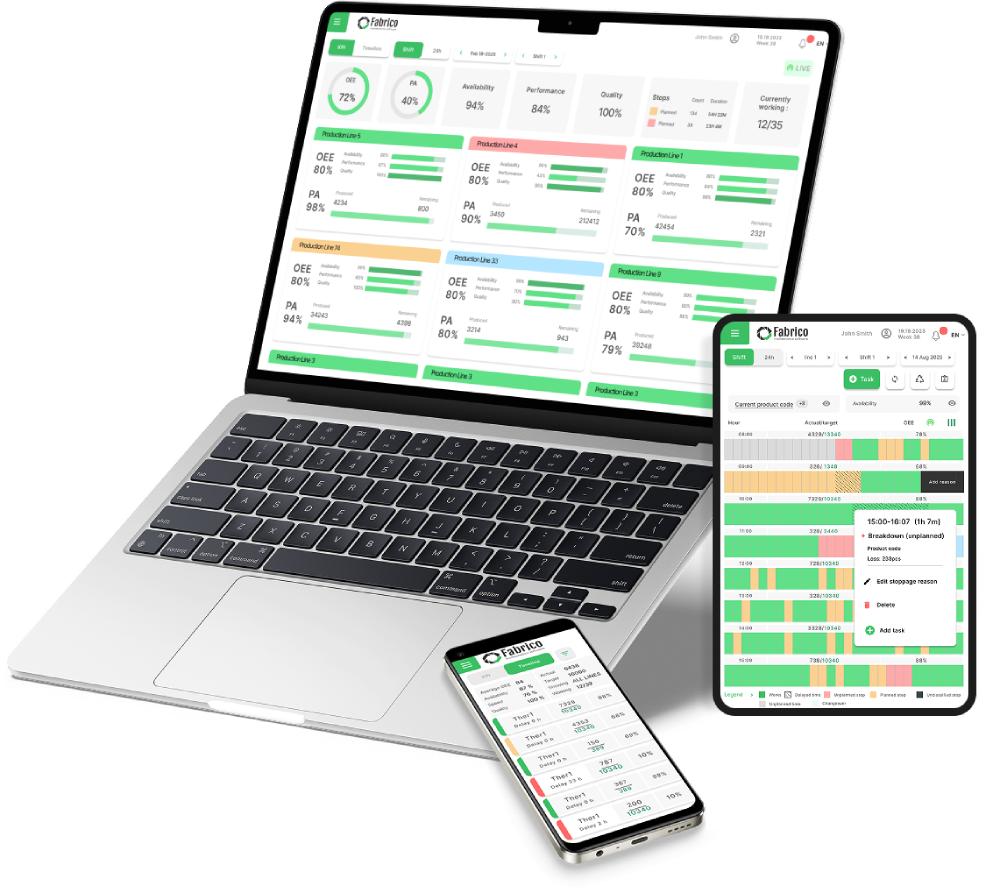
A unified manufacturing platform solves this by deploying Native OEE tracking across your facility.
By connecting directly to your machine logic controllers, the system monitors Availability, Performance, and Quality in real time.
It records every cycle time variation and micro stop to the exact second.
You no longer have to rely on an exhausted operator to report a drop in machine speed.
The Native OEE system automatically flags the anomaly, providing a flawless baseline for your failure report.
Analysis: Visual Evidence via Computer Vision
Once a failure is reported, your engineers must conduct a thorough root cause analysis.
Sensors are highly effective at registering a sudden drop in machine cycle times.
Unfortunately, raw sensor data cannot explain the human variables that often cause high speed packaging bottlenecks.
Leading manufacturers solve this diagnostic mystery by utilizing Computer Vision technologies.
Industrial cameras mounted above your production lines act as an objective digital witness.
When a downtime event occurs, engineers use the Inefficiencies Zoom In feature to watch a high definition video replay.
You gain absolute visual proof of the root cause, completely eliminating the need for departmental finger pointing.
Corrective Action System: The Field Ready CMMS
Diagnosing a critical failure adds zero value to your bottom line if you cannot deploy a cure immediately.
Standalone production dashboards are passive tools that highlight your failures without fixing them.
We firmly believe that OEE data diagnoses the illness, while a modern CMMS administers the treatment.
Our unified platform automates the transition from failure analysis to maintenance execution.
When your team identifies the root cause using video replay, the system generates a prioritized condition based work order.
A mobile alert is dispatched directly to the nearest technician via the Field Ready CMMS.
The technician scans a QR code on the machine to unlock digital standard operating procedures and execute the corrective action flawlessly.

Protecting the Master Production Schedule
Executing a corrective action usually requires taking a critical asset offline.
When your maintenance software operates independently of your production planning, your supply chain logistics suffer.
The Interactive Planning Board eliminates this operational latency completely.
This drag and drop scheduling tool reacts dynamically to your real time maintenance constraints.
If a corrective repair requires three hours of downtime, the board automatically recalculates the upcoming production runs.
Your leadership team never has to overpromise on deliverables because the schedule reflects actual machine availability.
The Autonomous Reliability Roadmap
The next generation of failure reporting and analysis will be driven by automated intelligence.
We are actively developing advanced capabilities to support your continuous improvement engineers.
The Fabrico Agent is an artificial intelligence engine currently in beta on our product roadmap.
It will autonomously analyze your historical OEE data to suggest updated preventive maintenance schedules and highlight recurring defect patterns.
Concurrently, the upcoming Fabrico Assistant will serve as a generative AI troubleshooting guide.
Technicians will be able to query complex equipment manuals using natural language directly from their smartphones.
Securing Your Enterprise Valuation
You cannot achieve high speed continuous flow by leaving your failure reports in a static spreadsheet.
Your reliability department requires immediate access to the exact performance metrics of your production line.
By choosing a unified platform that combines machine validated data with mobile work execution, you permanently close the loop.
This integrated strategy turns failure reporting from a passive academic exercise into an active driver of corporate profitability.


 Login
Login
 Blog
Blog