The Site-Silo Trap: Why Local Success is an Enterprise Risk
What is Group-First OEE for multi-site manufacturers?
Group-First OEE is a centralized digital framework that consolidates real-time production performance and maintenance data from multiple facilities into a single source of truth, allowing leadership to enforce global standards and compare site-by-site KPIs.
Most manufacturers operate in "Silos," where each plant manager chooses their own tracking tools and maintenance methods.
This fragmentation creates "Data Inconsistency," making it impossible for Paula to see if a performance gap is due to machine age, operator skill, or a failed maintenance strategy.
Fabrico eliminates this blindness by providing a unified data layer that captures the Hidden Factory across your entire global footprint.
Standardizing "What Good Looks Like" with Master PM Templates
High-speed lines in Food & Beverage or Plastics require precise maintenance to avoid the "Six Big Losses."
When Plant A discovers a specific lubrication cycle or setup adjustment that increases cycle speed by 5%, that win should be global.
Fabrico allows you to define a "Master PM Template" for specific asset classes and push it to every site instantly.
This ensures that Tom (the Technician) in the USA is following the same best-in-class procedures as the team in Germany.
By enforcing these global standards, you protect the Residual Asset Value of your multi-million dollar investments and ensure consistent OEE Quality across all regions.
Identifying Global "Bad Actors"
Not all machines of the same model perform equally across different environments.
Fabrico’s Group-First Architecture identifies "Bad Actor" assets that underperform the group average.
If a specific brand of high-pressure homogenizer has a 20% higher MTTR (Mean Time to Repair) in your Brazil plant, the system flags the anomaly for investigation.
This allows Mike (the Tactical Manager) to determine if the issue is local training, poor spare parts quality, or a specific environmental factor.
Comparison Matrix: Local Dashboards vs. Group-First Systems
| Strategic Requirement |
Standalone Local Dashboards |
Enterprise ERP / MES |
Fabrico (Group-First) |
| KPI Benchmarking |
Manual / Excel Heavy |
Batch-Processed / Slow |
Real-Time / Native |
| Standardization |
Zero (Local Only) |
Rigid / Hard to Change |
Agile / Master Templates |
| Visibility |
Site-Limited |
High-Level Financial |
Operational (Deep-Dive) |
| Maintenance Link |
None / Disconnected |
Delayed / Financial |
Native Integrated CMMS |
| Decision Latency |
High (Days/Weeks) |
Moderate |
Zero (Automated Triggers) |
| ROI Strategy |
Reporting |
Compliance |
Global Capacity Reclamation |
The Virtual Warehouse: Sharing Knowledge and Spares Across Plants
For the Strategic Leader, the "Virtual Warehouse" is a major financial lever.
Fabrico allows teams to see spare parts inventory across all locations in the group.
If a critical motor for a "Bad Actor" asset is out of stock in the Italy plant but available in Poland, the system facilitates an internal transfer.
This reduces the "Order-to-Fix" cycle and eliminates the need for expensive "Emergency Air Freight" or high safety stocks at every site.
It turns your global inventory into a strategic asset that supports your Value Fulcrum and minimizes total downtime.
The Strategic Verdict: Engineering Enterprise Uptime
For Paula, the business case for Fabrico is built on the speed of enterprise-wide improvement.
By reclaiming just 3% of availability across ten sites through reduced Decision Latency, she can increase total group revenue by millions.
This unified data layer is also the essential prerequisite for the Fabrico Agent (AI Roadmap).
The Agent will eventually automate the comparison and optimization of global production schedules based on the real-time capability of every facility.
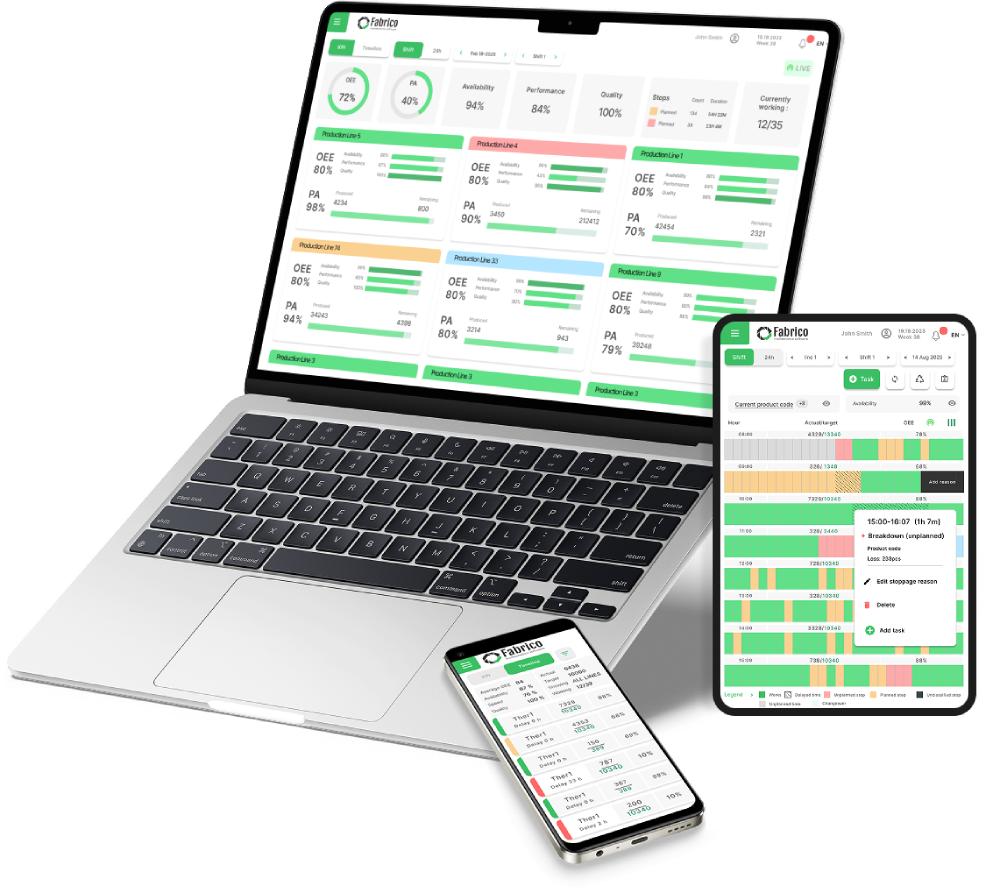
Stop managing site-by-site. Start engineering global uptime with a System of Action.


 Login
Login
 Blog
Blog