In the eyes of your customer, a great product delivered late is a failure.
Your sales team promises a delivery date. Your logistics team books the trucks. But if the production line stops on Thursday afternoon due to a broken motor, that truck leaves empty, or it leaves half-full.
This is why On-Time In-Full (OTIF) is the "King of Metrics." It is the scorecard your customers use to grade you. Retailers like Walmart and Amazon impose massive fines for low OTIF scores. Automotive OEMs will de-certify suppliers who miss targets.
Many manufacturers try to fix OTIF by "padding" their lead times or holding massive safety stock. This kills cash flow.
The real way to fix OTIF is to fix the variability in your factory. You need a production process that is boringly predictable.
Here is the strategic guide to analyzing and improving OTIF in 2026.
1. Deconstructing the Metric
OTIF seems simple, but it is harsh.
-
On-Time: Delivered within the specific window (not early, not late).
-
In-Full: The exact quantity ordered (no backorders, no partials).
The Math of Failure:
If you ship On-Time 95% of the time, and In-Full 95% of the time, your OTIF is 90.25% (0.95 x 0.95).
To hit a 98% OTIF target, your internal operations must be near-perfect.
2. The "Hidden" Killer of OTIF: Unplanned Downtime
When you miss an OTIF target, do a "5 Whys" analysis.
-
Why was the shipment late? Production wasn't finished.
-
Why wasn't it finished? The packaging line ran slow.
-
Why did it run slow? The labeler kept jamming (Micro-stops).
The Insight:
Logistics didn't fail. Maintenance failed.
If you schedule a production run to take 8 hours, but breakdowns stretch it to 12 hours, you miss the shipping window.
3. The "In-Full" Challenge: Quality Defects
Shipping "In-Full" means shipping good parts.
If you produce 1,000 units but Quality rejects 50 of them at the end of the line, you can only ship 950. You failed "In-Full."
The Strategy:
You need to move quality checks upstream.
-
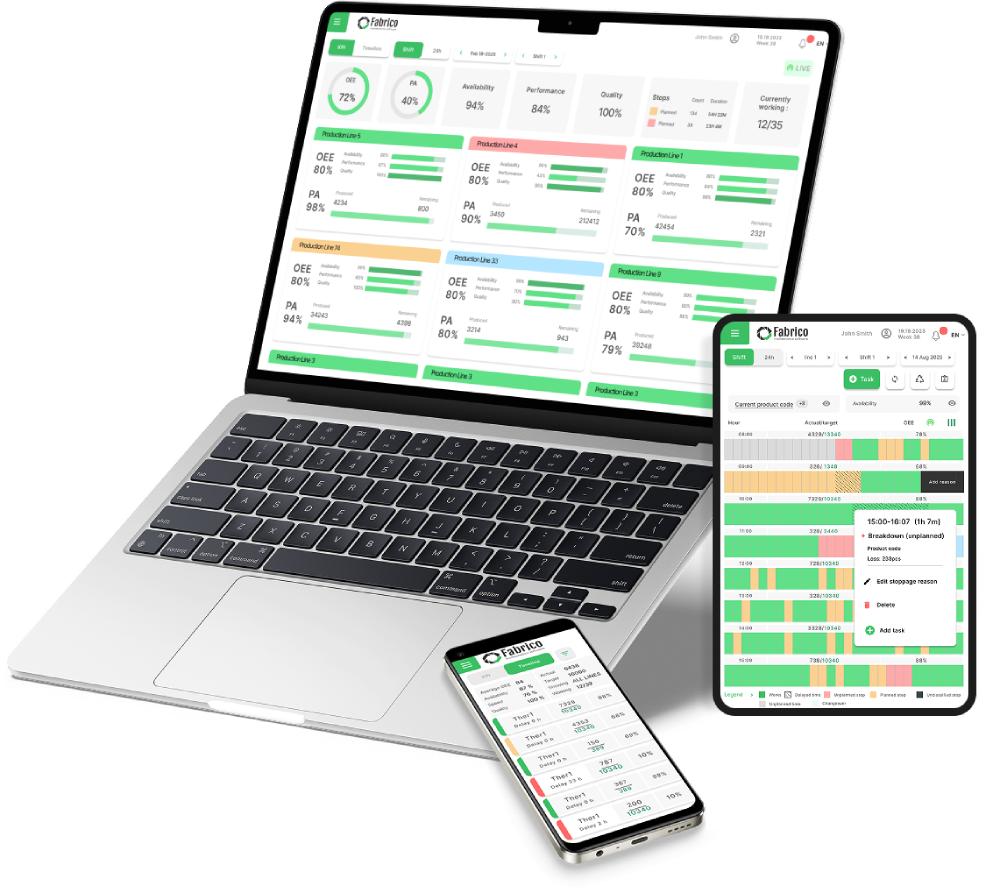
Use Digital Production Tracking: Monitor the "Good Count" in real-time using a system like Fabrico.
-
The Alert: If the scrap rate spikes in the middle of the shift, the Production Planner needs to know immediately so they can add a "Makeup Run" to the schedule before the truck arrives.
4. Aligning Maintenance with the Shipping Schedule
In many factories, Maintenance and Planning are enemies.
Planning wants to run 24/7. Maintenance wants to stop the machine to fix it.
The Solution: Synchronized Scheduling
-
Visual Boards: Use a shared digital calendar. If a major shipment is due Friday, schedule the critical maintenance for Tuesday, not Thursday.
-
Condition-Based Priority: If sensors show a bearing is deteriorating but can last 48 hours, schedule the repair after the critical batch is finished. Don't stop the line mid-run unless it's a safety risk.
5. Improving "Schedule Adherence"
Your ERP creates a plan. Your factory executes it.
Schedule Adherence measures how closely reality matched the plan.
How software helps:
Fabrico tracks the OEE (Availability x Performance x Quality) of the line.
If you know your true OEE is 75% (not the theoretical 90%), you can build realistic schedules.
Conclusion: Reliability is a Competitive Advantage
In a world of tight supply chains, being the "Reliable Supplier" allows you to charge a premium.
Customers will pay more for a guarantee.
By attacking the root causes of delay, downtime, scrap, and poor scheduling, you stop paying fines and start winning contracts.
Don't just track the shipment. Track the machine that makes the shipment possible.


 Login
Login
 Blog
Blog