What is the Hidden Factory in manufacturing?
The "Hidden Factory" is the untapped production capacity within a manufacturing plant that is currently lost to the "Six Big Losses": equipment failure, setup and adjustments, idling and minor stoppages, reduced speed, process defects, and reduced yield.
Recovering this capacity allows for increased output and revenue without the need for new machinery or additional floor space.
TEEP vs. OEE: Finding Your True Capacity
Paula, the Strategic Leader, often looks at OEE to judge plant performance. However, to truly understand capacity, we must look at TEEP (Total Effective Equipment Performance).
While OEE measures how well you perform during scheduled hours, TEEP measures performance against 24/7 calendar time. This distinction is the "Value Fulcrum." If your OEE is 85% but your TEEP is only 40%, you have a massive opportunity to scale production by smoothing your maintenance and changeover schedules.
Diagnosing the "Performance Hemorrhage"
Mike, the Tactical Manager, knows that machines rarely "break" for eight hours straight. Instead, they "hemorrhage" capacity through micro-stops—30 seconds of waiting for material, a 1-minute jam, or a slow operator hand-off.
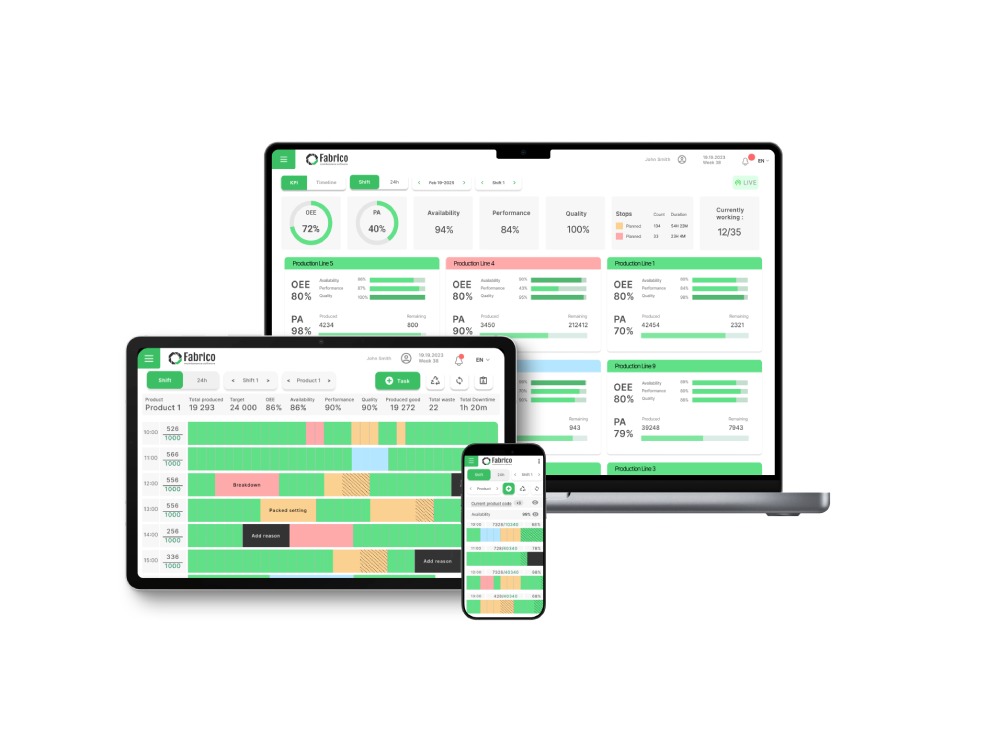
Traditional PLC sensors often miss these events because they don't reach the "downtime threshold." This is where the "OEE Gap" lives. Fabrico’s Computer Vision (Inefficiencies Zoom-In) uses overhead cameras to detect these manual inefficiencies and micro-stops. By providing video evidence of the root cause, it moves your team from guessing to solving.
The Pull System: OEE Diagnoses, CMMS Cures
The Toyota Template teaches us that maintenance should be "pulled" by the machine’s actual condition. If your OEE data shows a performance degradation on the labeling station, your system shouldn't just record it, it should act.
Unified Data Intelligence allows OEE drops to automatically trigger Condition-Directed (CD) Tasks in the CMMS. Instead of waiting for a total breakdown (Reactive) or over-servicing a healthy machine (Time-Based), your technicians are deployed exactly when the "Value Fulcrum" tips.
Recovering the 80/20 Profit
In world-class maintenance, 80% of failures come from 20% of your assets—the "Bad Actors." A unified platform allows you to link your MRO spend directly to OEE losses.
If Line 1 has the highest maintenance cost but the lowest Quality score, you have identified a "Zombie Asset." Using unified data, Mike can present Paula with a clear, data-driven business case for an overhaul, backed by the exact revenue loss from scrap and rework.
Capacity Growth: Unified vs. Siloed Systems
| Feature |
Fabrico (Unified) |
Legacy CMMS + Manual OEE |
| Capacity Discovery |
✅ TEEP & OEE Analytics |
❌ OEE only (Scheduled) |
| Micro-stop Detection |
✅ Computer Vision / AI |
❌ PLC only (Misses <2 min) |
| Maintenance Trigger |
✅ Condition-Directed (Pull) |
❌ Calendar-Based (Push) |
| Root Cause Validation |
✅ Visual/Video Replay |
❌ Tribal Knowledge |
| ROI Speed |
✅ Full value in 3-4 months |
❌ 12+ months (if ever) |
The Strategic Path to Operational Excellence
Increasing capacity is a journey from "Firefighting" to "World-Class." By integrating your production data with your maintenance execution, you stop treating maintenance as a cost center and start treating it as a Profit Center.
Fabrico is designed for the "Field-Ready" factory. It replaces paper binders with a mobile-first "System of Action" that ensures your technicians spend less time on admin and more time recovering the revenue hidden in your machinery.


 Login
Login
 Blog
Blog