In the rapid evolution of Artificial Intelligence, terminology matters.
Last year, everyone talked about Chatbots.
In 2026, the conversation has shifted to Agents.
For an Innovation Director, the distinction is critical.
Industrial AI Agents are the next frontier. They act as "Digital Co-Workers" that run in the background 24/7. They don't just read data; they reason with it. They look for opportunities to save time and money that humans are too busy to notice.
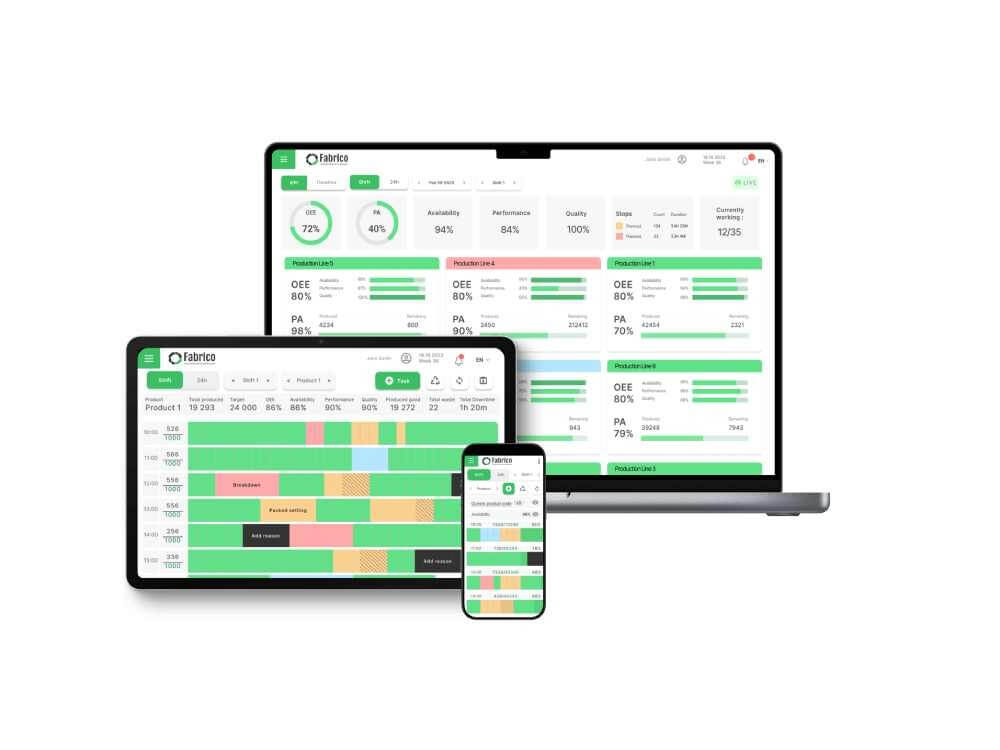
Here is the vision for Agentic AI in maintenance, and how Fabrico is building the infrastructure to make it a reality.
The Role of the Agent: Moving from "Read" to "Reason"
Humans are great at complex physical tasks and creative problem-solving. We are bad at monitoring 5,000 variables simultaneously.
Agents excel at the boring, repetitive logic that keeps a factory running.
1. The Agent as "Scheduler"
Maintenance scheduling is a constant conflict between Production Needs and Maintenance Needs.
-
The Human Limit: A planner checks the schedule once a day. If production stops unexpectedly at 10:00 AM, the planner might not notice the opportunity until noon.
-
The Agent Vision: The Agent watches the OEE Feed continuously.
-
Observation: "Line 4 has stopped for a material shortage. Duration estimate: 2 hours."
-
Reasoning: "We have a pending 'Lubrication Task' for Line 4 (30 mins)."
-
Action: The Agent pings the Maintenance Lead: "Suggestion: Deploy Tech to Line 4 now to complete PM during downtime?"
2. The Agent as "Supply Chain Watchdog"
Spare parts management is often reactive. We order when we run out.
3. The Agent as "Reliability Scout"
Data analysis is often done "at the end of the month." By then, the damage is done.
The Fabrico Approach: Human-in-the-Loop
There is a fear in manufacturing that AI will "take control." This is not the goal.
At Fabrico, we believe in Human-Centric Automation.
The Fabrico Agent is designed to be a "Co-Pilot," not an Autopilot.
This keeps the human in control of safety and strategy, while offloading the data crunching to the software.
Data Readiness: You Can't Have Agents Without Structure
An Agent needs a map. If your maintenance data is unstructured (handwritten notes, disconnected Excel sheets), the Agent will be lost.
Fabrico is the Map.
We provide the structured environment where Agents can thrive:
-
Digital Assets: A clear hierarchy for the Agent to navigate.
-
Digital Inventory: Accurate counts for the Agent to monitor.
-
Digital Schedules: A dynamic board for the Agent to optimize.
Implementing Fabrico today captures the data that will train your Agents tomorrow.

Comparison: The Evolution of Help
| Feature |
CMMS (The Tool) |
Chatbot (The Assistant) |
AI Agent (The Co-Worker) |
| Interaction |
You type data in. |
You ask a question. |
It notifies you. |
| Role |
Record Keeper |
Knowledge Retriever |
Logic Optimizer |
| Trigger |
Human Input |
Human Prompt |
Data Pattern |
| Value |
Compliance |
Efficiency |
Proactivity |
| Status |
Standard |
Emerging |
The Future (Fabrico Vision) |
Conclusion: Hire Your Digital Team
The factories of the future will be run by hybrid teams: Humans solving physical problems, supported by Agents solving logical problems.
Don't wait for the future to arrive. Start building the data foundation today.
Prepare for the next level.
[Request a Demo] and see how Fabrico structures your factory for intelligence.


 Login
Login
 Blog
Blog