What is a "Frankenstein" tech stack in manufacturing?
A Frankenstein tech stack is a collection of disconnected software tools—such as a standalone OEE tracker, a separate maintenance database, and a custom reporting layer—that requires manual intervention or complex APIs to communicate.
This fragmented approach is the "Silent Killer" of OEE software ROI.
For Mike (the Tactical Manager), it means looking at one screen to see a performance drop and another screen to assign a work order.
Fabrico eliminates this friction by ensuring the machine signal and the maintenance response live in the same digital environment.
The Hidden Costs of Disconnected Data
Why is an integrated OEE and CMMS better than separate tools?
Integrated systems eliminate the "Integration Tax," which includes the hidden costs of manual data entry, broken API connections, and the inability to perform visual root cause analysis across silos.
When your OEE data and your Field-Ready CMMS don't talk, you lose the "Value Fulcrum."
Technicians arrive at the machine without knowing the specific OEE trend that preceded the failure.
This results in higher MTTR (Mean Time to Repair) because the team is fixing symptoms rather than the process-driven root causes.
Fabrico: The Unified System of Action
Fabrico bridges the gap between Production (Data) and Maintenance (Action) through a single, field-ready interface.
By utilizing the Visibility Trifecta, PLC signals, operator context, and AI-powered Computer Vision, we capture 100% of the truth.
When a micro-stop occurs, the system doesn't just alert the manager; it triggers a prioritized Work Order.
Tom (the Technician) receives a smart notification on his mobile device that includes the Inefficiencies Zoom-In video clip of the failure.
This ensures your team spends less time in meetings and more time on the high-impact "Wrench Time" that drives profitability.
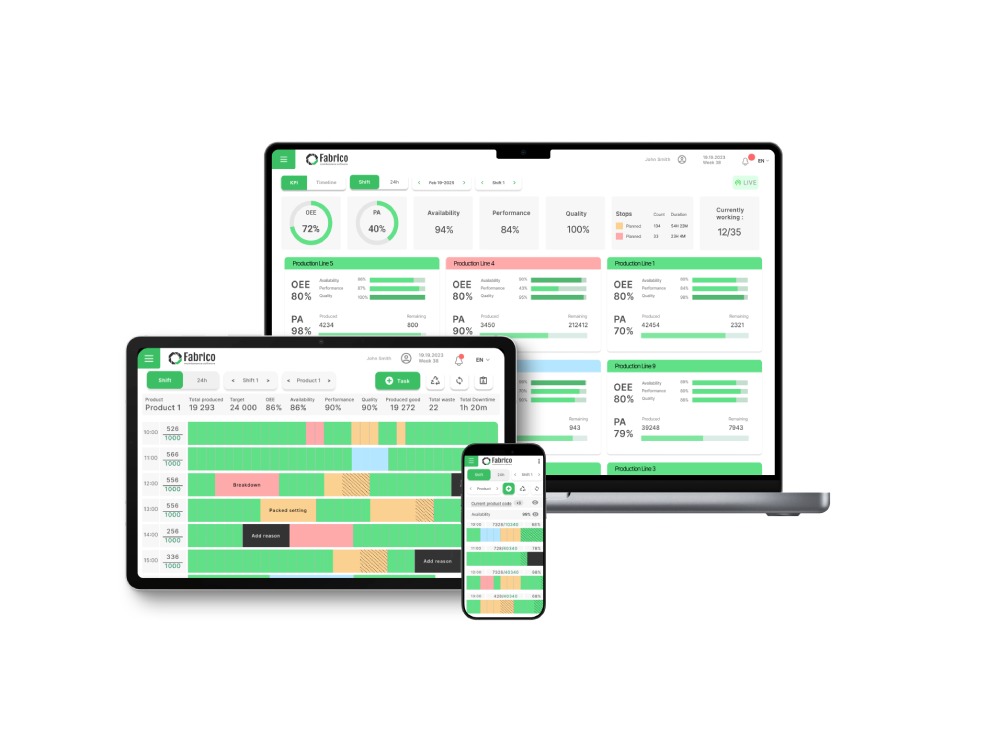
Comparison Matrix: Frankenstein Stack vs. Fabrico System of Action
| Capability |
Frankenstein Stack (Siloed) |
Legacy ERP Modules |
Fabrico (System of Action) |
| Data Synchronization |
Manual / Delayed API |
Batch / Financial Focus |
Native / Real-Time |
| Response Trigger |
Human Intervention |
Periodic Review |
Automated OEE-to-CMMS |
| Micro-stop RCA |
Data-Only / Subjective |
None |
Advanced Visual Zoom-In |
| User Adoption |
Low (Multiple Apps) |
Very Low (Too Complex) |
High (One Native App) |
| TCO (Total Cost) |
High (Multiple Fees) |
Very High (Customization) |
Optimized (Unified) |
| Implementation |
Ongoing / Never Finished |
12-18 Months |
3-4 Months |
The Financial Impact: Lower TCO and Faster Uptime
For Paula (the Strategic Leader), the business case for Fabrico is built on "Capacity Reclamation" and cost consolidation.
By eliminating the need for three separate subscriptions, she instantly lowers her annual software spend.
More importantly, she reclaims the revenue previously lost in the Hidden Factory by reducing Decision Latency.
By identifying "Bad Actor" assets through unified data, she can move her team to Condition-Directed Tasks on the machines that actually need attention.
This turns maintenance from a "cost center" into a strategic lever for Operational Excellence.
Stop fighting your software. Start engineering your uptime with a System of Action.


 Login
Login
 Blog
Blog