For 50 years, manufacturers have worshipped at the altar of the Toyota Production System (TPS). We implemented 5S, we hung whiteboards, and we counted inventory with Kanbans.
And it worked. It reduced waste and improved quality.
But in 2026, "Analog Lean" has hit a ceiling.
The modern factory moves too fast for sticky notes. When a high-speed packaging line jams for 10 seconds, no operator has time to write it down on a "Red Tag" log. The data is lost. The waste remains.
Lean isn't dead. But the tools we use to execute it are obsolete.
To survive in the high-speed economy, you must upgrade from Analog Lean to Digital Lean.
Here is why your whiteboard is holding you back, and how to digitize your improvement culture.
1. The "Observer Effect" (Stopwatch vs. Sensor)
The Old Way: An engineer stands behind an operator with a stopwatch to measure Takt Time.
-
The Problem: The operator works differently when watched (The Hawthorne Effect). The data is biased.
-
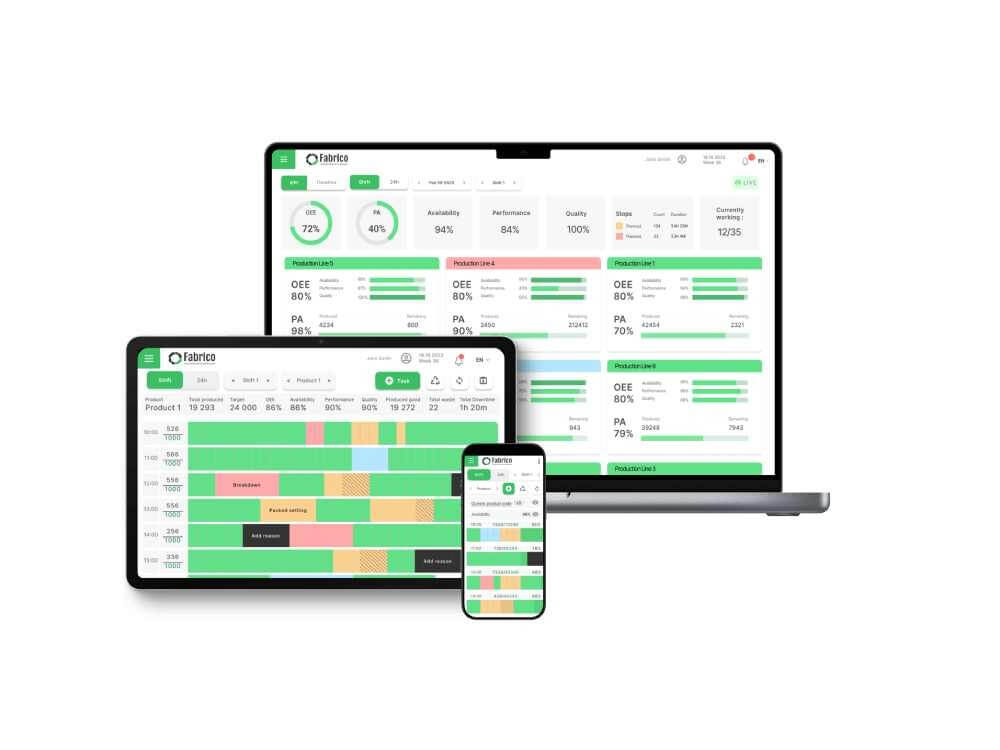
The Digital Way: Fabrico connects to the machine sensors or uses Computer Vision. It measures every single cycle 24/7. It builds a "True Takt Time" based on thousands of data points, not a 30-minute observation. You see the real variation, not the performed consistency.
2. The "Memory Gap" (Downtime Logs)
The Old Way: The machine stops. The operator clears the jam. At the end of the shift, they write "Jam" on the log sheet.
-
The Problem: You don't know which jam. You don't know why. You just have a generic word on a piece of paper. This makes Root Cause Analysis (RCA) a guessing game.
-
The Digital Way: Visual Context. Fabrico captures a video clip of the jam automatically. The CI team watches the "Game Tape." They see the guide rail wobble. They fix the rail. The jam never happens again. This is Poka-Yoke (Mistake Proofing) powered by video.
3. The "Gemba Walk" (Static vs. Live)
The Old Way: Management walks the floor at 9:00 AM. They look at yesterday's numbers written on a board.
-
The Problem: They are managing the past. They are asking "Why did we fail yesterday?" instead of "How do we win today?"
-
The Digital Way: Live Tier Boards. The dashboard on the shop floor TV shows Real-Time OEE. If the line is behind at 9:00 AM, the manager can deploy resources now to recover the shift. The Gemba Walk becomes a strategy session, not a history lesson.
How to Digitize Without Losing the "Human" Touch
The fear of Digital Lean is that it turns people into robots. The reality is the opposite.
When you remove the burden of Data Collection (writing things down) from the operator, you free them up for Problem Solving.
-
Step 1: Stop asking operators to count parts. Let the PLC do it.
-
Step 2: Stop asking operators to describe the breakdown. Let the Video do it.
-
Step 3: Ask the operator: "Based on this video and this data, how do we fix it?"
This allows your team to focus on the Improvement part of Continuous Improvement.
Conclusion: Speed is the New Waste
In traditional Lean, inventory was the biggest waste (Muda). In Digital Lean, Latency is the biggest waste. The time between a "Problem Occurring" and a "Solution Implemented" is where you lose money.
Paper is slow. Digital is instant.

Don't throw away your Lean principles. Give them a processor upgrade with Fabrico.


 Login
Login
 Blog
Blog