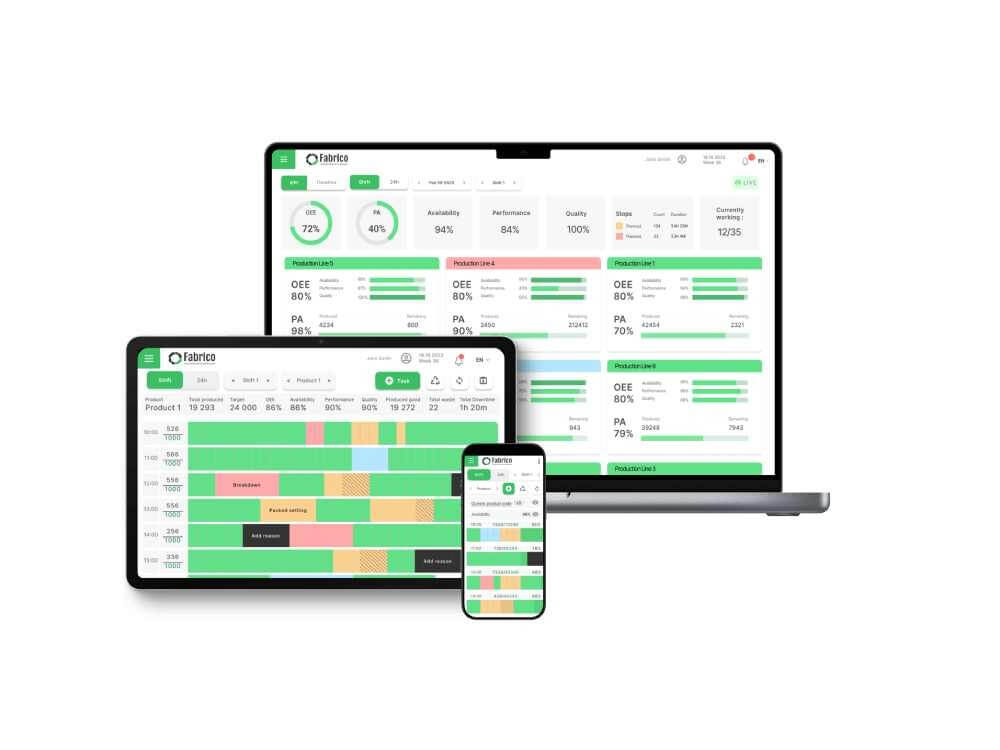
For decades, maintenance software has been a Digital Filing Cabinet.
You put a Work Order in. It stays there forever. If you buy a new machine, the software doesn't "learn" anything from the old machine's history. It just opens a new empty drawer.
In 2026, the paradigm is shifting to Machine Learning (ML).
The goal of ML in maintenance is to create a "Learning Factory." Every time a machine breaks and is fixed, the system should get smarter. It should recognize the symptoms earlier next time.
But for Innovation Directors, ML can feel abstract. How do you actually apply it?
The answer starts with Data Structure. You cannot have a "Learning System" if you don't have a "Teaching Curriculum" (your data).
Here is how to prepare your maintenance operation for the Machine Learning era with Fabrico.
What is Machine Learning in Maintenance?
It is simply Pattern Recognition at scale.
A human Reliability Engineer can analyze 50 work orders to find a pattern. An ML algorithm can analyze 50,000 work orders, sensor logs, and OEE events in seconds.
1. Learning from "Bad Actors" (Anomaly Detection)
-
The Human Limit: You might notice that "Press #1" breaks often.
-
The ML Capability: An algorithm notices that "Press #1" breaks specifically when the ambient temperature is above 25°C and the line speed exceeds 80 units/minute.
-
The Fabrico Foundation: To enable this, Fabrico captures the Context (Speed, Temp, Time) alongside the Failure. We build the dataset that makes this insight possible.
2. Learning from "Successful Fixes" (Recommendation Engines)
-
The Human Limit: A technician guesses which part to swap.
-
The ML Capability: The system looks at 5 years of history. It sees that for Error Code 404, replacing "Sensor A" fixed it 90% of the time, while replacing "Cable B" only worked 10% of the time.
-
The Vision: The Fabrico Assistant will eventually prompt the technician: "Suggestion: Check Sensor A first (90% success rate)."
3. Learning from "Visuals" (Computer Vision Training)
-
The Human Limit: You can't watch every machine 24/7.
-
The ML Capability: By recording thousands of "Jam" events via Inefficiencies Zoom-In, the system learns what a "Jam" looks like pixel-by-pixel.
-
The Future: Eventually, the camera will detect the jam before it stops the machine, triggering an automated alert.
The Reality Check: You Need "Training Data"
This is where most ML projects fail. Companies buy an expensive AI tool and plug it into their messy Excel sheets or paper logs.
The AI fails because it has nothing to learn from.
Fabrico is your ML Data Infrastructure.
We ensure your "Training Data" is high quality by enforcing:
-
Standardized Failure Codes: No more free-text "Fixed it." We force structured inputs (Component > Problem > Cause).
-
OEE Synchronization: We timestamp maintenance actions against production cycles perfectly.
-
Digital Asset Hierarchy: We ensure "Motor A" is correctly linked to "Conveyor B" so the relationship is clear.
The Roadmap: From Structured Data to Automated Agents
Fabrico is developing the Fabrico Agent to be the consumer of this data.
-
Step 1 (Now): You use Fabrico to capture clean, structured, connected data.
-
Step 2 (Near Future): The Fabrico Assistant allows you to query this data with natural language.
-
Step 3 (Future): The Fabrico Agent uses ML to proactively optimize your schedule and predict failures based on the data you are collecting today.

Comparison: Static Software vs. Learning Systems
| Feature |
Static CMMS (Database) |
ML-Ready System (Fabrico) |
| Data Structure |
Free Text / Messy |
Structured / Tagged |
| Relationship |
Isolated Tables |
Interconnected Graph |
| Logic |
"If/Then" Rules |
Pattern Recognition |
| Growth |
Database grows larger |
System grows smarter |
| Goal |
Compliance |
Optimization |
Conclusion: Start Teaching Your System
You cannot turn on Machine Learning tomorrow if you don't start collecting structured data today.
Every Work Order you log in Fabrico is a lesson for your future AI.
Build your future intelligence.
[Request a Demo] and start building the data foundation for your smart factory.


 Login
Login
 Blog
Blog