Tracking maintenance KPIs and metrics is the only way to measure the true reliability of your factory.
Operations directors rely on these critical data points to justify capital expenditures and manage their labor budgets.
Unfortunately, the way most manufacturing facilities gather this data is fundamentally broken.
Relying on tired operators and busy technicians to manually record their stop times on a paper clipboard guarantees inaccurate reporting.
When your leadership team makes multimillion dollar decisions based on fabricated performance scores, your enterprise valuation suffers.
Here is the strategic 2026 guide to mastering your industrial reliability metrics.
We will explore why you must replace analog tracking methods with unified asset intelligence to protect your profit margins.
What are Maintenance KPIs?
Maintenance Key Performance Indicators are quantifiable data points used to evaluate the efficiency and effectiveness of a factory's reliability program. These metrics track equipment health, labor utilization, and repair velocity.
The most critical maintenance KPIs include Mean Time To Repair, Mean Time Between Failures, Preventive Maintenance Compliance, and Overall Equipment Effectiveness.
The Latency Tax of Manual Reporting
The primary problem with traditional performance tracking is the absolute reliance on human memory.
When a critical packaging machine jams, the operator is under immense pressure to clear the fault and resume production.
They frequently fix the minor issue in thirty seconds and completely forget to log the downtime event on their clipboard.
This operational reality creates a massive intelligence gap known as the hidden factory.
Because dozens of micro stops go entirely undocumented, your total operational uptime appears much higher than it actually is.
This pencil whipping artificially inflates your Mean Time Between Failures and obscures your true capacity.
Your boardroom believes the factory is running flawlessly, but the reality on the shop floor is constant reactive firefighting.
Establishing Truth with Native OEE
You cannot optimize your equipment reliability if your baseline data is entirely subjective.
Machine degradation leaves a clear data trail long before a catastrophic failure occurs.
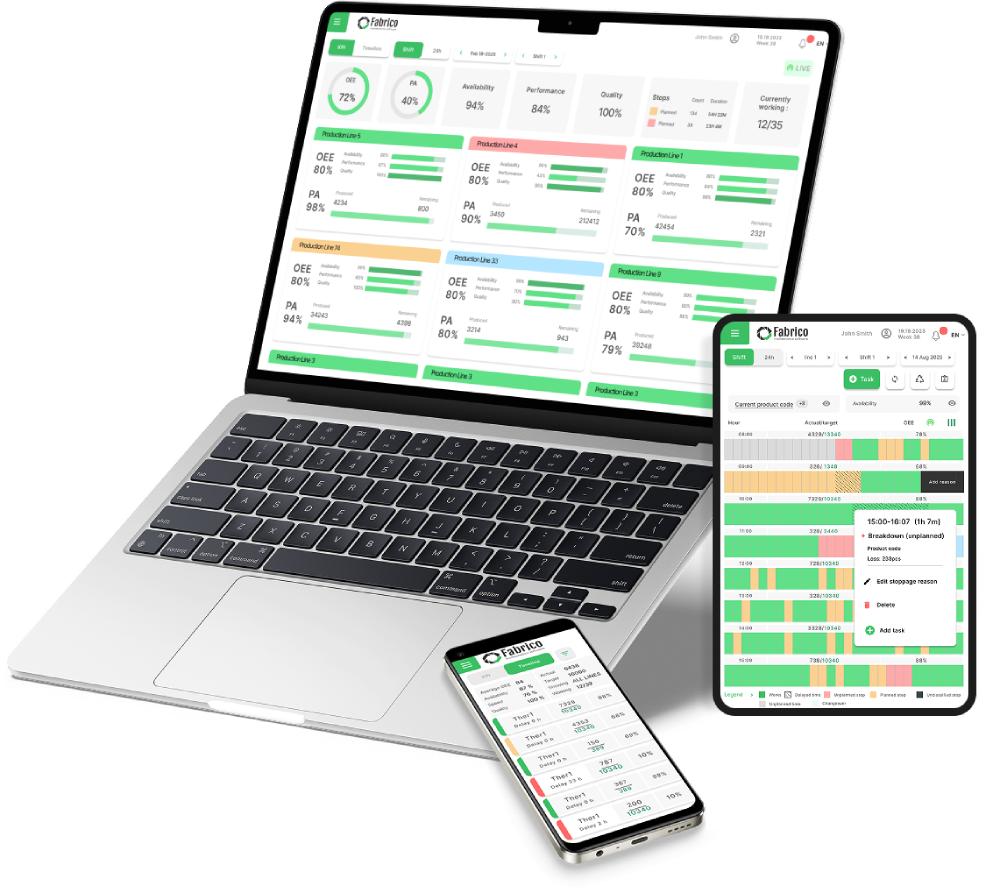
Native OEE tracking captures this operational reality by pulling signals directly from your logic controllers.
By connecting to your equipment, the system monitors exact cycle times and micro stops automatically.
It does not wait for a human operator to write down a fault code.
The Native OEE system stops the uptime clock the exact second the machine goes offline.
This machine validated truth provides your engineering team with a flawless, unalterable baseline for all performance metrics.
Visual Diagnostics via Computer Vision
Data from your logic controllers will tell you exactly how often a machine is failing.
However, raw data cannot explain the human variables or physical mechanics that cause a premature breakdown.
If your reliability metrics are dropping rapidly, you must understand exactly why the asset is degrading.
Leading factories solve this diagnostic mystery by demanding Computer Vision capabilities.
Industrial cameras mounted above your assembly lines act as an objective digital witness.
When a downtime event occurs, engineers can use the Inefficiencies Zoom In feature to watch a high definition video replay.
You gain absolute visual proof of the root cause, completely eliminating the need for diagnostic guesswork.
Improving PM Compliance with a Field Ready CMMS
Knowing that an asset is failing frequently adds zero value to your bottom line if you cannot prevent it.
Standalone production dashboards are passive tools that highlight your failures without offering a mechanism to improve them.
We firmly believe that OEE data diagnoses the illness, while a modern CMMS provides the physical cure.
To increase your reliability metrics, your technicians must execute preventive maintenance flawlessly.
A Field Ready CMMS allows technicians to receive prioritized preventive work orders directly on their mobile devices.
They must scan a QR code on the physical asset to unlock the required Digital CILs (Clean, Inspect, Lubricate).
By forcing mandatory photo uploads and digital signatures, you guarantee the preventive work was completed to your exact standards.
This strict compliance prevents future breakdowns and permanently extends the lifespan of your machinery.

The Core Metrics You Must Automate
Selecting the right technology stack determines whether you actually improve your factory or simply report on its failure.
To achieve world class manufacturing efficiency, you must automate the tracking of four critical metrics.
First, automate your Mean Time To Repair by using system alerts to dispatch technicians instantly.
Second, automate your Mean Time Between Failures by capturing exact machine run hours directly from your PLCs.
Third, track your Preventive Maintenance Compliance automatically through your mobile work order completion rates.
Finally, track your Overall Equipment Effectiveness continuously to monitor the compounding impact of your availability, performance, and quality losses.
Protecting the Master Production Schedule
Frequent equipment failures directly threaten your ability to deliver products on time.
When your maintenance software operates independently of your production planning, your logistics suffer.
The Interactive Planning Board eliminates this operational latency completely.
This drag and drop scheduling tool reacts dynamically to your real time machine availability.
If a degrading asset requires three hours of emergency downtime, the board automatically recalculates the upcoming production runs.
Your leadership team never has to overpromise on deliverables because the schedule reflects actual machine availability.
The Autonomous Reliability Roadmap
The next generation of industrial reliability will be driven by automated intelligence.
We are actively developing advanced capabilities to support your continuous improvement engineers.
The Fabrico Agent is an artificial intelligence engine currently in beta on our product roadmap.
It will autonomously analyze your historical OEE data to predict failures and suggest optimized preventive maintenance schedules.
Concurrently, the upcoming Fabrico Assistant will serve as a generative AI troubleshooting guide.
Technicians will be able to query complex equipment manuals using natural language directly from their smartphones.
Securing Your Enterprise Valuation
You cannot achieve high speed continuous flow by leaving your failure metrics in a static spreadsheet.
Your reliability department requires immediate access to the exact performance data of your production line.
By choosing a unified platform that combines machine validated data with mobile work execution, you permanently close the loop.
This integrated strategy turns performance tracking from a passive academic exercise into an active profit driver.


 Login
Login
 Blog
Blog