There is no secret formula for World Class Maintenance. The playbook has been written for decades.
The difference between a struggling factory and a profitable one isn't "Magic"; it is Discipline.
Successful managers don't invent new strategies every week.
They execute the fundamental Best Practices with relentless consistency.
Whether you are managing a small machine shop or a global enterprise, these rules do not change.
Here are the 10 Maintenance Management Best Practices you need to master in 2026, and how digital tools help you stick to them.
1. Prioritize Planning Over Scheduling
Many teams confuse the two.
-
Planning: Deciding what to do, how to do it, and getting the parts ready. (The "Kit").
-
Scheduling: Deciding when to do it based on production windows.
Best Practice: Never schedule a job that hasn't been planned. Sending a technician to a job without parts is a waste of "Wrench Time." Use Fabrico to build "Ready-to-Execute" kits before you assign the date.
2. Enforce the 80/20 Rule (Proactive vs. Reactive)
If your team spends all day fighting fires, you are in a "Reactive Death Spiral."
Best Practice: Track your ratio weekly.
-
Goal: 80% Planned Work (PMs, PdM, Corrective Planned) / 20% Emergency Work.
-
How: Use your backlog to group non-urgent repairs into planned routes, rather than dispatching someone the moment the phone rings.
3. Democratize Data (No More Silos)
Data hidden in a maintenance office is useless.
Best Practice: Visual Management.
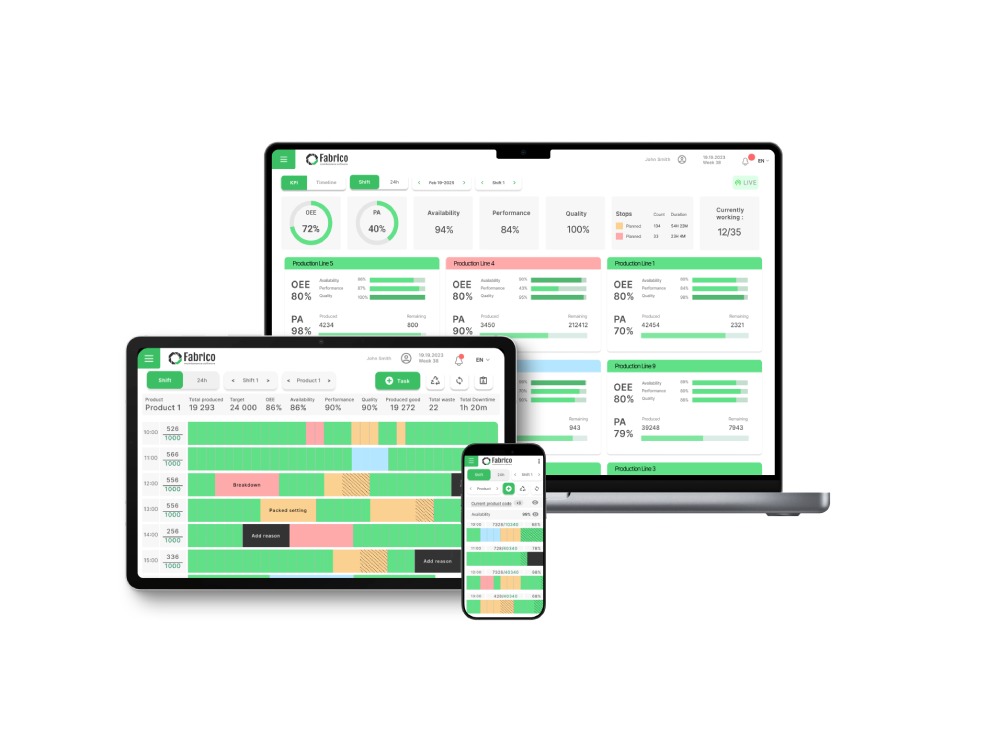
Display your KPIs (OEE, PM Compliance, Backlog) on screens where the operators and technicians can see them. When the team knows the score, they play harder.
4. Standardize Failure Codes
You cannot analyze text. "Broken," "Busted," and "Failed" all mean the same thing, but a computer can't graph them.
Best Practice: The "Problem-Cause-Remedy" hierarchy.
Force technicians to select from a dropdown list (e.g., Component: Motor > Issue: Overheat > Cause: Dust). This allows Fabrico to generate Pareto charts of your worst problems automatically.
5. Implement Operator Driven Reliability (ODR)
Maintenance technicians are expensive. Using them to tighten bolts and clean sensors is a waste of money.
Best Practice: Autonomous Maintenance.
Give operators a digital checklist (CIL) to perform basic care. They own the "Condition"; Maintenance owns the "Repair."
6. Optimize Inventory (The "Grocery Store" Model)
Hoarding parts "just in case" ties up cash. Running out of parts causes downtime.
Best Practice: Cycle Counting.
Don't wait for the annual audit. Count 10 parts every day. Set automated Min/Max Reorder Points in your software so you order exactly what you need, exactly when you need it.
7. Focus on "Wrench Time," Not "Clock Time"
It doesn't matter if your technicians are clocked in for 8 hours if they only fix machines for 2 hours.
Best Practice: Remove barriers.
Analyze why they aren't fixing. Is it walking? Searching for manuals? Waiting for permits?
Use Mobile CMMS Apps to put the manual and the permit in their pocket, doubling their effective Wrench Time.
8. Root Cause Analysis (The "5 Whys")
Fixing a fuse is easy. Finding out why it blew is hard.
Best Practice: The "Three Strikes" Rule.
If an asset fails for the same reason 3 times in a month, trigger a mandatory Root Cause Analysis (RCA). Use Video Evidence ("Zoom-In") to stop guessing and find the physical cause.
9. Condition-Based Triggers (Stop Guessing)
Changing oil because it's "Monday" is outdated.
Best Practice: Listen to the machine.
Connect your software to the PLC. Change the oil because "Run Hours = 500." Service the motor because "Amps > 10% baseline." This is the path to Predictive Maintenance.
10. Close the Loop with Production
Maintenance serves Production. If Production is unhappy, Maintenance is failing.
Best Practice: Weekly Alignment Meetings.
Review the OEE Losses together. Agree on which downtime events were "Maintenance" (Breakdowns) and which were "Operations" (Jams/Setup). One team, one set of numbers.
Conclusion: Excellence is a Habit
You don't implement these best practices overnight. You build them one by one.
But you cannot build them on paper. You need a digital backbone to enforce the discipline.
Master the basics.
[Request a Demo] and see how Fabrico automates these best practices for you.


 Login
Login
 Blog
Blog