What is Maintenance Contractor Management?
Maintenance contractor management is the systematic tracking, validation, and documentation of all repair work executed by external vendors or Original Equipment Manufacturer (OEM) technicians within your facility.
In a highly regulated manufacturing environment, this process ensures that outsourced labor adheres strictly to internal safety protocols and quality standards.
When implemented through a digital system of action, it mathematically verifies external invoicing by capturing the exact labor hours and MRO spare parts consumed by the contractor.
The Financial Danger of Unverified Contractor Hours
Most manufacturing executives are actively bleeding working capital because they treat external contractors as unquestionable experts operating outside the rules of the facility.
When a specialized OEM technician is called in to service a high-speed packaging line, they typically arrive, work in isolation, and leave behind a vague paper invoice.
Because legacy systems of record have no mechanism to track external labor on the shop floor, the facility manager blindly approves an invoice for eight hours of premium labor.
The maintenance department possesses zero historical context regarding what the contractor actually tweaked, replaced, or recalibrated inside the machine.
This analog oversight completely corrupts your equipment lifecycle data and artificially inflates your Maintenance Cost Per Unit.
You cannot maximize your enterprise valuation if your boardroom is writing blank checks for undocumented, unverified external labor.
Forcing Vendor Accountability with a Field-Ready CMMS
To eliminate billing discrepancies and secure your asset history, strategic leaders must force external contractors to operate within the facility's digital ecosystem.
Fabrico achieves this strict governance by extending its native, offline-capable mobile application to authorized external vendors.
When an outsourced technician arrives at a broken asset, they are not permitted to simply open their toolbox and begin turning wrenches.
They are required to physically scan the machine's QR code using the Field-Ready CMMS on their mobile device to initiate the work order.
This single scan creates a time-stamped digital ledger that mathematically starts the clock on their labor, completely eliminating the opportunity for invoice padding.
Before they can close the ticket, the contractor must digitally sign off on your facility's specific safety lockouts, input standardized failure codes, and document their exact mechanical adjustments.

Validating External Repairs with Computer Vision
Forcing a contractor to log their hours digitally protects your budget, but it does not physically guarantee the quality of their mechanical work.
A vendor might execute a temporary band-aid fix rather than a permanent structural repair, ensuring they are called back—and paid again—the following month.
Fabrico eliminates this quality control blind spot with its "Inefficiencies Zoom-In" module, deploying overhead computer vision cameras to continuously monitor the production environment.
When the contractor executes the repair, the cameras visually record the exact sequence of their mechanical adjustments and tooling alignments.
Reliability engineers can instantly watch a high-definition replay of the contractor's work from their web dashboard before signing off on the invoice.
This indisputable visual evidence proves whether the vendor executed a permanent, OEM-grade repair or simply bypassed a malfunctioning sensor to temporarily clear a fault.
Unifying Contractor Performance via Native OEE
The ultimate test of an external contractor's value is whether their intervention actually restored the machine's baseline performance and stabilized the process.
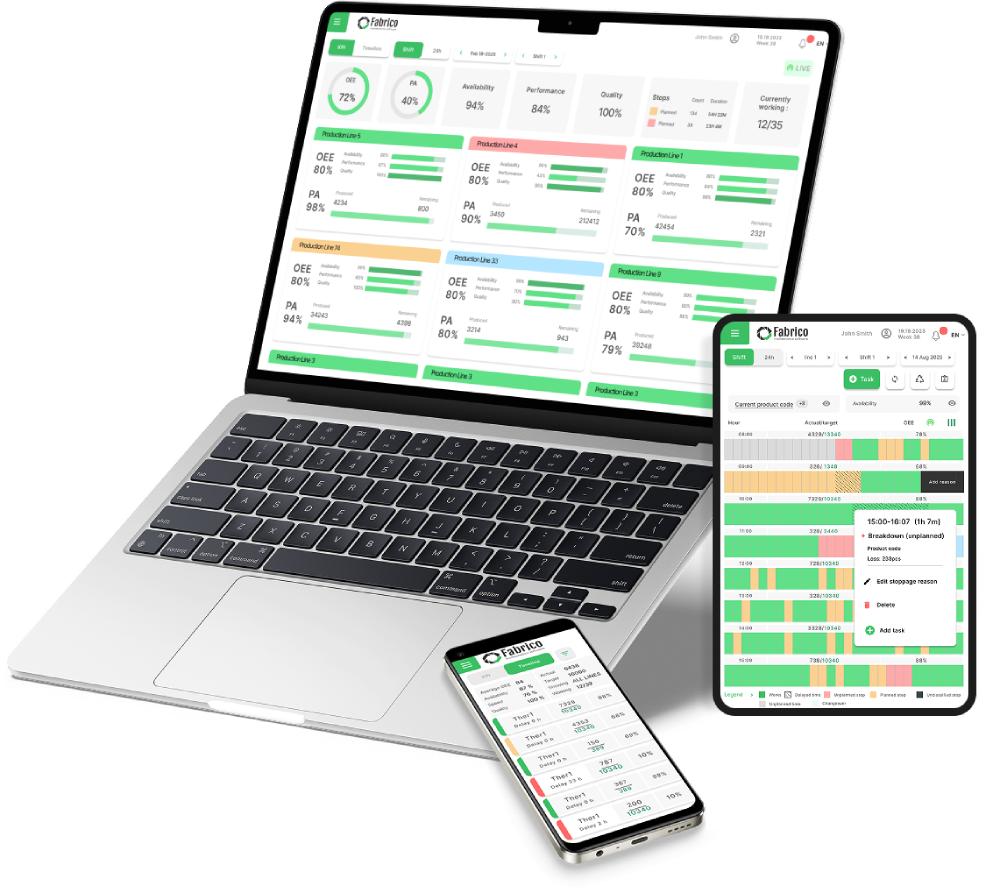
By unifying native OEE tracking within the core CMMS architecture, Fabrico allows you to mathematically validate the effectiveness of the outsourced repair.
The system continuously captures real-time data from your PLCs, logging cycle counts, throughput variance, and minor speed losses the moment the machine resumes production.
If the contractor claims the machine is fixed, but the native OEE dashboard registers a 10% performance drop and massive cycle time variance on the next shift, management is instantly alerted.
This seamless integration of production data and maintenance execution ensures that you only pay vendors who successfully restore your equipment to peak operational capacity.
The 2026 Strategic Roadmap: Building Master Data for AI
Industrial boardrooms are aggressively pushing to deploy Artificial Intelligence to autonomously audit vendor invoices and prescribe optimal contractor dispatch times.
However, AI algorithms will fail catastrophically if they are trained on vague, paper-based invoices that provide zero context on how a repair was actually executed.
Before a factory can trust an AI to autonomously manage multi-million-dollar vendor contracts, it must establish at least 12 months of clean, verified master data.
By implementing Fabrico’s visual RCA and mobile CMMS architecture today, you are actively building the contextualized dataset that future automation requires.
Advanced capabilities,such as the Fabrico Agent for autonomous process optimization and the Fabrico Assistant for AI-driven troubleshooting guidance, are currently on our strategic roadmap.
Forcing digital vendor execution and capturing visual repair evidence right now is the mandatory first step toward an AI-ready, highly secure manufacturing facility.


 Login
Login
 Blog
Blog