The Fiduciary Failure of Aggregated Performance Data
What is the OEE Information Gap in manufacturing?
The OEE Information Gap is the discrepancy between the high-level performance metrics seen in boardroom dashboards and the granular, millisecond-level reality of the production floor.
This gap, typically caused by manual shift logs or aggregated ERP modules, masks the micro-stops and speed losses that act as a structural tax on enterprise margins.
For the CEO and Board, the most expensive capacity is the kind you have already paid for but cannot access.
Most industrial balance sheets contain a structural "Resolution Deficit" that hides unmanaged Technical Debt.
Robert C. Hansen identifies this as the foundation of the "Hidden Factory."
This represents the 20% to 30% of revenue potential that is effectively lost because your current "Systems of Record" cannot capture high-resolution machine signals.
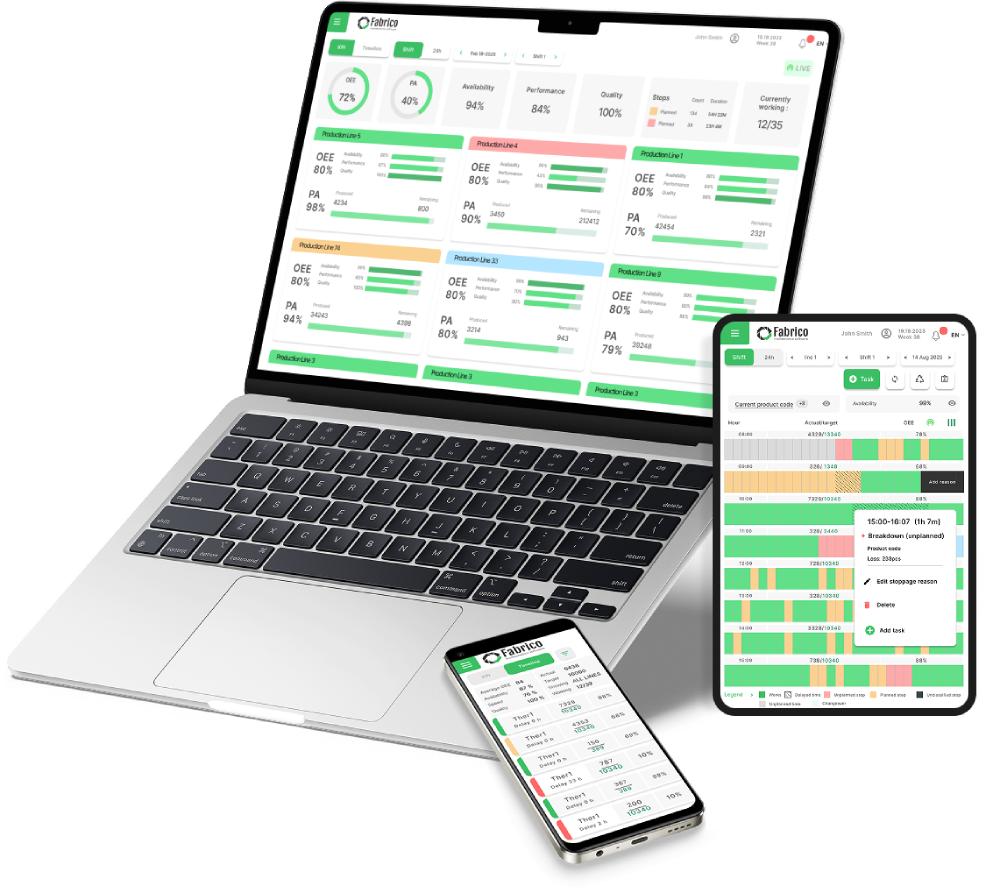
Fabrico provides the System of Action required to bridge this divide.
It turns raw machine signals into courtroom-ready financial evidence, ensuring your profitability is governed by truth rather than optimistic reporting.
Strategic Comparison: Aggregated Dashboards vs. Unified OEE Action
| Strategic Metric |
Fragmented ERP Reporting (The Risk) |
Fabrico Unified Action (The Standard) |
| Data Fidelity |
Subjective: Filtered manual shift logs |
Validated: Direct Machine Connectivity |
| Integrity Proof |
Low: High risk of "Pencil-Whipping" |
High: Machine-validated audit trails |
| Visibility Speed |
Lagging: Monthly site-to-group reports |
Real-Time: Unified Performance Dashboard |
| Maintenance Link |
Siloed: Departments act independently |
Native: Performance drops trigger field action |
| Asset Evaluation |
Static: Based on linear book value |
Dynamic: Based on live functional health |
| Diagnostic Layer |
None: Vague text-based reports |
Visual Intelligence: Machine-linked evidence |
Liquidating the "Hidden Factory" via Machine-Validated Truth
Strategic leaders know that the most profitable unit is the one produced by an asset whose function is perfectly understood.
Robert C. Hansen’s "Value Fulcrum" identifies that ROIC is maximized only when maintenance intensity perfectly supports maximum effective runtime.
In a disconnected enterprise, OEE data is often "filtered" by human bias, masking the true frequency of minor losses.
This lack of resolution creates a structural true cost of unrecorded downtime that stays hidden in your overhead.
Fabrico bridges this gap by establishing operational machine connectivity to capture cycles and downtime at the source.
By capturing millisecond losses, you eliminate the "Subjectivity Tax" of manual entry.
It ensures that your strategic capital decisions are based on absolute truth, allowing you to fund growth through recovered capacity rather than new debt.
Visual Intelligence: Eliminating the Boardroom Context Gap
In the boardroom, a miss in throughput targets is often explained away as "unavoidable variability" or "material failure."
Without visual evidence, the Board is forced to accept these subjective excuses for poor utilization.
Fabrico provides integrated visual monitoring that identify the root cause of inefficiencies that traditional sensors miss.
Leadership can see the exact circumstances of a performance drop, a manual intervention, or a process deviation in any plant globally.
This transparency allows the Board to direct capital toward fixing the system rather than blaming the workforce.
It provide a level of accountability that turns the "Hidden Factory" into a visible, solvable set of improvement tasks.
It ensures your digital strategy is based on visual facts, not boardroom assumptions.
Global Governance: Standardizing the "Enterprise DNA"
For the Global VP of Operations, the primary risk to portfolio stability is "Operational Variance" between sister plants.
Standardization is impossible when disconnected factory data silos prevent the comparison of like-for-like performance.
Fabrico allows you to deploy Master PM and Operational Templates across your entire global footprint.
This ensures that every facility,regardless of territory, adheres to the same Smith & Hinchcliffe RCM standards.
This turns technical expertise into an enterprise-wide digital asset.
It protects your Value Fulcrum against local labor turnover and ensures that "Best Practice" is the group-wide baseline.
You move from "managing a collection of independent plants" to "governing a unified high-performance enterprise."
The Roadmap: Toward Autonomous Yield Optimization
Strategic leaders are building today for a future where production flow is self-stabilizing and automated.
However, industrial intelligence cannot protect your valuation if the underlying data is currently unstructured or "dirty."
On our future roadmap, we are developing advanced AI-driven optimization agents for automated schedule refinement based on live asset health.
We are also working on intelligent assistant modules designed to provide technicians in any site with expert troubleshooting guidance derived from your proprietary history.
Consolidating on Fabrico now ensures that your organization owns the high-resolution, validated dataset required for these future modules.
You move from "reporting on the gap" to "automating the alignment" by building the business case for OEE.


 Login
Login
 Blog
Blog