Manufacturing Process Improvement is the systematic effort to make your factory safer, faster, and more efficient.
For a Plant Manager, this is the engine of growth. You cannot simply buy your way to profitability with new machines. You must get more out of the assets and people you already have.
However, many improvement initiatives fail. They start with excitement (a "Kaizen Week") but fade away after a month. The process drifts back to the old, inefficient baseline because the new way wasn't standardized or monitored.
To drive sustainable improvement, you need a structured approach that combines Lean Principles, Data Visibility, and Digital Discipline.
Here are 5 data driven strategies for manufacturing process improvement in 2026.
1. Visualize the "Hidden Factory" (Value Stream Mapping)
Most of what happens in a factory adds no value to the customer. Moving parts, counting inventory, waiting for machines, and fixing defects are all "Waste."
To improve the process, you must first map it.
The Strategy:
-
Walk the Process: Don't sit in a conference room. Walk the floor from Raw Material to Shipping.
-
Identify the Non Value Added steps: Highlight every time the product stops or moves backwards.
-
Digital VSM: Instead of sticky notes that fall off the wall, use data from your manufacturing software to identify the time gaps between process steps. This data shows you exactly where the flow is broken.
2. Attack the Bottleneck (Constraint Management)
A common mistake is "Local Optimization." This means improving a machine that is not the bottleneck.
If Machine A (the bottleneck) produces 10 parts an hour, and Machine B (downstream) produces 20 parts an hour, making Machine B faster does not improve your output. It only creates piles of inventory.
The Strategy:
-
Find the Constraint: Use OEE data to find the asset with the lowest throughput.
-
Focus Improvements Here: Direct your engineering and maintenance resources to this single point.
-
Ignore the Rest (For Now): Do not spend money speeding up non critical assets until the bottleneck has moved.
3. Shorten the Feedback Loop
In traditional manufacturing, operators don't know they are producing bad parts or running slow until the end of the shift report. By then, it is too late to fix it.
Process improvement requires real time feedback.
The Strategy:
-
Live Scoreboards: Display the current "Cycle Time" and "Quality Rate" at the operator's station.
-
Empowerment: Give operators the authority to stop the line or call for help immediately if the process drifts.
-
Hourly Reviews: Use Short Interval Control to check performance every few hours. Small corrections during the shift are better than a big autopsy the next day.
4. Standardize the "New Best Way"
When you find an improvement (e.g., a faster way to load the hopper), it often stays with one operator. When that operator goes on vacation, the improvement disappears.
This is the "Entropy" of manufacturing. Processes naturally degrade to chaos without standards.
The Strategy:
-
Update the SOP Immediately: As soon as an improvement is verified, update the digital work instruction.
-
Push to All Shifts: Ensure the night shift uses the same new method as the day shift.
-
Audit the Standard: Use digital Gemba walks to verify that the new process is actually being followed. If the standard is not being followed, find out why.
5. Implement Data Driven Maintenance
A process cannot be stable if the equipment is unstable.
You can have the best workflow in the world, but if the machine vibrates, jams, or stops randomly, your process improvement efforts are wasted. Maintenance is a foundational pillar of process improvement.
The Strategy:
-
Eliminate Micro Stops: Use video analysis to find the small jams that interrupt the process flow.
-
Predictive Triggers: Monitor process parameters (pressure, temperature) to predict when the process is about to drift.
-
Restore Basic Conditions: Ensure the machine is clean, lubricated, and tight. A well maintained machine holds tolerance better and runs more consistently.
The Fabrico Framework: Measure, Improve, Standardize
Process improvement is a cycle, not a destination.
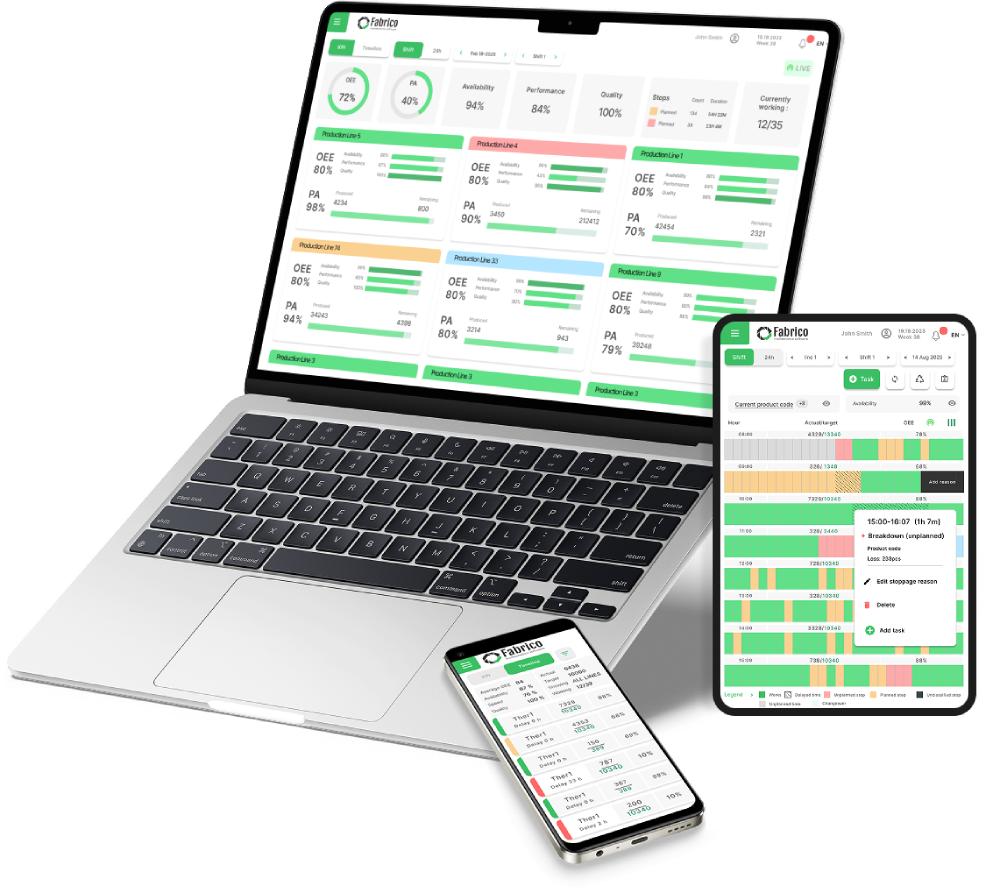
Fabrico provides the digital toolkit to keep this cycle moving.
-
We Measure: Our OEE and production tracking give you the baseline data.
-
We Improve: Our visualization tools help you find the bottlenecks and micro stops.
-
We Standardize: Our digital checklists and SOPs lock in the gains so you don't slide back.
Ready to improve your baseline?
Turn your data into a better process. [Request a Demo] to see how Fabrico drives continuous improvement.


 Login
Login
 Blog
Blog