What is Native OEE and CMMS integration?
Native OEE and CMMS integration is a unified manufacturing platform where production monitoring and maintenance execution live in the same database, allowing machine signals to trigger work orders instantly without third-party APIs.
Most standalone tools act as "Systems of Record" that stop at the report.
Fabrico acts as a System of Action, ensuring that when a performance threshold is breached, the "Cure" is as fast as the "Diagnosis."
For Mike (the Tactical Manager), this means his team isn't waiting for an email alert—they are already scanning the QR Code at the machine.
The Hidden Costs of the "Best-of-Breed" API Trap
Why is an API-connected tech stack more expensive than a native one?
An API-connected stack carries a high "Complexity Tax" because it requires ongoing IT resources to maintain the bridge between tools, creates data silos that prevent visual root cause analysis, and leads to high decision latency.
For Paula (the Strategic Leader), the goal is Capacity Reclamation.
If your OEE tool identifies a micro-stop but your CMMS doesn't "see" it for 15 minutes, you have lost the opportunity to fix the flow in real-time.
Fabrico eliminates this lag, allowing you to reclaim the Hidden Factory revenue that typically disappears into the "Context Gap" between separate systems.
Comparison Matrix: Native Integration vs. API-Connected Stacks
| Capability |
Standalone OEE + Separate CMMS |
Manual / Excel Stacks |
Fabrico (Native OEE + CMMS) |
| Data Sync Speed |
Delayed (API Polling) |
Weekly / Manual |
Instant (Native) |
| Response Trigger |
Human Intervention |
"Firefighting" |
Automated OEE-to-WO |
| Root Cause Depth |
Data-Only |
Subjective |
Visual (Zoom-In) Proof |
| User Adoption |
Low (Multiple Apps) |
High Friction |
High (One Native App) |
| IT Overhead |
High (API Support) |
Zero |
Low (SaaS Unified) |
| Total ROI |
Moderate |
Negligible |
High (Capacity Reclamation) |
Protecting the Value Fulcrum: ROI in High-Speed Lines
Sustainable OEE gains are only possible when your maintenance effort is perfectly balanced against your effective runtime.
This is the Value Fulcrum.
In a native system, you can move from calendar-based repairs to Condition-Directed Tasks based on actual OEE performance.
If a labeling machine’s performance drops by 5%, Fabrico triggers a prioritized task before a breakdown occurs.
This reduces your Maintenance Cost per Unit and ensures your capital assets reach their full residual value.
Closing the Loop: From "Zoom-In" to "Wrench Time"
The hallmark of a native platform is the ability to move from a visual root cause to a physical fix in seconds.
-
Detection: Fabrico’s OEE module identifies a "Reduced Speed" loss via the Visibility Trifecta (PLC + Operator + Computer Vision).
-
Verification: The Inefficiencies Zoom-In module flags a video clip, showing exactly why the machine is failing.
-
Action: A prioritized Work Order is automatically triggered in the Field-Ready CMMS, sending Tom (the Technician) to the line with the right parts.
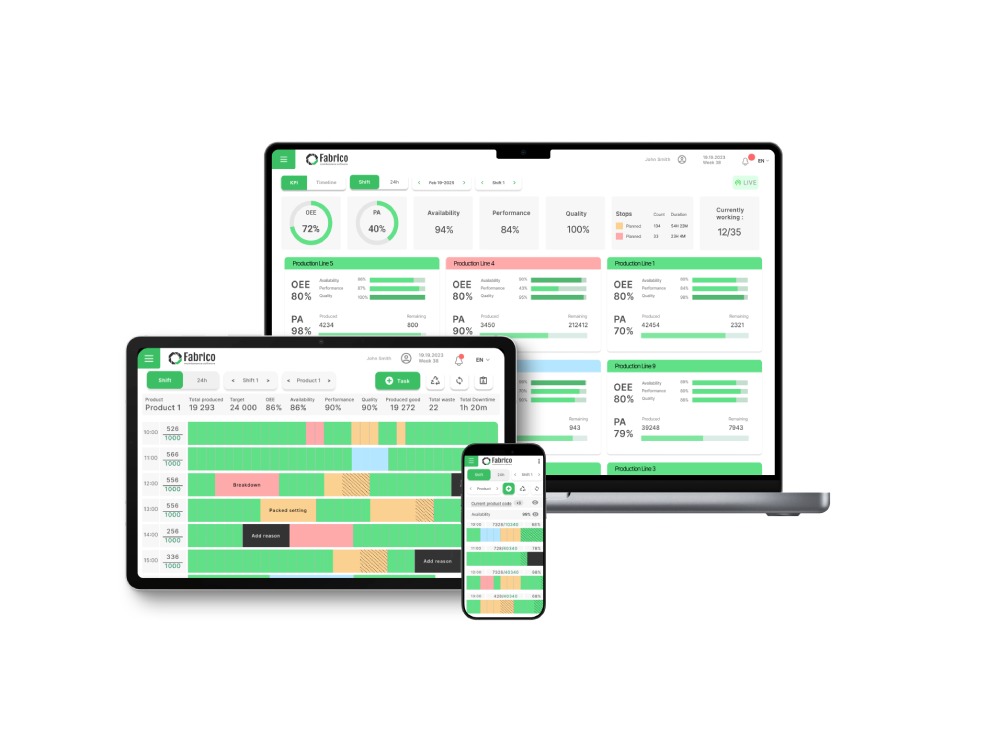
This end-to-end loop is impossible in a fragmented tech stack.
The Strategic Verdict: Consolidate to Accelerate
For Paula, the business case is simple: why pay for three tools and three integrations when one System of Action delivers better results?
Consolidating your production and maintenance data now also builds the "Master Data" layer required for future optimizations on the roadmap.
By investing in a native platform, you are engineering a more agile and profitable enterprise for 2026.
Stop fighting your APIs. Start engineering uptime with a System of Action.


 Login
Login
 Blog
Blog