Blind Spot #1: The Micro-stop Void
What is a micro-stop in manufacturing?
A micro-stop is a short-duration downtime event, often lasting less than two minutes, that is too frequent for manual logging and often "invisible" to traditional PLC sensors that only track major breakdowns.
These events are the primary drivers of the Hidden Factory.
While a sensor can count a bottle on a line, it cannot tell you why that bottle tipped over fifty times a shift.
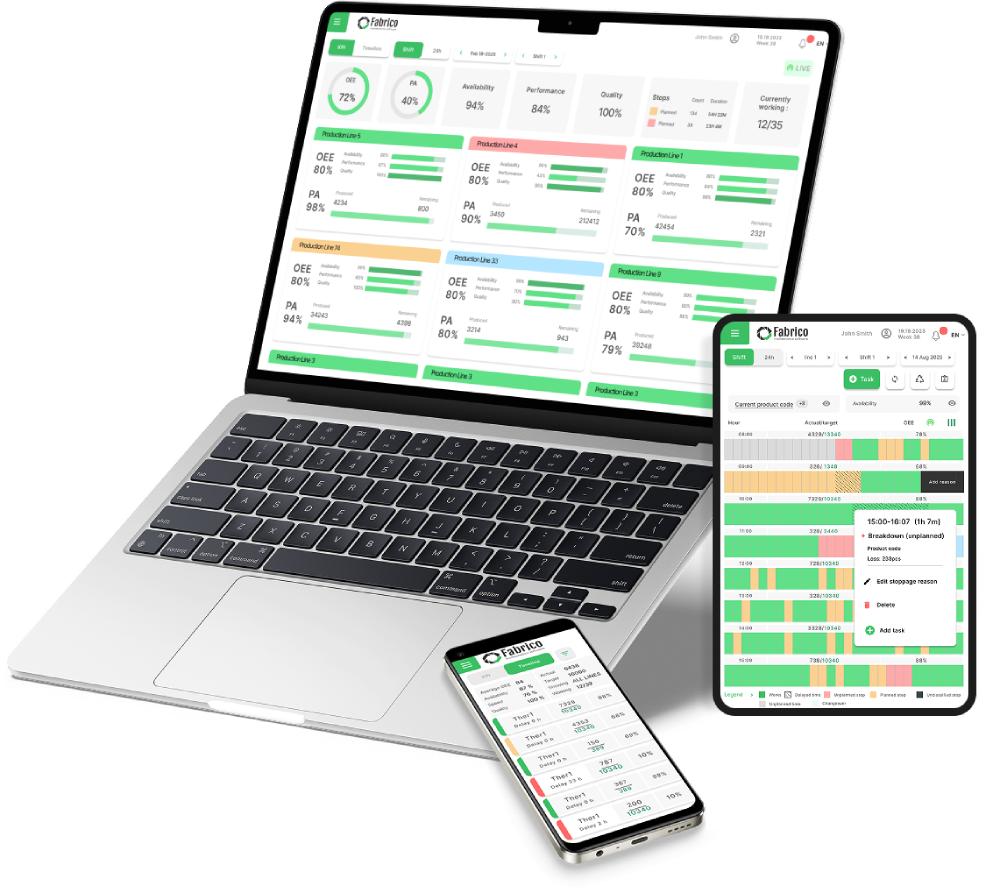
Fabrico eliminates this blind spot with Inefficiencies Zoom-In (Computer Vision).
AI-powered cameras capture visual proof of every micro-stop, providing the visual truth needed for permanent root cause analysis.
Blind Spot #2: The "Action Gap"
What is the Action Gap in OEE monitoring?
The Action Gap is the time wasted between an OEE system identifying a production loss and a maintenance team receiving a prioritized work order to resolve the underlying mechanical cause.
Most OEE tools are "Systems of Record" that stop at the report.
This forces Mike (the Tactical Manager) to manually bridge the gap by radioing a technician, leading to high Decision Latency.
Fabrico is a System of Action that natively triggers a Work Order the moment a performance threshold is breached.
By automating this loop, you ensure that diagnostic data from the machine leads to a physical "cure" in seconds.
Blind Spot #3: The "Operator Context" Gap
Machine signals (PLC) provide the "When," but they lack the "Why" that only a human can provide.
A PLC might log a "Motor Overload," but it doesn't know the operator was struggling with poor-quality raw materials.
Fabrico utilizes the Visibility Trifecta—combining PLC signals, operator context, and Computer Vision.
This ensures that Paula (the Strategic Leader) is making decisions based on 100% of the truth, not just 33% of the machine data.
By providing technicians with a Field-Ready CMMS app, you empower them to log context at the machine, increasing data integrity across every shift.
Blind Spot #4: The Planning Mirage
What is maintenance-aware production scheduling?
Maintenance-aware scheduling is a production strategy where the planning board automatically adjusts in real-time based on actual machine health, OEE performance, and the current maintenance backlog.
A production schedule built on theoretical capacity is a fantasy that leads to missed deadlines.
Fabrico’s Interactive Planning Board synchronizes with your OEE and maintenance data to create "Predictive Availability."
If a machine's performance begins to degrade, the board reflects this change instantly, allowing for proactive adjustments before a breakdown occurs.
This aligns the "wish list" of the planner with the technical reality of the shop floor.
Blind Spot #5: The Enterprise Silo
For multi-site manufacturers, the biggest blind spot is the inability to compare performance across different facilities.
Success in one plant remains "Tribal Knowledge" that is never shared with the rest of the group.
Fabrico’s Group-First Architecture allows for global KPI comparison (MTTR, MTBF, OEE) in one unified view.
If the plant in Germany solves a recurring micro-stop, that "Best Practice" can be instantly pushed as a standard to sites in the USA.
This turns individual successes into a global maintenance standard that protects your Residual Asset Value.
Comparison Matrix: OEE Intelligence vs. Standalone Tools
| Capability |
Siled OEE Scoreboards |
Legacy ERP / MES |
Fabrico (System of Action) |
| Response Trigger |
Visual Alert Only |
Batch / Post-Shift |
Automated Mobile Work Order |
| Micro-stop RCA |
Basic / Manual |
None |
Advanced Visual Zoom-In |
| Maintenance Link |
None |
Financial / Delayed |
Native Integrated CMMS |
| Scheduling Board |
Static |
Historical / Manual |
Predictive / Machine-Aware |
| Mobile UX |
N/A |
Very Low (Complex) |
One App (Field-Ready) |
| Data Integrity |
High (Visual) |
Low |
Absolute (PLC + Vision) |
The Strategic Verdict: From Data to Deliverable Revenue
For Paula, eliminating these blind spots is the fastest route to a more profitable cost-per-unit.
By moving your team to Condition-Directed Tasks, you stop wasting "Wrench Time" on healthy machines and start fixing the "Bad Actors."
This protects your Value Fulcrum, ensuring that every maintenance dollar spent yields maximum effective runtime.
As your factory builds its 12-month data layer, it creates the essential foundation for the Fabrico Agent (AI Roadmap).
Stop watching the score. Start engineering uptime with a System of Action.


 Login
Login
 Blog
Blog