What is maintenance-aware production scheduling?
Maintenance-aware production scheduling is a digital planning framework that natively integrates real-time machine performance (OEE) and maintenance backlog data (CMMS) to adjust production targets based on the actual technical health and availability of factory assets.
For Paula (the Strategic Leader), this is the end of "Promise Inflation."
Instead of committing to a customer based on an Ideal Cycle Time, she plans based on the Effective Runtime her factory is actually delivering.
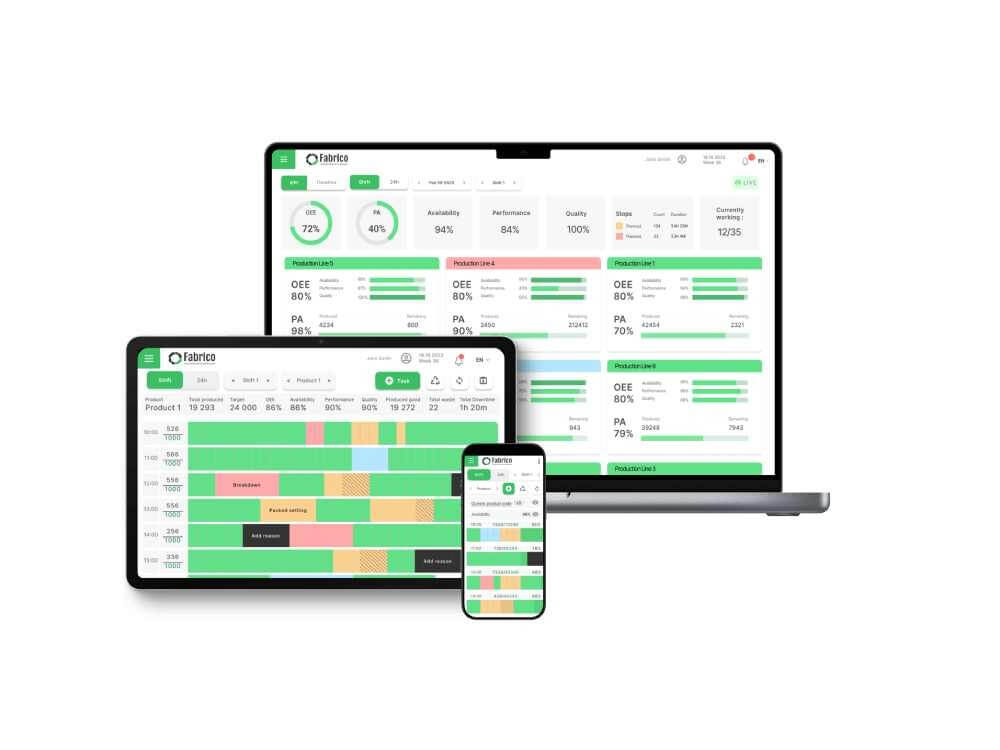
Fabrico’s Interactive Planning Board synchronizes these worlds, ensuring that the machine pulse and the planner’s board are one single source of truth.
Layer 1: Real-Time Capacity via Native OEE
The biggest drain on a schedule is the "Performance Loss" that traditional ERPs miss.
If Line 4 is running 8% slower than its rated speed to prevent a jam, your schedule is already falling behind.
Fabrico pulls millisecond cycle data directly from the machine's PLC.
The planning board "sees" this speed loss instantly and recalculates the expected completion time for the current order, allowing Mike (the Tactical Manager) to react before the delay cascades into the next shift.
Layer 2: Protecting JIT with Predictive Availability
What is the "Planning Mirage" in manufacturing?
The planning mirage is the strategic failure that occurs when high-priority orders are assigned to assets trending toward failure, resulting in catastrophic downtime that could have been avoided through a maintenance-aware schedule.
Fabrico eliminates this mirage by highlighting conflicts between production orders and maintenance needs.
If a high-speed filler has an overdue PM or a low MTBF (Mean Time Between Failures), the system flags it on the Interactive Planning Board.
Planners can use drag-and-drop functionality to move the order to a healthier line or schedule a proactive 10-minute adjustment during a gap, protecting the Value Fulcrum and the bottom line.
Comparison Matrix: ERP Static Schedules vs. Fabrico Interactive Planning
| Capability |
Traditional ERP / Excel |
Manual Planning Boards |
Fabrico (System of Action) |
| Data Source |
Historic / Static |
Subjective / Human |
Real-Time OEE Pulse |
| Maintenance Link |
Financial / None |
Verbal |
Native Integrated CMMS |
| Conflict Detection |
Batch / Lagged |
Manual Check |
Automated / Instant |
| Change Management |
Rigid / High Friction |
Chaotic |
Agile Drag-and-Drop |
| Accuracy |
70-75% |
< 65% |
> 95% (Data-Driven) |
| Decision Latency |
High (Post-Shift) |
Moderate |
Zero (Real-Time) |
Layer 3: Material and Tooling Readiness
A reliable plan requires more than just a healthy machine; it requires parts and materials.
Fabrico’s board is natively linked to the Spare Parts Management module.
If a critical repair is needed before a high-intensity run, the system verifies that the MRO parts are in stock.
This ensures that Tom (the Technician) has the "Cure" ready before the planner commits the machine, reclaiming the capacity lost in the Hidden Factory due to poor coordination.
The Strategic ROI: Lowering Maintenance Cost per Unit
For Paula, the business case for an integrated planning board is simple: it stabilizes the factory’s throughput.
By aligning the production load with the technical reality of the floor, you eliminate the "Firefighting" that drives expensive emergency labor and shipping.
This directly reduces the Maintenance Cost per Unit and ensures that your multi-million dollar assets reach their full residual value.
As you build 12 months of clean planning and OEE data, you are preparing for the Fabrico Agent (AI Roadmap) to automate these optimizations.
Stop planning based on hope. Start engineering your flow with a System of Action.


 Login
Login
 Blog
Blog