In Electronics Manufacturing (PCB Assembly, SMT, Box Build), speed is the currency.
Modern Pick & Place machines can mount 100,000 components per hour (CPH).
If your machine slows down by just 1% due to a sticky nozzle, you lose 1,000 components every hour.
If you run 24/7, that is 8.7 million lost opportunities per year.
Standard OEE (Overall Equipment Effectiveness) tracking often fails in this environment because it relies on operators to manually log downtime.
In a high-speed SMT line, the operator cannot log every 3-second stop. They will just write "Running" on the log sheet, hiding the true efficiency loss.
To master OEE in electronics, you need Automated Data Capture linked to Precision Maintenance.
Here is your guide to optimizing OEE in SMT and PCB assembly for 2026.
The Unique OEE Profile of Electronics
Electronics manufacturing is different from bottling or steel making. The three OEE factors behave differently here.
1. Availability (The "Changeover" Gap)
Your machines are reliable. They rarely break down catastrophically.
The Loss: Changeovers. Switching from "Board A" to "Board B" involves swapping feeders, reprogramming robots, and adjusting reflow profiles.
The Fix: SMED (Single Minute Exchange of Die). You need digital checklists in Fabrico that guide operators to pre-stage feeders while the machine is running, minimizing the internal stop time.
2. Performance (The "Micro-Stop" Gap)
This is the silent killer. A "Pick Error" stops the head for 2 seconds. The machine retries. It works. The line continues.
The Loss: These 2-second stops add up to 10-15% of your total capacity.
The Fix: Automated Data Collection. You must connect Fabrico to the machine API (Panasonic/Fuji/ASM) to capture every single error code.
3. Quality (The "Rework" Gap)
In SMT, a bad board is a disaster. You have to bake it, remove components, clean it, and re-solder it.
The Loss: Rework loops destroy your "Effective" output.
The Fix: Condition-Based Maintenance. Most quality defects (tombstoning, bridging) are caused by dirty nozzles or worn feeder springs.
Strategy 1: Automate the Data (No More Paper)
You cannot improve SMT OEE with a clipboard. The cycle time is too fast.
The Fabrico Solution:
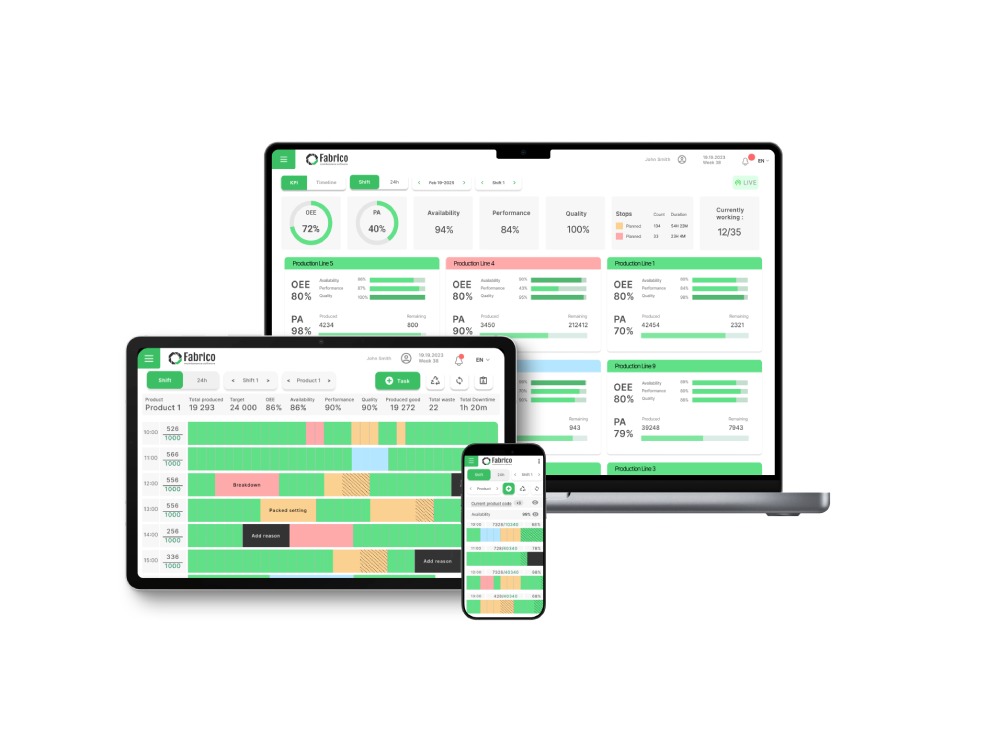
Fabrico connects directly to your SMT line's PLC or outputs.
-
Real-Time Speed: We track the actual CPH (Components Per Hour) vs. the Theoretical CPH.
-
Fault Mapping: When the machine throws "Error 404 - Vacuum Leak," Fabrico records it instantly.
-
Visualizing the Loss: You see a Pareto chart showing: "Feeder Slot 42 caused 80% of the micro-stops today."
Now you have a Diagnosis.
Strategy 2: From Diagnosis to Cure (Feeder Maintenance)
Knowing that "Feeder 42" is bad is useless if you don't fix it.
In many plants, the bad feeder is just swapped out and put back on the shelf "to be fixed later." It gets mixed up and put back on the line next week, causing the same problems.
The Fabrico Cure:
-
Fault Trigger: Fabrico detects high error rates on Slot 42.
-
Auto-Work Order: Fabrico creates a "Repair Feeder" ticket.
-
Asset Tracking: The specific feeder (Serial #12345) is flagged as "Broken" in the system. It cannot be checked out to a line until a technician closes the Work Order.
-
Cycle-Based PM: Fabrico tracks the "Total Picks" of every feeder. It triggers a "Calibrate and Clean" Work Order every 1,000,000 picks, preventing wear-related errors.
Strategy 3: Environmental OEE (The Invisible Variable)
Electronics are sensitive.
The Fabrico Integration:
Fabrico connects to IoT sensors in your factory. If humidity drifts out of the safe zone, it alerts the Facilities team immediately. It overlays environmental data on your OEE chart, letting you prove that "The drop in Yield on Tuesday was caused by the HVAC failure."
Strategy 4: The "First Article" Efficiency
A massive amount of availability is lost waiting for "First Article Inspection" (FAI). The line sits idle while Quality checks the first board.
The Fabrico Workflow:
-
Digital Handshake: When the line stops for FAI, Fabrico triggers a "Quality Inspection" ticket.
-
Instant Notification: The Quality Manager gets a ping on their watch.
-
Digital Sign-off: As soon as the board passes, the Quality Manager signs off in the app. The "Production Run" is unlocked immediately.
This shaves minutes off every changeover. Across 5 lines and 3 shifts, that is hours of gained production.
Summary: Precision Requires Systems
You cannot run a high-tech factory with low-tech management tools.
If you rely on manual logs, you will always be chasing ghosts. You need to connect the Machine Data to the Maintenance Action.
Stop the micro-stops.
[Book a Demo with Fabrico] to see how we help electronics manufacturers hit 85%+ OEE.


 Login
Login
 Blog
Blog