
Electronics plants are the best-instrumented in industry and still lose margin invisibly, because the two numbers that decide profitability are the two almost nobody measures. An OEE guide written for SMT, test and box build.
Quick answer: OEE in electronics differs from other industries in three ways: performance should anchor to quoted cycle time per job (because on 3 to 6 percent EMS margins, the quote-vs-actual gap is the profit)
setup on high-mix lines is the dominant recoverable availability loss, and the biggest measurement blind spot is not SMT (which is well instrumented) but box build, final assembly and test, where machine data ends and most labor hours live.
The classic OEE narrative assumes an under-instrumented plant discovering its losses. Electronics is the opposite: placement lines report everything, MES is often customer-mandated, traceability is contractual. Visibility is not the gap.
The gap is that the instrumentation answers engineering questions (is the machine running, did the board pass) while profitability hangs on commercial ones the systems were never asked: did this job run at the cycle time we priced, and what did that setup actually cost against the batch's margin?
Standard OEE measures performance against ideal cycle time. In an EMS context the commercially honest anchor is the quoted cycle time, because that is the number the margin was built on. A board quoted at 42 seconds and running at 51 is not 82 percent of an abstraction; it is a job leaking its margin on every panel, invisibly, order after order.
Measuring per-job actuals against quotes, continuously rather than in the occasional post-mortem, converts OEE from an engineering score into a per-job P&L, and it tells the quoting team which assumptions to fix before the next RFQ repeats the loss.
Feeder carts, stencils, program loads, first-article checks: on high-mix lines, setup is where availability goes. Two comparisons matter. Actual against standard, where standards exist (often they do not, which is itself the finding). And best demonstrated against median for repeated identical product transitions on the same line: that gap is pure execution variance, recoverable without capital, because the line has already proven the better time.
Tracked per transition and trended, setup stops being a fixed tax and becomes a managed number.
Box build, final assembly, test and rework carry a growing share of hours and losses in most electronics plants, and almost no native instrumentation. Waiting for kits, missing materials, absorbed micro-delays: none of it appears in any system, so improvement programs optimize the instrumented half and wonder why throughput does not move.
Camera-based capture, synchronized with production data and pointed at the process rather than at people, can give the manual half the same measurement standard as SMT.
One condition is non-negotiable: measurement of manual areas succeeds only under the written commitment that cameras point at the process and never at people, agreed with the workforce before installation. Box-build crews have spent careers being blamed for throughput on the strength of nobody's evidence; the same instrument that finds the waiting time exonerates the people doing the waiting, and it must be introduced as exactly that.
What is a good OEE for an SMT line?
It depends on mix. A high-volume, low-mix line and a prototyping line are different animals, and both differ from box build. Compare against lines of your archetype under a disclosed definition, and treat any single universal figure as folklore.
How is OEE calculated differently in electronics?
The formula is identical; the anchors differ. Performance against quoted (or demonstrated) cycle time per job rather than a generic ideal, setup tracked as a distinct availability category per transition, and quality anchored to first pass yield at test.
Our SMT vendor's software already reports OEE. Why add anything?
Vendor line analytics are excellent at their own machines and stop at their edges. The commercial picture (quote-vs-actual per job, setup across the whole line, the manual areas, cross-line comparison) lives above any single vendor's scope.
Can OEE data help win RFQs?
Yes: machine-verified line performance, benchmarked against industry archetypes, is evidence an EMS can put in front of OEM customers.
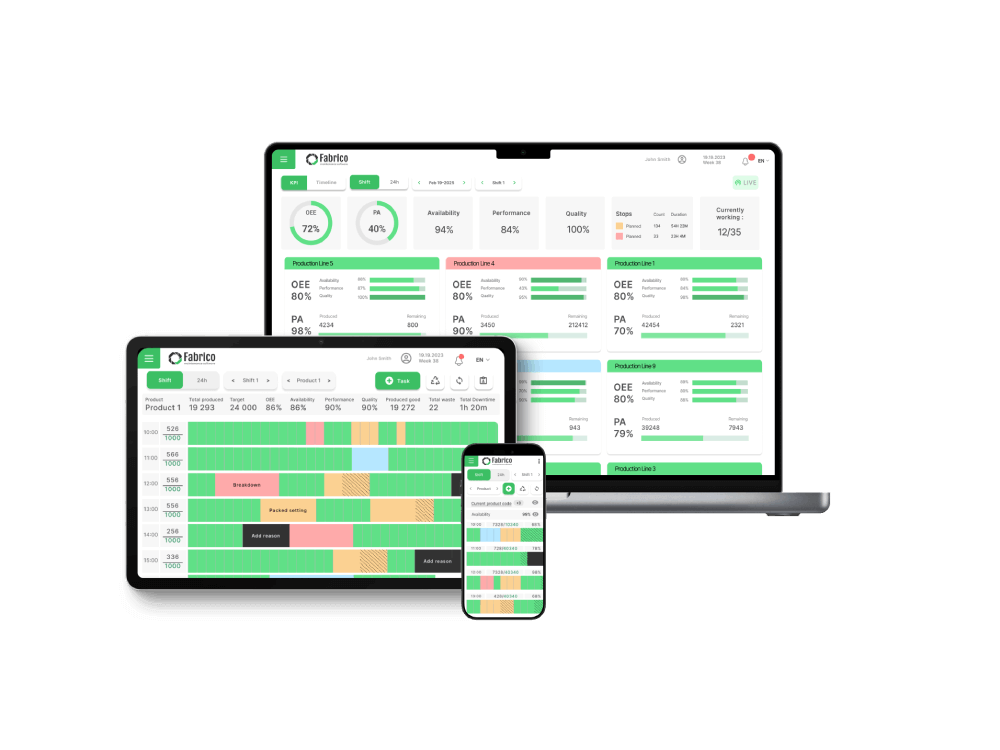
Fabrico collects live machine data through PLC connectivity and IoT sensors, and it covers box build with computer vision. Read next: IPC-CFX and Hermes explained.
See how Fabrico unifies OEE and maintenance in one platform.
Request a demo










 Login
Login
 Blog
Blog