If you are shopping for OEE Software in 2026, you are likely overwhelmed.
There are simple cloud apps, complex SCADA add-ons, and expensive ERP modules.
They all promise the same thing: "Real-Time Visibility."
But visibility is not the goal. Profitability is the goal.
Seeing a graph that says your production line is running at 50% efficiency doesn't fix the line. It just documents the disaster.
For a Decision Maker, the challenge isn't finding a tool that can calculate OEE (Availability x Performance x Quality). An Excel sheet can do that.
The challenge is finding a tool that helps you improve OEE.
This is the Buyer’s Guide to Actionable OEE. Here are the 5 critical capabilities that separate "Passive Monitors" from "Active Improvement Engines."
1. Automated "Truth" (PLC/IoT Integration)
The first question you must ask a vendor is: "Where does the data come from?"
The Fabrico Standard: We prioritize hard-wired or wireless connectivity to the asset's control layer. You get the raw heartbeat of production, unfiltered by human bias.
2. Visual Context (The "Video" Feature)
Data tells you What happened. "Conveyor stopped at 10:42 AM for 45 seconds."
It doesn't tell you Why.
Was it a box jam? Did the operator hit E-Stop by mistake? Did a sensor flicker?
Without context, you are guessing.
The Must-Have Feature: Video Integration.
Look for software that integrates with cameras on the line. When the OEE signal detects a stop, the software should present a video clip (Replay) of that specific event.
3. The Maintenance Handshake
This is the most common failure point in OEE implementations.
Production buys an OEE tool. Maintenance uses a CMMS. They never talk.
The Solution: Unified Operations.
Your OEE software must natively integrate with your Maintenance workflows.
-
Trigger: When OEE Performance drops below 85%, the system should auto-generate a Corrective Work Order.
-
Validation: When Maintenance closes the ticket, the OEE system should tag that downtime block as "Resolved - Bearing Replaced."
The Fabrico Standard: We treat OEE and Maintenance as two views of the same database.
4. Micro-Stop Aggregation (The Hidden Factory)
Most downtime isn't the "Big Bang" breakdown. It's the "Death by a Thousand Cuts."
-
Stop 1: 15 seconds.
-
Stop 2: 40 seconds.
-
Stop 3: 10 seconds.
Operators ignore these. Legacy software filters them out as "Noise."
But if you have 200 micro-stops a day, you are losing 2 hours of production.
The Capability:
Your software must be able to Aggregate Micro-Stops.
5. Operator Engagement (Gamification)
Ultimately, the operator controls the machine. If the software is just a "Big Brother" spy tool, they will hate it.
If the software is a "Scoreboard," they will play to win.
The UI Requirement:
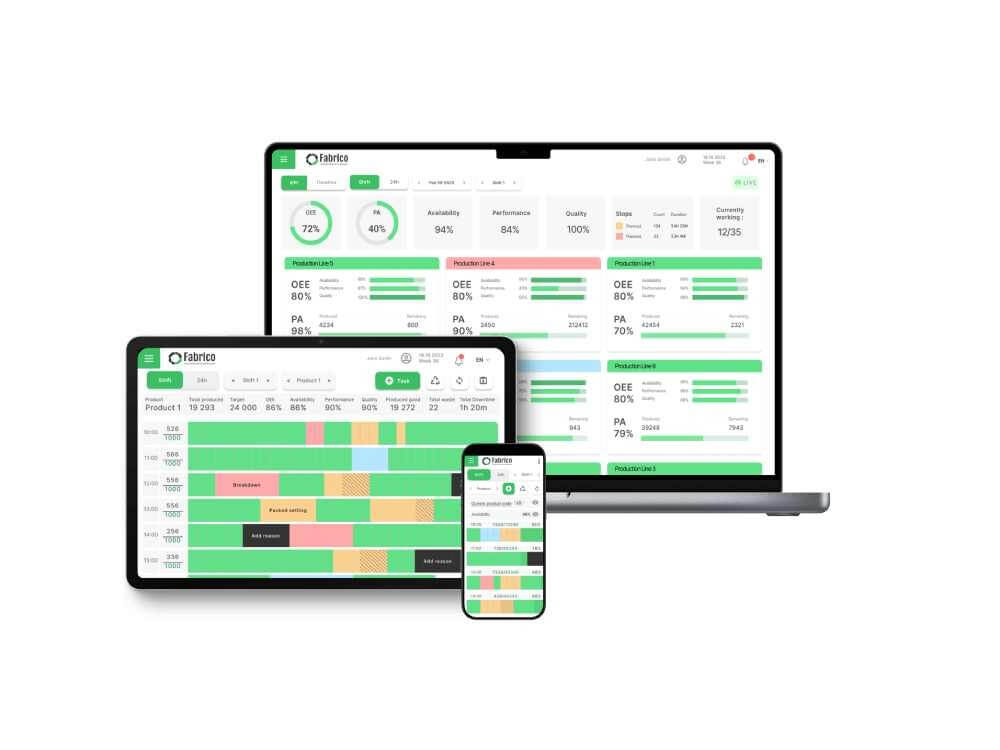
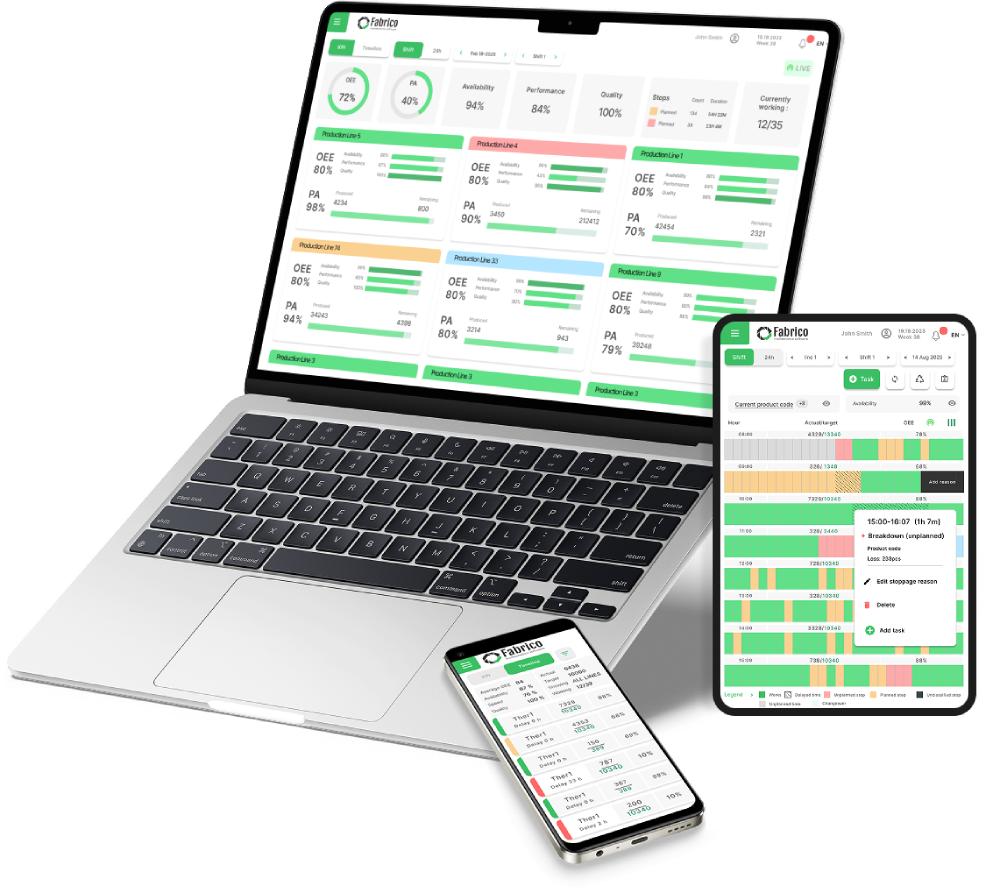
The shop floor dashboard must be simple, colorful, and big.
-
Target vs. Actual: "You should be at 5,000 units. You are at 4,800."
-
Color Logic: Green is good. Red is bad.
-
The Psychology: When the screen turns red, operators naturally speed up or call for help to get back to green. It drives behavior without management intervention.
Comparison: The 3 Tiers of OEE Software
| Feature |
Tier 1: The Spreadsheet |
Tier 2: The Scoreboard (Monitoring) |
Tier 3: The System (Actionable - Fabrico) |
| Data Source |
Manual Entry |
PLC / Sensors |
PLC + Video + Human |
| Granularity |
Shift Totals |
Downtime Events |
Micro-Stops & Speed Loss |
| Root Cause |
Guesswork |
Reason Codes |
Visual Evidence (Zoom-In) |
| Maintenance |
Disconnected |
Email Alerts |
Integrated Work Orders |
| Goal |
Reporting |
Awareness |
Problem Solving |
Conclusion: Buy the Solution, Not the Report
If you want to create a report for the CEO, buy a Tier 2 monitoring tool.
If you want to increase capacity and reduce costs, buy a Tier 3 Actionable System.
The goal of OEE isn't to know your score. It's to improve it.
Select software that gives you the tools to fight the losses, not just measure them.
Move from monitoring to fixing.
[Request a Demo] and see how Fabrico turns OEE data into maintenance action.


 Login
Login
 Blog
Blog